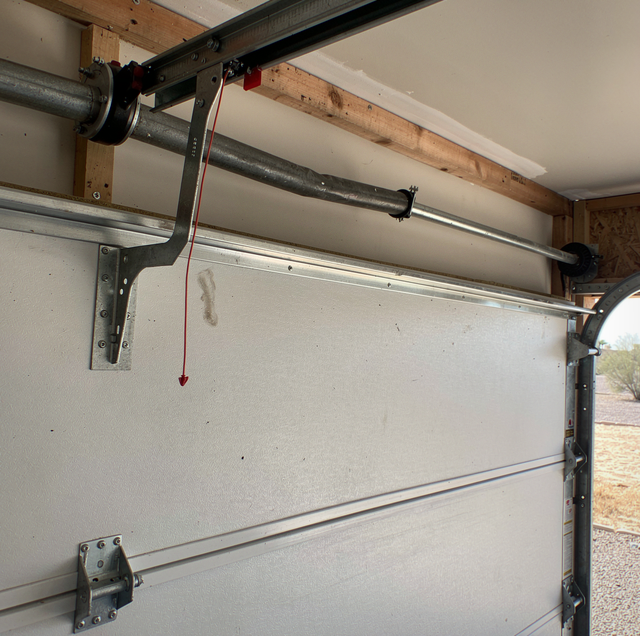
A bow in a garage door section is a panel that has begun to curve or sag along its width rather than remain flat between its edges. It can show up two ways: as a visible sag when you stand back and look across the closed door, or as a curve that only appears once the door is raised, when the section's own weight and the pull of the opener arm are both working against a thin sheet of steel. A strut is a steel channel bolted across the back of a section, running the width of the panel from one edge to the other, and its job is narrow: it stiffens that section along its width so the skin resists bending under whatever load is pushing on it. What a strut does not do is pull a section back to flat once it has taken a permanent bend, close a crack, or hold a skin together once it has separated from the panel behind it. Whether reinforcement, panel repair, or replacing the section is the right call depends on what caused the bow, and that varies by exactly where and when it shows up.
| What You're Seeing | Does a Strut Help | What Else the Fix Needs | When Replacement Is the Answer |
|---|---|---|---|
| Top section bows where the opener bracket pulls | Yes, on an otherwise sound section | The opener arm bracket and the section's hinges get checked at the same time | If the opener bracket has torn through the skin |
| Wide door sags in the middle when it's raised | Yes, a strut is a standard fix for this | Balance gets re-checked once the strut changes the section's weight | Not unless the sag has already creased the panel |
| Panel has a crease or crack from an impact | No | The crease or crack has to be addressed directly, not stiffened over | Yes, a creased panel doesn't return to flat under a strut |
| Door bows only when raised overhead | Yes, if the panel is sound apart from the sag under load | Nothing beyond the strut while the panel still springs back flat once the door is down | If the bow holds with the door closed too, the panel is already bent |
| Panel has rust-through or a separated skin | No | The compromised material has to come out first | Yes, a strut has nothing sound left to bolt to |
Why Wide and Lightweight Sections Bow
A garage door section is a flat sheet of steel, or on an insulated door, steel wrapped around a foam core, held rigid by its own shape and by whatever is fastened across its back. The wider that section is, the more unsupported span its skin has to hold flat on its own between the two side edges, and a thinner skin resists bending less across that same span than a thicker one does. Put a wide section and a light skin together, and you have the two conditions that can make a panel bow before anything has been struck or has rusted. Wind pushing against the outside face of a wide door adds to the bending load from the opposite direction, which is why wind-load reinforcement on wider doors uses the same strut, resisting an outward push rather than the section's own weight. A strut is formed into a channel rather than left as a flat strip of steel because a channel's depth provides greater resistance to bending than a flat piece of the same steel thickness.
Springs and cables hold a garage door under high tension, and a bottom bracket or fastener near a cable can release that tension onto a hand or face, so drilling and strut mounting on the door are for a technician.
The Top Section and the Opener Arm
On a door with a standard trolley opener, the arm connects to a bracket fastened to the top section, and that bracket is where the pull of every open and close cycle lands. Instead of spreading evenly across the panel, that pull lands at one point along the section's width, and a light-gauge top section can start to bow right at that spot while the rest of the door stays flat. A strut fastened across the back of the top section spreads the pull across the section's full width rather than concentrating it at the bracket, which is why a strut is added across the top section where the opener bracket mounts. Without that reinforcement, the same spot on the section flexes on every open-and-close cycle, and repeated flexing past the point where the skin can spring back can leave a visible, permanent bow at that spot.
What a Strut Can and Cannot Do
A strut stiffens a sound panel. Bolted to the back of a section that hasn't already deformed, it increases the section's resistance to bending under wind, the opener's pull, or its own weight when the door is raised and unsupported along nearly its full width. What it doesn't do is undo damage that has already happened. A section that took an impact and has a crease running through it stays creased with a strut bolted over it; the strut just holds the already-bent shape more firmly in place. A skin that has separated from its foam core, or a panel with rust eaten through the steel, has nothing sound left for a strut's fasteners to grip, so bolting one on doesn't restore the section's strength. Reinforcement works on a panel that is structurally intact and simply needs help resisting bending; it does nothing for a panel whose structure has already failed. A door bowed far enough to bind in its tracks is left where it is rather than cycled by the opener.
Weight Added by Struts and Why Balance Is Checked Afterward
A strut is steel, and steel adds weight to whatever it's bolted to; a section carrying one or more struts is heavier than the same section without them. Because a garage door's springs are wound to counterbalance the door's total weight, any change in that weight alters what the springs need to provide, so spring tension is checked and reset by a technician after reinforcement work rather than left as it was set. On a door with torsion springs, the springs store that counterbalancing force by twisting around a shaft above the door, so the adjustment is made at the shaft rather than at the section carrying the new strut.
When Panel Repair or Section Replacement Makes More Sense
A crease, a crack, rust-through, or a separated skin all rule out reinforcement as the fix, because in each case the section's material has failed rather than flexed under load. A cracked or dented section can sometimes be straightened and stabilized rather than replaced outright, depending on how far the damage runs and whether the panel still seals and travels correctly afterward. Where the damage is more extensive, or the section is rusted through in more than one spot, swapping that section for a matching one is the fix, since steel that has lost its strength does not regain it through straightening or bracing.
Frequently Asked Questions
No. A strut is fastened through the section's stiles along its length and does not add or remove a hinge point; on some doors, it shares a stile with a hinge, and the hinge continues to do the same job.
Yes, if the section wasn't held fully flat before the strut was fastened to it. A strut holds a panel at the shape it's in at the moment it's bolted on; if the section was slightly sprung outward when the strut went on, that curve gets locked in rather than corrected, and the section can still flex further beyond that starting point under enough load.
No. On the top section, the opener bracket can be fastened through the strut itself, so the bracket's bolts bear on the strut's steel as well as on the door skin.
Yes. A wide top section under steady opener pull can carry more than one strut, stacked at different heights across its back rather than a single one, which spreads the reinforcement across more of the panel's height and width.
Yes. A strut is steel fastened to a steel section, so it can corrode at its fasteners, and a strut that has loosened at its mounting points no longer stiffens the section even when the panel skin still looks sound.
Not on its own. Some doors leave the factory with struts already fastened across their wider or opener-bearing sections, and others get them added later. A bow reflects the section's span, its skin thickness, and the loads on it; an opener set to push past the floor is another source, so it does not, by itself, say how the door was specified.
Commission garage door panel reinforcement — strut work for a section that's sound but bowing, panel repair where a section is creased or cracked. Quality Overhead Door serves Mesa and the East Valley. ROC #310144. Call (480) 838-8850.
