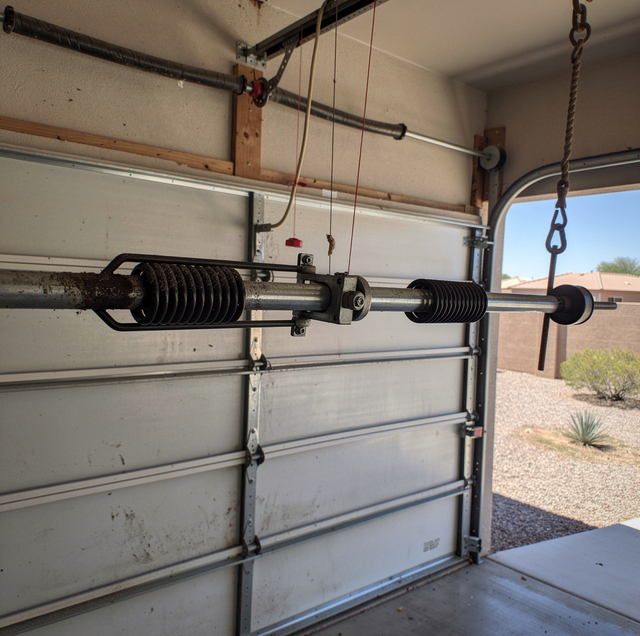
A torsion spring mounted above a garage door has one assignment, and every other part of the system depends on it being done accurately: counterbalance the door's weight. When held under tension, the spring produces torque that opposes the door's mass through the shaft it sits on, so the door's effective weight at the point where the opener grabs it is close to zero. What the motor overcomes is the small remaining difference, plus friction in the rollers, hinges, and tracks. Read the system that way, and the one-spring-or-two question becomes a question about how that counterbalance load gets divided across the hardware, and what happens to the division when part of it disappears.
Quick Answer: A second torsion spring divides the door's weight so each spring is wound to roughly half the load. Both cycle together on every open and close, so one broken spring leaves the door unbalanced and unsafe to operate.
What a Torsion Spring Carries Every Time the Door Moves
Torque is the currency here. A door section stack has a fixed weight; the cables lift it from the bottom corners, and the spring has to provide exactly enough rotational force to counter that weight over the full travel from closed to open. When the match is right, the door holds still wherever you stop it. It does not creep up, it does not drift down, and the opener spends its effort on friction rather than on lifting.
Nothing about that match is adjustable the way a limit switch is adjustable. The counterbalance the spring provides has to fall within a fairly tight window because the whole system is designed around a near-weightless door, and the steel fatigues along a predictable curve as the door is worked.
What that fatigue eventually produces is a permanent change in balance, and it arrives slowly enough to be easy to miss. A door that has begun to feel heavy to the opener, that no longer holds where it stops, or that lands harder than it used to is almost always telling you where its springs sit in their service life. The door's weight has not changed; what has changed is how much torque the springs give back for the same amount of wind.
A Door's Weight Sets the Spring Specification
Two garages can have identical openings and take completely different springs. A standard double opening might hold a single-layer steel door with hollow sections, or a three-layer insulated door with a wood carriage-house overlay and glass in the top row. The opening did not change. The weight did, substantially.
Everything bolted to the door counts toward that weight: the thickness of the steel skins, the polyurethane or polystyrene in the core, the glass inserts, the decorative hardware, the struts running across the back of each section, even a second layer of paint on a heavy wood door. The counterbalance has to match the total, and the total is measured, not estimated from the opening dimensions.
This is why the answer to "what spring does my door need" is never available from a tape measure across the doorway. A technician determines the door's actual weight and travel height, and specifies the spring based on those figures. It is also why replacing a light door with a heavier one in the same opening requires new springs, even if the tracks and the opener stay. The counterbalance was built for the old weight and cannot carry the new one.
What Changes When a Door Runs Two Springs
In a two-spring setup, both springs sit on the same shaft above the opening, typically one on each side of the center bracket, and each is wound to carry roughly half the door's weight. The two act as a single counterbalance made of two parts. The shaft ties them together, so they turn as one unit.
That last point does more work than it looks. Because both springs are fixed to the same rotating shaft, both are worked on every open and every close. Neither one waits. Neither one holds anything in reserve. Splitting the load changes how hard each spring works within a single cycle; the number of cycles each one racks up stays exactly equal to the door's own count.
There is also a mechanical reason the split helps on larger doors. A single spring at one end of the shaft has to transmit all its torque along the shaft to reach the drum on the far side, and the long shaft twists slightly under that load before the far end responds. Two springs placed on either side of center deliver torque nearer to each drum, so the shaft carries less twist and the two sides of the door start moving more nearly together.
Why One Broken Spring Stops a Two-Spring Door
Here is where the common assumption falls apart. A two-spring door with one broken spring is not a door running on a backup. It is a door whose counterbalance just lost about half its capacity, with the survivor still wound for the share it was originally given.
The remaining spring cannot pick up the difference. It was specified to produce roughly half the required torque, and no amount of goodwill changes what a given spring returns. The door is now heavily under-sprung. It will feel enormously heavy; it may not stay up if it is open, and the lift cables on either side are being loaded unevenly as all of this happens.
Running the opener at that point is the worst available choice. An opener is sized to overcome friction and a small residual, not to lift an uncounterbalanced door, and its motor, drive gear, trolley, and the bracket bolted to the top section are all being asked to do something outside their design. Doors have been pulled apart at the opener bracket exactly this way. The door must be left down and left alone until a technician replaces the spring set.
That replacement covers both springs, and balance is the reason for it. A spring that has done years of work takes a permanent set, so it returns slightly less torque at the same wind than a new one built to the same specification. Put a fresh spring beside a tired one and the two halves of the counterbalance stop agreeing: the shaft carries unequal torque from each end, and the balance a technician sets on the day keeps drifting as the older spring relaxes further.
A torsion spring holds enough stored energy to break bones or kill. Nothing about spring work is a homeowner task: do not touch the spring, shaft, or brackets, and do not attempt any adjustments. Call a trained technician.
Counting Springs from the Garage Floor
The safe observation takes about ten seconds and requires touching nothing. With the door fully closed, stand inside the garage and look at the horizontal shaft that runs above the door opening. Count the springs mounted on it. One spring means a single-spring counterbalance. Two, usually sitting to either side of a bracket at the middle of the shaft, means a matched pair.
While you are looking, check whether the coils read as continuous. A broken torsion spring shows an obvious gap where the coil separates, because the two halves release and pull apart. That gap is visible from the floor and does not require a ladder or a flashlight held up close.
Keep it to looking. Do not pull, poke, or lean on anything; do not run the door to see how it feels; and do not put a hand near the shaft or the brackets at either end. Counting springs tells you the configuration. It does not tell you whether those springs are correctly sized for your door's weight, and that determination belongs to someone with the equipment to measure it.
When a Second Spring Earns Its Place
Weight is the first trigger. Insulated multi-layer steel, solid wood, wood-overlay carriage house doors, and full-view aluminum sections with glass all push past what a single spring of practical size can counterbalance comfortably. Past a certain door weight, the spring required becomes impractical, and the counterbalance is built from two instead.
Width is the second. On a wide double door, the shaft has to carry torque across the full span, and the twist in that shaft is what makes one side of the door lead the other on the way up. Two springs feeding the shaft closer to each drum reduce that lag and keep the lift more even across the width.
Duty is the third. A door that runs many times a day, serves as the household's main entry, or hangs on a shop or a small commercial building works far harder over its life than one that opens on weekends, and the counterbalance under it is specified for that harder duty. A technician may build it from two springs so the work is shared at both ends of the shaft on a door that will never get a quiet week.
Each of those triggers resolves to something measurable: the door's weight on a scale, its width and travel height, and how hard the building actually works it. A two-spring configuration gets specified because those figures call for it. On a door where they do not, one correctly specified spring counterbalances the load just as completely as two, and it does so with a single component to age.
Frequently Asked Questions
Sometimes, and the deciding factor is physical room. The existing shaft must be long enough to accommodate a second spring, and there must be adequate headroom between the top of the opening and the ceiling for the assembly to sit. A technician confirms both on site before the work is scheduled, because on some low-clearance installations the geometry simply will not allow it.
Not meaningfully. Spring noise comes from coil rubbing against coil as the spring loads and unloads through the door's travel, and the light factory coating on the wire is what damps that sound. Doubling the spring count does not change roller noise, chain or belt noise, or the rattle of loose hinges, which are where most garage door sound actually originates.
Only indirectly, and the detail worth holding onto is what happens afterward. Once a spring set has been replaced, the technician who did the work needs to check and reset the opener's force and travel limits, because the door's resistance has changed. A limit left over from the failing springs will be wrong for the new ones, and an opener running on stale settings can push or stop in the wrong place long after the spring problem is solved.
A description from the floor will not settle that, and it is worth resisting the guess. An opening with nothing above it may carry a low-headroom torsion assembly set back along the horizontal tracks, or it may carry a different spring system altogether, counterbalanced on a different principle and anchored to different hardware. Nothing described above transfers between the two: the load sharing, the matched-pair reasoning, and the way a spring behaves on the shaft all belong to one of them and not the other. Which one hangs over your opening is a call a technician makes on site, with the door in front of them.
The spring count is not the safety variable. A torsion spring rides on the shaft and stays captive on it when it breaks, whether there is one or two, which is why the failure is loud without throwing anything across the garage. Contained is not the same as harmless, though. After a break, the shaft, the drums, and the cables are all still under load, and the door above them has lost its counterbalance. Stay clear of the whole assembly and let a technician approach it.
Not by raising the door. With the door already fully down, pulling the emergency release cord disconnects the trolley from the opener carriage so nobody can drive the door with a remote, and unplugging the opener removes that possibility entirely. Leave the door down after that and let a technician handle the lift.
Spotted a gap in a coil above your door — leave the door down and schedule a spring replacement with a licensed technician who matches the set to your door's measured weight. Quality Overhead Door serves Mesa and the East Valley. ROC #310144. Call (480) 838-8850.
