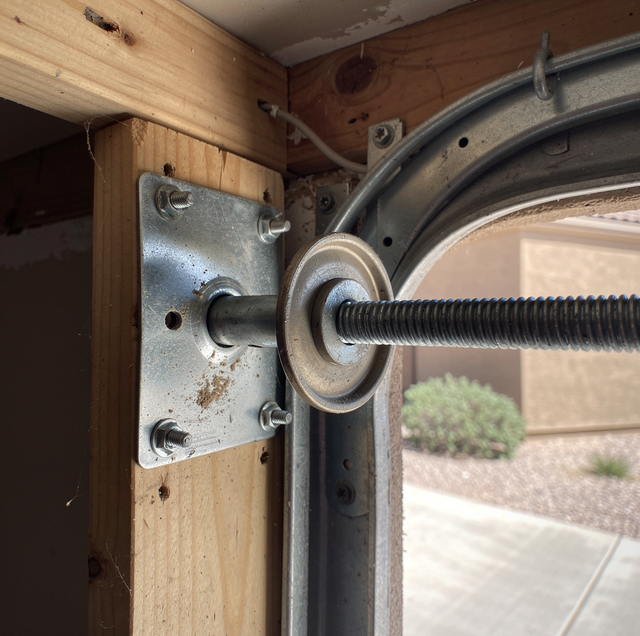
Each end of a torsion shaft rests in a bearing held by a steel plate fastened at the top corner of the door opening. That end bearing plate does three jobs at once. It holds the shaft level and in line above the door; it lets the shaft turn freely as the springs wind on the way down and unwind on the way up; and it carries the pull of the cable drums, which is the weight of the door hanging from its cables, into the wall framing. A shaft that rocks, dips, or walks sideways at that end has lost part of that support. Any noise is the small part of the problem; the path the door's weight takes into the building has shifted, and the cables and springs feel it on every trip.
Each sign at the end plate has a cause behind it and a consequence for the cables and springs:
| Sign at the End Plate | What Is Going On | Why It Matters to the Cables and Springs |
|---|---|---|
| The shaft end rises and falls as the door moves | Play in a worn bearing, or a plate loose on its fasteners | That drum rides up and down, so its cable tightens and slackens each trip |
| A grinding or dry rumble from the plate | Bearing balls and races worn or no longer rolling | Friction loads every cycle, and metal is lost from the shaft or plate |
| The plate tipping or pulling away from the wall | Fasteners backing out, or split wood behind the plate | The shaft end is moving toward the door under full spring torque |
| The shaft sliding sideways, a drum drifting toward or away from the plate | A drum slipped along the shaft | A cable leaving its grooves can pile up or jump off the drum |
| A door lifting unevenly, or one cable slack | A low shaft end, or a drum turned on the shaft | One cable carries more than its share and the door racks in its tracks |
| Rust flakes or bright wear under the plate | Metal grinding away at the bearing, shaft, or mounting | A thinned part can let go without further warning |
How the End Plate and the Center Bracket Share the Shaft's Load
On a torsion door with a center bracket, the shaft is held at both ends and in the middle, and these three supports perform different functions. The center bracket is lag-screwed into the wall above the header, and the stationary end of each spring bolts to it. When the door comes down and the springs wind tighter, their twist pushes back against the building at that bracket. The shaft turns through the bracket, which holds the springs' anchored end still.
The end plates handle the other load. Just inside each plate, a cable drum is locked to the shaft, and the lift cable runs from that drum down to the door's bottom corner. With the door closed, each cable pulls straight down on its drum, a short distance from the end bearing, and the plate passes that pull into the framing. So the center bracket holds the springs' twist, and each end plate holds its side of the door's hanging weight.
That division explains why a problem at one end plate spreads. The spring delivers the same torque regardless of what happens at the ends, and the two drums can only share the load evenly while both ends of the shaft turn on a single line. Once one end drops or shifts, its drum moves with it, and the load split between two cables starts to lean toward one.
A Worn or Seized Bearing and What It Does to the Shaft
The bearing inside the plate is a ring of steel balls running between an inner race that turns with the shaft and an outer race held by the plate. As the balls and races wear, the clearance between them opens up. The drum's pull holds the shaft end down at the bottom of that clearance, and as the door travels and the pull changes, the shaft end can lift and settle inside it. From the floor, the shaft end bobs while the middle stays steady. A worn bearing can also announce itself as a dry rumble from that corner.
A seized bearing does a different kind of damage. When the balls stop rolling, the springs and the opener keep driving the shaft, so the shaft grinds against the inner race or the whole bearing spins in its seat in the plate. Metal wears away at that contact on every cycle. Left running, the shaft can wear a groove at that end, and a shaft end worn thin enough can break, dropping that drum and taking away the cable's hold on that side of the door. Bright filings or rust-colored dust on the top section of the door, directly under one plate, mark which end is wearing.
A Plate Working Loose From Its Mounting or From Weak Framing
The plate is only as steady as what it is fastened to: the framing at the side of the opening and, on some doors, the angle that carries the top of the horizontal track. The pull on the drums changes on every trip, and that repeated loading can back screws out or crush the wood fibers around them until the plate has play. A plate fastened into trim, a thin jamb board, or split wood has little to grip, and under the drum's pull it can tip toward the door or pull away from the wall.
A plate does not have to move far to make a difference. The bearing sits in the plate, so any lean carries the shaft end with it. A plate out of plumb also loads its bearing along one edge, and a bearing loaded that way wears on one side and develops play of its own. The loose plate and the worn bearing then feed each other, and the shaft end moves a little more with each cycle. Where the wood behind the plate has split, the fix starts in the framing, which makes a loose plate a mounting repair as much as a part swap.
A Bent Shaft or a Drum Out of Position
A shaft bent by a blow, or by a plate that dropped at one end, sways along its length as it turns, and no new bearing removes that sway, so the shaft itself is replaced. A drum that slips along the shaft because its set screws are loosened or it is not seated against its bearing lets the shaft slide end to end, and that shows as the gap between the drum and the plate changing. Those set screws carry the springs' torque, so no drum is re-set while they still hold it.
Why the Cables and Door Balance Suffer When the Shaft Moves
The cables register every error upstream of them. When one end of the shaft drops, the drum on that end sits lower, and its cable goes slack by the same distance. The door's weight shifts onto the other cable while the slack side lifts late. The door rises with one corner leading and racks in its opening, and the rollers on the slack side press against their track on every trip.
A slack cable brings its own risk. As the door opens, a cable that has lost tension winds back onto the drum and can land outside its grooves, wrap over itself, or come off the drum entirely. On a drum that is also sliding along the shaft, the cable can be pulled across the grooves sideways as it winds.
The springs register the change as well. A spring is wound to counterbalance a door hanging evenly from two cables on a level shaft. With one end low or one cable slack, the spring applies the same torque to a door that no longer hangs evenly from it, and the door's balance is off. A seized bearing adds friction to every trip, and an opener pushing the door through that friction strains its drive.
With a plate pulling out of the wall or a cable slack, the drums still hold full spring torque, and a door run on the opener can drop or throw hardware at anyone nearby. It stays closed for the technician.
From the floor, looking is the homeowner's whole. The end plate's bolts, the set screws on the drums, and the winding cones on the springs all hold spring torque. Loosening any of them, prying at the shaft, hammering the plate or hanging from it can release that torque into a hand or a face.
Plate Replacement, Remounting and Re-Setting the Shaft
Every part of this repair sits on a loaded assembly, so the spring's tension comes off first; with the shaft, drums and cables under torque, no plate, bearing or drum can be moved safely. From there, the work follows the fault.
Worn bearing or damaged plate: A bearing with play or that has seized is replaced, and a plate that is cracked, bent, or worn at its mounting is replaced with a new one.
Loose plate: The plate is remounted into solid framing, with a sound anchor built into the wall where the old wood has failed, and set plumb so the shaft rests level.
Bent or grooved shaft: A shaft with a bend or a groove worn at one end is replaced whole.
Drums and cables: The drums go back against their bearings so the shaft cannot walk, and the cables are wound on evenly so each side carries its share of the door.
The spring is then wound back to the door, and the job ends with a balance check. Off the opener, a balanced door moves under light hand pressure and holds where it is left, with both cables taut and the shaft turning true at both ends.
Noting which end of the shaft moves, whether the door was open or closed, and whether either cable looks slack gives the technician the side of the door and the likely part before the visit starts.
Frequently Asked Questions
No. Standard steel plates serve residential doors of ordinary weight; heavy-duty plates are made for larger and heavier doors; adjustable plates allow the mounting to be set to the opening; and corrosion-resistant plates are finished to hold up where rust would attack plain steel. The plate is chosen to match the door it supports.
Yes, when the plate is sound. Where the bearing is pressed into a round seat, it can be pressed out and replaced on its own if the plate is straight, free of cracks, and still has round, tight mounting holes. A crack at the bearing seat or worn oval mounting holes mean the plate and bearing are replaced together.
That depends on its condition. Both plates carry the same shaft through the same number of trips, so the opposite plate is worth checking whenever one fails. With the spring's tension already released for the first plate, the second can be examined and, if it shows the same wear, replaced without winding the spring down a second time.
No. A light spray can quiet a bearing that is dry but still rolling, but no lubricant fills the clearance in worn races or tightens a plate to its fasteners. A shaft end that moves has lost material at the bearing or support at the plate, and lubricant restores neither.
Yes. The drums pull hardest with the door closed and least with it open, because the horizontal tracks carry more of the door as it rises. A shaft end with play is held down firmly in the closed position and freer to float near the top, so a wobble that only shows near fully open still marks a worn bearing or a loosening plate.
On some doors it does. The shaft passes through the center bracket either on a ball bearing or on a plain bushing, depending on the hardware. Either one can wear, and a worn center bearing or bushing lets the middle of the shaft move while both end plates stay tight, which separates it from an end-plate fault.
Order end bearing plate replacement and shaft realignment with a spring balance check — a new plate or bearing, the shaft and drums re-set in line, and spring tension matched to the door. Quality Overhead Door serves Mesa and the East Valley. ROC #310144. Call (480) 838-8850.
