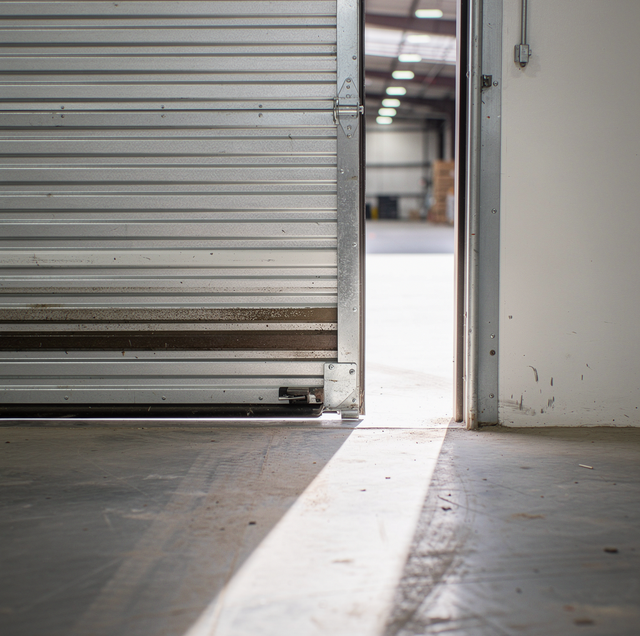
A rolling steel door moves in a way that's easy to overlook once it's installed and working: the curtain, a run of narrow interlocking steel slats, coils up around a barrel fixed above the opening and unwinds back down when it closes. Torsion springs inside that barrel counterbalance the curtain's weight so the operator isn't lifting the full load on its own, and guide tracks fixed along each side of the opening keep the curtain's edges captured as it travels. When a door that used to run smoothly starts taking longer to open, catching partway through the cycle, or needing a shove to keep moving, the slowdown is a sign that one part of the curtain, guides, springs, or operator is asking for more effort than it used to give back.
Where the slowdown shows up in the cycle narrows down the part behind it:
| Where it sticks or slows | Likely part |
|---|---|
| The same spot, every single cycle | A bent guide, a damaged slat, or debris caught at that exact point |
| Heavy to start from closed, or drifting down from near full open | Spring tension loss, since the springs hold the whole hanging curtain at the closed position |
| Nearer the bottom of the travel | A windlock engaging early, a bottom bar out of square, or a bottom-bar lock not fully retracted |
| Dragging in one guide track but not the other | That single guide bent, out of plumb, or fouled, pulling the curtain off-center |
| Slow or heavy across the entire travel, not one spot | The operator's drive losing power, or the springs fatigued overall rather than at one point |
Guides and End Locks or Windlocks
The vertical guide tracks serve two purposes together: they keep the curtain's edges from swinging out of line as it travels, and they give the windlocks something to engage against when wind pressure pushes on the curtain. A windlock is a small mechanical catch mounted on the curtain's edge that's meant to grip inside the guide track under load and release once that pressure is gone; if one stays partially engaged, it drags against the track at that spot every cycle rather than releasing cleanly. End locks are separate pieces riveted to the ends of alternate slats along the whole curtain; they keep the slats from shifting sideways and ride inside the guides, so a worn or broken end lock can let a slat drift and catch. A bent guide rail, a buildup of debris inside the track, or a worn or broken end lock can each produce the same symptom: a door that sticks or slows at one repeatable point instead of running evenly.
Barrel Springs and Lost Tension
The torsion springs housed inside or alongside the barrel do the heavy lifting, offsetting the bulk of the curtain's weight so the operator only has to manage what the springs don't cover. Spring steel loses some of its stored energy during its cycles of winding and unwinding, and as a result, the operator has to work harder to make up the difference. That loss shows up as a door that is heavy to start from closed, where the springs hold the whole hanging curtain, and one that can drift down from near-full open before it becomes a door that feels heavy through the whole cycle.
A moving curtain or a released barrel spring can crush or strike anyone beneath or beside it. Staff stays clear of the opening while it runs, and a technician locks out the operator before tension or slat work starts.
The Operator and Its Drive
A commercial operator turns the barrel through a gear reducer. On an operator fitted with a slip clutch, the clutch between the motor and the drive is meant to slip if the door meets resistance, protecting the motor and gearing from damage. A clutch that's worn or set too loose slips under normal load too, which reads as a door that starts moving and then loses momentum partway through rather than a door that's mechanically jammed. Limit switches are a separate part of the same system: they mark the curtain's open and closed travel limits for the operator, and they're an electrical setting rather than a physical part of the curtain. Depending on the operator, that setting is made by adjusting a mechanical cam on the limit shaft or by entering a count on an electronic control board. A worn drive chain, a sprocket that's lost teeth, or gear wear inside the reducer can each rob the operator of the power it needs to keep the curtain moving at a steady pace.
Slats Out of Line or Bent
Each slat in the curtain interlocks with the ones above and below it, and that interlocking joint is what lets the curtain flex around the barrel while still forming a rigid, flat surface when it's closed. A slat that's been struck, bent, or corroded along its edge changes shape just enough to bind against its neighbors or catch on the guide track as it passes through. Corrosion can start at the curled hook edge where one slat overlaps the next, since that's where moisture collects between the two surfaces. Because the damaged slat is in the same physical position every time the curtain travels, the symptom repeats at the same point in the cycle. A curtain edge that's been forced out of its guide, even briefly, can also leave slats riding slightly off-center for the rest of their travel, which shows up as a drag along one whole side rather than a single point. A slat bent inward at its middle can scrape the barrel's coil on the way up even when its ends ride clean in the guides.
What a Service Visit Checks
A technician working on a slow or sticking rolling steel door starts by observing where in the cycle the problem appears and matching that pattern to the likely parts before opening anything up. Guide tracks get checked for bends, misalignment, and obstructions along their full length, and windlocks get tested for full engagement and release. End locks get checked slat by slat along the curtain, since a broken one anywhere on that run can let its slat drift sideways. Spring tension gets measured against what the curtain's weight calls for, using tools built for that job rather than judged by feel. The operator's clutch setting, limit switch positions, and drive components get run through their range and checked for wear, and the curtain itself gets inspected slat by slat for any section that's bent, cracked, or corroded enough to bind. Matching the fix to the worn part, rather than replacing whatever's easiest to reach, is what keeps a door that's slowing down from turning into one that stops moving entirely.
Frequently Asked Questions
Engaging the manual hand chain or crank means disengaging the motor drive first. On an operator with a chain-disconnect interlock, the chain or crank can't turn while the motor remains coupled, so the two drives can't work against each other.
A windlock that's stuck engaged leaves a visible catch or pin still extended into the guide track even after the door should be free to move, which is something you can spot by eye at that one point on the guide. Spring tension loss doesn't show a visible part left engaged; it shows up as the door being heavy to start from closed instead of catching at one visible spot.
A curtain made from a heavier-gauge steel resists denting and bending from impacts better than a lighter one, which lowers the odds of the kind of slat damage that binds against a guide track. That heavier curtain also weighs more, which means the barrel springs supporting it are doing more work, so any tension they lose leaves more curtain weight for the operator to move.
Yes. A limit switch that's drifted from its correct setting can make the operator stop, hesitate, or reverse at that one point in the cycle, every time, even when every guide, spring, and slat checks out fine, because the switch is telling the operator it has reached a boundary that doesn't match where the curtain is.
Wider commercial curtains are heavy enough that some barrel assemblies use two or more torsion springs mounted along the same shaft rather than one, splitting the load between them. When one of them breaks, the springs left on the shaft offset only part of the curtain's weight, and the operator is left moving the rest, so a door that turns slow and heavy right after a loud bang from the barrel is running on less counterbalance than it was built with.
Slide locks mounted at the ends of the bottom bar slide into slots cut near the foot of each guide, separate from the end locks riveted along the slats, and a padlock can pass through the latch for added security.
Hire a commercial roll-up door repair visit — the guides, springs, operator, and curtain are checked in order until the cause of the slowdown is found. Quality Overhead Door serves Mesa and the East Valley. ROC #310144. Call (480) 838-8850.
