Garage Door Hard to Lift? How to Tell Spring From Balance
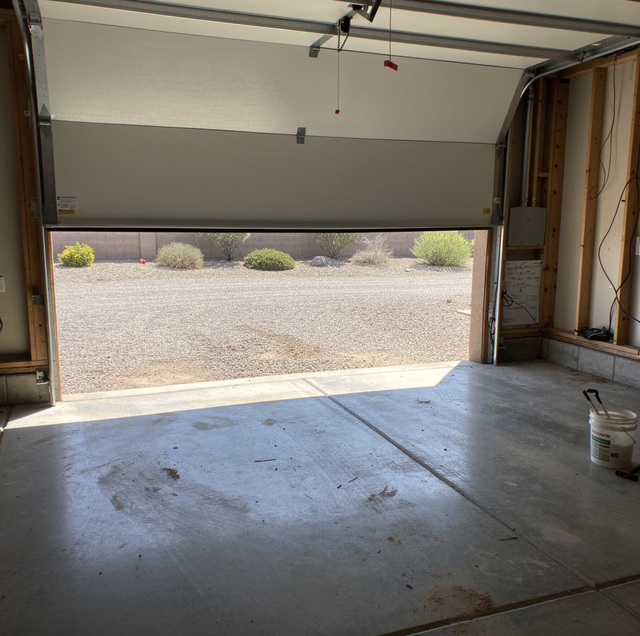
Pull the emergency release cord, grab the bottom of the door, and lift it about three or four feet by hand. That's the actual test for whether a garage door is properly balanced, and most homeowners have never done it. A well-balanced door should lift with one hand and stay roughly where you leave it, not slam down and not shoot upward on its own. If yours takes real effort, fights you the whole way, or drops the second you let go, something in the counterbalance system has changed, and figuring out what tells you whether this is a quick adjustment or a spring that's close to giving out.
What "Balance" Actually Means
A garage door's torsion spring doesn't just hold the door shut; it stores rotational energy that offsets the door's weight as it travels up and down. The spring winds tension onto a shaft, and cables running from drums on that shaft to the bottom corners of the door transfer that stored energy into lift force. When the math works out (spring torque roughly matching the torque needed to counter the door's weight through the drum's radius), the door feels nearly weightless to lift by hand, typically requiring well under 10 pounds of pulling force even on a heavy insulated door. When it doesn't, the door either fights you on the way up (under-tensioned) or wants to fly open on its own (over-tensioned, less common but does happen after certain repairs).
Signs Pointing to a Spring Problem
A spring that's actually losing tension usually shows a pattern: the door has gotten progressively harder to lift over weeks or months, the opener seems to strain more than it used to on every cycle, and the spring itself (visible above the door on most residential setups) may show a gap where the coils have separated, unlike a healthy spring's tightly wound coils. Torsion springs are rated by cycle count, commonly 10,000 to 15,000 cycles for a standard-duty spring and 20,000 to 25,000 or more for a high-cycle spring, and a spring nearing the end of that rating loses counterbalance force gradually rather than all at once, which is exactly why the change often feels slow enough to dismiss for a while before it becomes obvious.
On a two-spring system, an uneven feel is a specific tell: if one side of the door seems to lift before the other, or the door visibly racks (one corner rising faster than the opposite corner), it often means the two springs aren't matched anymore, either because one has weakened faster than the other or because they were wound with different wind counts during a prior repair. Two springs on the same shaft need matching wire gauge and wind count to share the load evenly; a mismatch throws off the whole system even if neither spring has technically failed yet.
Signs Pointing to a Balance Problem That Isn't the Spring
Not every hard-to-lift door is a spring issue. A bent or misaligned track creates rolling resistance that can feel a lot like a spring problem, especially if the bend is subtle. Rollers binding against a track section that's out of parallel by even an eighth of an inch add drag that shows up as extra lifting effort at that specific point in the door's travel, rather than uniformly across the whole cycle, as a true spring problem usually does.
Worn cable drums are another one that gets missed. The drums the lift cables wind onto have grooves that guide the cable at a consistent radius; as those grooves wear or a cable starts riding in the wrong groove, the effective radius changes slightly, which alters how much force the same spring tension actually delivers to the door. Off-center hinges or a warped panel can also shift where the door's weight is distributed across its width, creating a lifting resistance that looks like a spring issue but has nothing to do with the spring itself.
Extension Spring Doors Test a Little Differently
Everything above assumes a torsion spring system mounted on a shaft above the door, which is the standard setup on most garages built or upgraded in the last few decades. Older installations sometimes still run extension springs instead, stretched springs mounted along the horizontal track that pull the door up rather than winding tension onto a shaft. The manual lift test still applies the same way, but the failure pattern looks a little different: an extension spring that's stretched out and lost tension tends to leave the door heavy but still moving smoothly, rather than producing the racking or uneven-lift symptom that a mismatched torsion spring pair shows. Extension springs should also always have a safety containment cable threaded through them; if that cable is missing, that's worth flagging on its own regardless of how the door balances.
What a Technician Actually Checks During a Balance Inspection
A proper balance inspection goes beyond the manual lift test alone. It typically includes checking spring wind count against the door's actual weight and size, inspecting cable condition at the drums for fraying or improper winding, verifying that both cable drums are seated correctly on the shaft, and confirming the track is plumb and parallel on both sides using a level rather than relying on how the door looks by eye. Any one of those can be off even when the manual lift test seems roughly normal, which is why a full inspection catches problems the simple hand-lift test alone sometimes misses, especially on a door that's borderline rather than obviously failing.
Quick Reference
| What You Notice | Likely Cause | What It Tells You |
|---|---|---|
| Gradually harder to lift over weeks/months | Spring losing tension with cycle wear | Spring nearing end of rated life |
| One side lifts before the other, door racks | Mismatched two-spring system | Springs need to be matched/rewound together |
| Resistance at one specific spot every time | Bent track or misaligned roller | Track alignment issue, not spring |
| Door slams down fast after lifting a few feet | Spring significantly under-tensioned | Spring likely near failure |
| Door wants to fly upward on its own | Spring over-tensioned | Usually points to a prior repair error |
Why Forcing a Hard-to-Lift Door Is a Bad Idea
An under-tensioned spring means the opener is doing more of the lifting work than it's designed for on every single cycle, which accelerates wear on the drive gear, the trolley, and, on chain-drive units, the chain itself. It can also mean the lift cables are working under more tension than intended, and a cable that's already showing wear under normal spring tension wears faster and can slip off its drum groove or fray when it's compensating for a weak spring. None of that failure happens gradually and gently; a cable slipping off a drum groove under load, or a torsion spring finally letting go, happens suddenly and with enough stored force to cause real injury, which is the main reason this is one repair that's worth having a professional handle rather than working through by trial and error.
Frequently Asked Questions
The under-10-pound figure is really a benchmark for a standard 16-foot double door; a smaller single door with correctly matched springs often lifts with noticeably less effort, so "heavy" is relative to the door's own size rather than a fixed number every door should hit. Test at chest height rather than right after pulling the release cord: that spot in the travel is where a weakening spring first shows up, since the door is still partly supported by the track curve near the bottom of its swing.
Yes, and it's often introduced by a common shortcut: replacing only the spring that snapped instead of both springs on the shaft. The surviving spring has already logged roughly the same cycle count as the one that failed, so it's typically not far behind. Pairing it with a fresh spring reintroduces the same wind-count and tension mismatch from a different angle rather than solving it.
Only if the cause is friction, not spring tension. Lubrication reduces roller and hinge friction, which helps a door that's sluggish from dry, dusty moving parts, but it does nothing to restore counterbalance torque if the actual problem is a weakened spring.
A bent track is usually a symptom of something else rather than the original problem: a bump from a car bumper or a ladder, or track brackets that have gradually loosened from the wall after years of vibration, letting the whole assembly drift slightly out of plumb. Straightening the visible bend without also checking and retightening the mounting brackets often causes the track to work its way back out of alignment within a few months.
Yes, and the risk is most immediate right when you disconnect the opener to test it — an under-tensioned door can drop faster than expected the instant it's released from the trolley, so keep hands, kids, and vehicles clear of the opening before pulling the cord. Don't leave a door disconnected and resting on the cables alone in the meantime, either: reconnect the opener or block the door in the down position until the spring gets serviced.
It's not a task to take on without the right tools and training. A wound torsion spring stores a significant amount of energy, and winding bars and a specific technique are required to adjust tension safely; using the wrong tool or technique on a loaded spring is one of the more common ways people get hurt while working on garage doors.
Run the lift test today if you haven't already — it takes about thirty seconds and tells you more than guessing from how the opener sounds ever will. What it can't tell you is how many cycles are actually left on that spring or whether the cable drums are still seated correctly, and that's the part worth having someone check by hand rather than assuming from the driveway.
Book a balance and spring inspection — find out whether it's the spring, the track, or the hardware before it fails on you. Quality Overhead Door serves Mesa and the East Valley. ROC #310144. Call (480) 838-8850.
