Repair or Replace Your Garage Door: 6 Signs That Decide
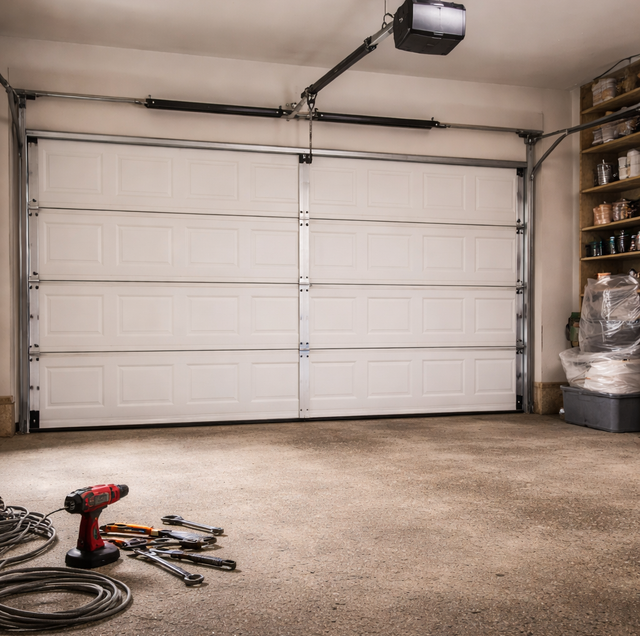
Quick Answer: Repair when the door itself is sound and a single component has failed: a spring, a cable, rollers, the opener, sensors, or one dented panel. Replace when the door is old, warped, rotted, or heavily rusted, when several parts are failing at once, when repairs keep stacking up, or when a section is no longer manufactured. Springs and cables are always a pro job.
A garage door that suddenly won't open, groans on the way up, or hangs crooked in its tracks forces a familiar question: patch the problem, or start over with a new door? The honest answer almost always comes down to two things weighed against each other. First, the age and condition of the door panels themselves. Second, the cost and extent of whatever has actually broken. Some failures are a same-visit fix. Others are the door quietly telling you it is near the end of its working life.
Sorting one from the other is easier once you separate the door from the things that move it.
The Door Versus the Parts That Move It
A garage door system is really two things sharing a frame. There is the door, the stack of hinged panels (also called sections) that seal the opening. Then there are the operating parts: the torsion or extension springs that carry the door's weight, the lift cables, the rollers that ride the track, the hinges, the track itself, and the opener with its safety sensors.
Here is why the distinction matters. The operating parts are wear items. They are designed to be serviced and swapped out on a schedule, the way tires and brake pads are on a car. The door panels are the long-lived body of the system. When only a wear item has failed, you repair. When the body itself is compromised, replacement moves onto the table even if every moving part still works.
Keep that split in mind, and most of the decision makes itself.
What Is Usually a Repair
Plenty of the failures that feel alarming are routine component swaps. The door stays; the broken piece gets replaced.
A broken spring: Springs do the heavy lifting, counterbalancing a door that can weigh well over a hundred pounds. They also have a finite cycle life and eventually snap, often with a loud bang. A broken spring is a repair, not a reason to replace the door, but it is never a homeowner job. More on that below.
A frayed or snapped cable: The lift cables work alongside the springs. When one frays or comes off its drum, the door may hang at an angle or refuse to move. A technician replaces the cables in pairs and rebalances the door.
Worn rollers: Rollers wear flat, lose their bearings, or seize up, which shows as grinding, jerky travel, or a door that binds. New rollers are inexpensive and restore smooth, quiet operation.
A failing opener or misaligned sensors: If the door mechanism is fine but the motor unit is dead, straining, or ignoring the remote, the opener alone can be replaced. Likewise, when the door reverses for no reason or won't close, the photo-eye sensors near the floor are often just knocked out of alignment or dirty, which is a quick adjustment.
A single dented or off-track panel: A door knocked off its track can frequently be reset and its rollers or hinges replaced. And on a sectional door, a single dented panel can sometimes be swapped for a matching one without replacing the whole door, provided that section is still made.
The through-line: each of these is a discrete part on an otherwise sound door.
What Points Toward Replacement
Replacement earns its place when the problem is the door itself, or when the repairs stop being one-and-done.
Multiple components failing together: One worn part is a repair. When the springs, cables, and rollers are all near the end at once, you are essentially rebuilding the moving half of the system piece by piece. At that point, a new door with fresh hardware throughout is often the sounder call.
An old, warped, rotted, or heavily rusted door: A wood door that has warped or begun to rot, or a steel door with severe rust eating through the panels, is a body-of-the-system problem. Cosmetic repair rarely holds, and a compromised panel affects how the whole door seals and balances.
Repairs that keep stacking up: If you have called for service several times in a short span and each visit fixes a different thing, the pattern itself is the signal. Money spent on one repair after another eventually exceeds what a single replacement would have cost, with none of the reliability.
Significant structural damage: A door struck by a vehicle, or one bent badly enough to twist the sections or the track, is often past reasonable repair. Beyond cost, a structurally damaged door may not travel or seal safely.
A section that is no longer available: Older doors, or discontinued models, sometimes reach a point where a matching replacement panel is not manufactured anymore. When you cannot source the part, the decision is made for you.
An outdated single-skin door you want to upgrade: Sometimes nothing is broken. A thin, single-layer (single-skin) door with no insulation can be replaced by choice with an insulated model that is quieter, holds temperature better, and lifts more smoothly. That is an upgrade decision rather than a failure, but it belongs in the replace column.
The Factors That Actually Decide
When a case sits in the gray zone, weigh these against each other rather than fixating on any single one.
Age against typical lifespan: A well-maintained door commonly lasts a couple of decades or more, and the opener somewhat less. A failure on a door only a few years old points strongly to repair. The same failure on a door pushing past its expected years tips toward replacement, because more parts are close behind.
Extent and recurrence: A single, first-time failure favors repair. A cluster of problems, or the same issue returning, favors replacement.
Safety: A door that will not hold its position, drops when released, or has come off its track is unsafe to keep operating regardless of age. Safety can override a purely financial calculation.
Energy efficiency and insulation: An uninsulated or poorly sealed door lets conditioned air escape through an attached garage. If comfort and efficiency matter to you, that pushes toward an insulated replacement.
Curb appeal and home value: The door is one of the largest visible features on most homes. A dated or damaged one drags down the look; a new one is among the higher-return exterior updates a homeowner can make.
Parts availability: If replacement components for your model are discontinued, repair may be a dead end no matter how sound the rest of the door is.
Repair adds up versus replace once: The core arithmetic is simple even without dollar figures. Each repair on an aging door buys you time, not certainty, because the next worn part is usually not far behind. Replacing once resets the entire system, so weigh the likely run of future repairs against a single new door rather than judging the immediate fix in isolation. A rule many technicians use: if a repair approaches a large fraction of replacement and the door is already old, replacement is usually the better value.
Think of it like an aging appliance. Fixing the pump on a dishwasher that is otherwise sound is smart; fixing the pump on one where the door seal, racks, and control board are all failing is money poured into a machine on its way out. The garage door is the same equation with springs and panels instead.
Safety: The Line You Do Not Cross
Some of this is truly dangerous, and it needs to be said plainly.
Garage door springs and cables are under extreme tension. A torsion spring stores enough energy to cause serious injury or death if it is released or handled without the right tools and training. These are never a do-it-yourself repair, and a door with a broken spring should not be operated, since without the counterbalance a heavy door with worn parts can drop suddenly.
A few more safety lines worth holding:
- Do not operate a door with a broken spring. Without the spring's counterbalance, a heavy door with worn parts can drop suddenly.
- A door that has fallen, hangs badly off-track, or won't hold its position is unsafe to use. Leave it down and call a pro.
- Test your safety features periodically. The auto-reverse should send the door back up when it meets resistance, and the photo-eyes should stop it when something breaks the beam near the floor. If either fails, stop using the door until it is corrected.
When safety items are in question, the repair-or-replace math takes a back seat to getting the door into a safe state first.
How a Professional Inspection Helps You Decide
Much of the gray zone clears up when someone measures the door instead of guessing. A technician checks the door's balance by disconnecting the opener and lifting by hand, inspects the springs and cables for wear, looks at the panels for rust, warping, or hidden cracks, and confirms whether replacement parts for your model are still available.
That last point often settles it. You may be set on a repair, only to learn the section you need is discontinued, or set on replacement over a problem that turns out to be a fifteen-minute roller swap. An honest inspection gives you the real condition of both halves of the system, the door and its parts, so the repair-or-replace call rests on facts rather than a hunch.
Frequently Asked Questions
A standard torsion spring is commonly rated for roughly 10,000 cycles, where one cycle is a full open and close. A household using the door four to six times a day can reach that in roughly five to seven years. Higher-cycle springs rated for 20,000 or more last proportionally longer, which is worth asking about if your family runs the door constantly.
You can, but the replacement panel must match your door's brand, model, and panel design, and the color has to be close enough that a single new section does not stand out against sun-faded older panels. Manufacturers also periodically discontinue designs, so the deciding factor is often whether that exact section is still produced, not whether the swap is technically possible.
Yes, in two ways the panels alone don't reveal. Insulated doors are built as multi-layer sandwiches, which makes them noticeably more rigid and quieter than a single-skin door, so they rattle and flex less over time. They also buffer an attached garage against the rooms it shares a wall with, which can steady the temperature in a bedroom or living space above or beside the garage.
Not usually on its own. New noise most often traces to a specific, fixable cause: dry or worn rollers, loose hinges and fasteners, or a chain-drive opener needing service. A technician can pinpoint it. Grinding tied to the springs is the exception and needs prompt professional attention, since it can point to a component under load that is failing.
With the door closed, pull the opener's manual release cord and lift the door by hand to about waist height, then let go. A properly balanced door holds roughly in place. If it slams down or springs upward on its own, the spring tension is off, which strains the opener and accelerates wear. Because correcting balance means adjusting the springs, this is a diagnosis you make yourself but a fix you hand to a pro.
Not automatically, since the opener and the door are independent. A newer opener in good working order can pair with a new door. But if the opener is already old, replacing both together avoids a second service call later and lets the installer match the opener's lifting capacity to a heavier insulated door, which an underpowered older unit may struggle with.
Not sure if it's a fix or a replacement — get an honest inspection and a clear answer before you commit to a new door. Quality Overhead Door serves Mesa, Phoenix, and Scottsdale. ROC #310144. Call (480) 838-8850.
