Worn Garage Door Weather Seals: Why Heat and Dust Get In
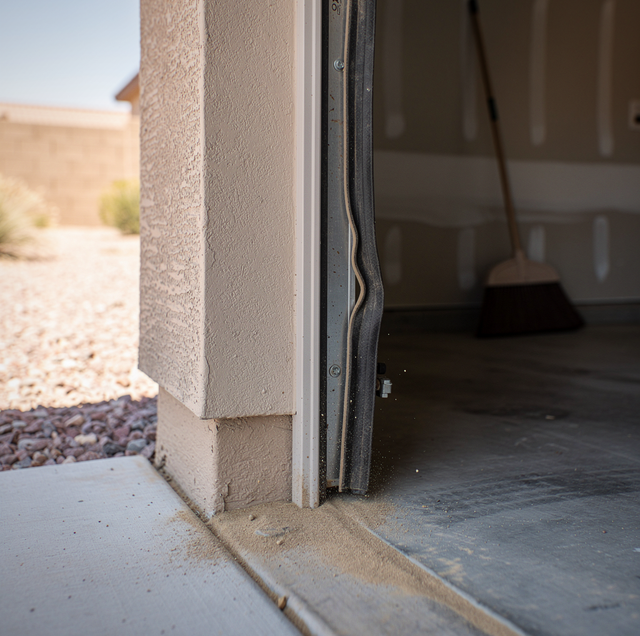
Press the back of your hand into the joint where the closed door meets the stop molding on either side, at about waist height, with nobody at the wall button while you do it. On a door that still seals, the vinyl flap sits flat against the steel and nothing moves against your skin. On a door that has spent several summers in full sun, warm air slides past your knuckles, and the flap has taken a set, no longer touching the face of the door along its length. That side joint is the one nobody checks. The strip along the bottom gets the attention because it is the only run of seal that shows daylight when it fails. The other three runs fail quietly, and they fail first.
The Perimeter a Closed Door Has to Seal
A closed sectional door seals along four runs of the opening, plus one part that is not on the door at all. Take them in the order of what each seals against, because that explains how each fails.
The bottom run works against a surface nobody controls: a flexible strip along the bottom edge of the lowest section has to close the joint between rigid steel and a slab that was floated by hand, sloped for drainage, and driven on. Nothing there is flat, so the strip folds into a bulb that flattens under the door's weight and fills what your slab leaves open.
The side runs meet an easier surface. Your door sections are held clear of the jamb so they never scrape past it, and a flap on the stop molding covers that clearance, bearing lightly on the door's outside face. The head run does the same across the top section.
The threshold seal is the odd one out: it sits on your slab rather than on the door, and it goes in where the concrete has fallen away too far for any bulb on the door to reach.
How Sun and Heat Take the Rubber Apart
Sunlight does not warm a seal so much as break it. Ultraviolet light carries enough energy per photon to split bonds in polymer chains at the exposed surface, and what remains there is harder and more brittle than the material beneath it. That skin crazes into a web of fine cracks, and every cycle of your door works them deeper into sound rubber behind.
Heat comes at the same strip from another direction. Flexible vinyl seals are soft because a plasticizer is dispersed through the polymer, and sustained heat drives that plasticizer out. The strip left behind is stiffer and shorter than the one that went in, which is why an old astragal pulls back from the ends of the door and opens a hole at each corner while the middle still looks fine.
Then there is rubber that spends every night squashed. A seal held deflected at high temperature does not fully recover when the load comes off. The property is compression set, measured with a standard rubber compression-set test. The bulb your seal used to form stays half-flattened, so the low spots in your slab now sit outside its range.
The Half of the Heat That Comes In as Air
A closed garage takes on heat through the door skin and as air. The first belongs to the panel. The second belongs to the perimeter, and it is the half that changes when the rubber goes.
Air moves through a slot only when something pushes it. Wind on the outside face of your door is one push. The other is the temperature difference between the air in your garage and the air outdoors, which varies throughout the day.
A floor-line slot draws on the layer of air lying directly on the driveway. A driveway in full sun runs hotter than the air above it because it absorbs more radiant energy than it can shed by convection, and that layer picks up the heat. It sits at exactly the height of a bottom seal that no longer touches down.
If your door stops short and leaves a visible band of daylight, the seal is one candidate among several; the larger question is how the door closes. A door that shuts fully and still passes heat is a different problem.
Why the Floor Never Stays Clean
Sweep the floor of a garage with a worn perimeter, close the door, and the film is back in days. The pattern it returns in is the useful part.
Wind-driven dust sorts itself by particle size at the gap. Heavier grains carry too much momentum to follow the air through a narrow slot and drop out at the threshold, where they collect in a line visible from outside. The fine fraction stays in the airstream, comes through, and settles slowly enough to lie thin and even over everything you last wiped.
Where it lands points at the run that let it in. A wedge spreading inward from one corner means the astragal has pulled back at that end. A narrow band up the base of one jamb, heaviest near the floor, means that side's flap is off the door face and air is following the wall down. A film even across the whole floor is the head run and both sides together, a perimeter aged as one piece.
Tires bring coarse grit in as well, in tread-width tracks a few feet inside your door. The fine even film in the far corners came through the seal line.
Vinyl, Rubber, and the Channel That Holds Them
The same bead profiles are sold in more than one material, and the two do not age alike under a summer sun. Flexible vinyl is a rigid plastic softened by a plasticizer dispersed throughout it, and nothing binds that plasticizer in place. Heat drives it out over the years, so the stiffening and shrinking of an old strip are properties of the material.
EPDM rubber has no plasticizer to lose; its backbone carries none of the double bonds ozone and ultraviolet attack first, and the carbon black in it absorbs the light that lands. It retains its length and softness much longer in the same exposure, and it costs more. Petroleum oils swell it, so the one place vinyl outlasts it is a slab that takes oil drips from your car.
Whichever goes on, its bead has to match the channel in the retainer on your lowest section, and it enters from one end, so the strip runs the full width of your door in one piece. That channel wears too, its lips spreading where a seal has been dragged through them until they no longer hold a bead. A retainer opened that far gets replaced with the strip, because a new seal in a worn channel slides straight back out the end it went in.
Frequently Asked Questions
It stands proud of the slab, so it acts as a low dam in both directions. Where your driveway pitches toward the garage, that is the point of it, and where the garage floor pitches toward the door instead, a threshold seal can hold wash water inside the door line. It is bonded to the concrete with adhesive rather than fastened, so the slab has to be swept, degreased, and dry first.
The flap and the molding are one part, so the trim comes off the jamb and a new length goes back in its place. It is set with the flap bearing on the door face slightly bowed, which maintains contact even when your door sits a little out of plumb. The old fastener holes are worth missing, since a nail that finds one pulls the new molding back to the old position.
On the floor first, then the moving parts. Fine grit works into the track and into the lubricant on your roller stems and hinges, where oil holds it against the surfaces it was put there to separate. A door that has grown louder through a windy stretch is carrying grit-loaded grease, and the track has to be wiped clean before fresh lubricant is worth adding.
Two pushes drive it, and they come and go. Wind on the outside face of your door raises the pressure there relative to the pressure indoors. Separately, warm air weighs less than cool air, so when inside and outside temperatures differ, the pressure difference grows with height, which is why the head joint and the bottom joint of a tall door can move air in opposite directions.
No. It wants light contact along its length and nothing more. A flap set tight enough to drag adds load to every cycle, and your opener's force setting has to carry that load along with the door. A flap held hard against the steel is also held deflected all day, which produces a permanent set, so overtightening the molding shortens the life of the part you just fitted.
Durometer hardness, on the Shore A scale, is measured with a standard hardness test method: a spring-loaded indenter is pressed into the rubber, and the resistance is read on a scale of 0 to 100, with higher values indicating harder. A seal's product data sheet lists that figure, so you can check a replacement against what you take off. A seal hardened beyond its original figure can be unsplit and unshrunk yet still fail to conform to your slab.
Book a full perimeter seal check — the jamb stops, the head run and the astragal get looked at together, and replacement parts are ordered to what comes off your door. Quality Overhead Door serves Mesa and the East Valley. ROC #310144. Call (480) 838-8850.
