Frayed Garage Door Cable: Is It Safe to Keep Using?
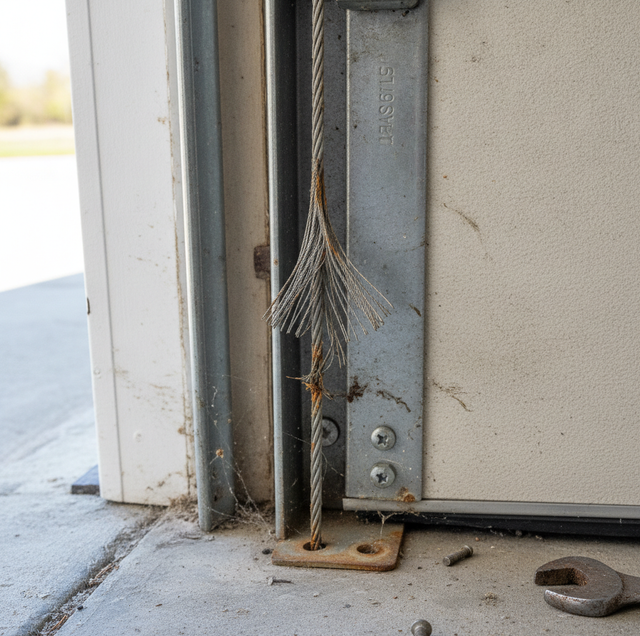
Quick Answer: No. A frayed garage door cable has already lost strength and can snap without warning, dropping the door or sending it off track. Stop using the door and have a technician replace the cables before you open it again.
You go to raise your garage door and catch a glimpse of the steel cable running up the side of the opening. Instead of a smooth, tight line, a few thin wire strands are sticking out like a wire brush that lost a fight. The door still works, so it is tempting to keep using it and deal with the cable later. That instinct is the wrong one here. A frayed cable is one of the clearest warnings a garage door gives before something breaks, and the honest answer is no: it is not safe to keep using it.
How the Lift Cables Actually Carry the Door
A residential garage door can weigh well over a hundred pounds, and the lift cables are a big part of what keeps that weight under control. They do not lift the door on their own. They work together with the springs, which store the real energy that makes a heavy door feel light.
On a torsion setup, the spring sits on a shaft above the opening. As the door closes, the spring winds up and the cables wrap onto grooved drums at each end of that shaft. When you open the door, the spring unwinds, and the drums feed the cables back out, allowing the door to rise in a controlled manner. On an extension system, the spring stretches along the horizontal track, and a cable and pulley translate that pull into a lift.
Either way, each cable runs from a bracket at the bottom corner of the door up to the drum or spring, and it is under serious tension the entire time the door hangs there. Think of the cable like the string on a hunting bow drawn back and held: it is not moving, but it is loaded with force, and a single nicked or fraying strand is the first sign that the string is about to let go. That is the whole problem with a frayed cable. Each cable is a bundle of thin steel wires twisted together, and fraying means some of those wires have already snapped. Fewer intact strands mean less strength, and less strength under constant tension means the cable is closer to failing than it looks.
Why Cables Start to Fray
Fraying is almost never random. It usually points to a specific cause, and finding that cause matters because a new cable will fray again if the root cause is still there.
Rust and moisture are common culprits. Steel cable corrodes when it stays damp, and corrosion eats away at individual strands until they weaken and break. In many garages, the moisture comes from an unexpected place: a swamp cooler adding humidity to the air, or condensation and the occasional leak in an otherwise dry climate.
Age and metal fatigue do the rest. Every open-and-close cycle flexes the cable slightly as it wraps and unwraps. Over thousands of cycles, the metal simply wears out, just like a paper clip snaps after you bend it back and forth enough times.
Hardware problems accelerate everything. A drum or pulley that is worn or slightly out of alignment will chew at the cable as it passes, shredding strands far faster than normal wear. A door that drags on a bent track, that has been knocked out of square after hitting something, or that has a failing bottom bracket, puts an uneven load on the cables and grinds them down on one side.
Why a Frayed Cable Is Truly Dangerous
The danger is not just that the door stops working. It is what happens in the moment a loaded cable finally gives out.
If a cable snaps while the door is up, that corner of the door loses its support instantly. The door can drop, lurch to one side and hang crooked, or twist far enough to jump off the track. A door coming off its rollers with a person or a vehicle underneath is exactly the situation you want to avoid. On top of that, a cable under tension does not fail quietly. A loose end can whip as the stored force releases.
The bottom bracket adds another layer of risk. Because it anchors the cable, that bracket carries spring tension whenever the door is closed. It looks like an ordinary piece of hardware, but loosening or removing it without releasing the tension first can turn it into a projectile. This is the core reason cable and spring work is not a job to improvise.
Lightly Worn or Badly Frayed? Both Mean Service
It is worth knowing the difference between a cable that is starting to show wear and one that is on the edge of failure, even though the action is the same for both.
A lightly worn cable might show light surface rust, a bit of fuzzing where the outer strands have started to lift, or slight discoloration. A badly frayed cable shows broken strands standing off the main line, visible kinks or flat spots, heavy rust, or a section that has clearly started to unravel. If the cable also looks loose or has slipped out of the groove on its drum, treat that as urgent.
Here is the part people get wrong: light wear is not a green light to wait. It is an early warning that the cable is heading in one direction. Both a lightly worn cable and a badly frayed one call for the same response, which is a professional inspection now rather than later. The difference only tells you how much time you might have, and that is not a number worth gambling on.
Why This Is Not a Do-It-Yourself Repair
The single most important rule with garage door cables is that you do not replace or adjust them yourself, and you do not touch the springs. The cables are wound and held under the same high tension as the springs they work with. Releasing that tension without the correct tools and technique, or handling a loaded cable or bottom bracket wrong, can release enough force to cause serious injury. This is a job for a trained technician with the right winding bars, clamps, and procedure, full stop.
What a professional actually does is more than swapping a single wire. Cables are almost always replaced in pairs because the two sides run the same number of cycles and wear at nearly the same rate. If one has frayed, the other is not far behind, and matching them keeps the door lifting evenly instead of pulling to one side. A good technician also inspects the springs, drums, pulleys, bottom brackets, rollers, and track while the door is open, since the frayed cable is often a symptom of one of those parts causing the wear in the first place.
What to Do Right Now
If you have spotted fraying, the steps are short. Stop using the door and leave it down if it is already closed, so the weight is resting on the frame rather than hanging on a failing cable. Do not try to force it open or run the opener. Do not attempt to replace the cable or loosen any bracket yourself. Then call a professional and describe what you are seeing so they can come prepared with the right cables and hardware. Taking the door out of service for a day is a minor inconvenience. A cable failing while the door is in motion is a much bigger problem.
Frequently Asked Questions
No. Frayed strands mean the cable has already lost strength and can snap without warning. When it goes, it can drop the door or send it crooked off the track with nothing holding that corner. The safe move is to stop using the door until the cable is replaced, rather than counting on it to survive a few more cycles.
The cables are wound under the same high tension as the springs, so releasing or handling them incorrectly can whip the cable loose or release the spring with enough force to break bones. There is no safe way to improvise it with household tools. It is strictly a trained-technician job, done with proper winding bars, clamps, and a set procedure for taking the tension out first.
The cable is a specific gauge sized to the door's weight, so it is not an interchangeable generic wire. A drum with a worn or rough groove is a common hidden cause, because the cable rubs the same spot each cycle until the strands break there. That kind of damage looks like random fraying, but is actually the drum leaving its signature on one section. Finding the bad groove is what stops the pattern from repeating.
Both, and there is a mechanical reason beyond even wear. Mismatched cable lengths make the door track crooked, so a good technician inspects and often replaces the drums and checks the springs when re-cabling. A bad drum groove will just fray the new cable too, which is why the parts that drive the wear get addressed in the same visit rather than left to ruin fresh cable. Swapping the cable alone while ignoring the drum sets up a repeat failure.
Yes. A cable that slips or snaps lets the door drop unevenly, and that sudden uneven load can bend the track, wrench a roller out of its holder, or overload the remaining cable and spring on the other side. What started as a simple cable swap can turn into a larger repair once those parts get dragged into the failure.
A subtle early sign is the door bouncing or hitching at one point in its travel, or a faint clicking as a broken strand catches on the way past. Either of those means the cable should be looked at before it lets go, well ahead of the obvious broken strands and kinks. The motion clue often shows up before you can see the damage from the floor. Treat a new hitch or click as a reason to stop and inspect, not a quirk to live with.
Book a cable and spring inspection — get your door back to lifting safely and evenly. Quality Overhead Door serves Mesa and the East Valley. ROC #310144. Call (480) 838-8850.
