How Long Do Garage Door Springs Last? What Really Sets the Clock
Quick Answer: Garage door springs are rated in cycles, not years. A standard torsion spring is built for around 10,000 cycles, which works out to roughly 7 to 12 years for a home that opens the door a few times a day. Heavy use burns through that much faster, and high-cycle springs last far longer.
Ask two neighbors how long their garage door springs lasted, and you may hear wildly different answers. One got fifteen years out of a set, the other replaced springs twice in six. Neither of them bought a lemon. The difference comes down to how the part is actually rated, and it has almost nothing to do with the calendar. Once you understand what a spring is really counting, the whole question of how long it will last starts to make sense.
Springs Are Rated in Cycles, Not Years
Here is the single most useful fact about garage door springs: the manufacturer does not rate them in years. They rate them in cycles. One cycle is one full open plus one full close. Every time the door goes up and comes back down, that is one cycle off the spring's life.
A standard torsion spring is commonly rated at around 10,000 cycles. That number sounds abstract until you translate it into daily life. A household that opens the door a few times a day, say leaving in the morning and coming home at night, plus a couple of extra trips, uses maybe three or four cycles a day. At that pace, 10,000 cycles stretch across roughly 7 to 12 years.
That range is why the "how many years" question has no single answer. A spring does not know what year it is. It only knows how many times it has wound and unwound. Two identical springs installed the same week can fail years apart simply because one door runs far more often than the other.
Why Frequency of Use Is the Real Driver
Since springs count cycles, how often you use the door is the biggest single factor in how long a spring lasts. Everything else is secondary to this.
Consider a home where the garage is the main entrance. Nobody uses the front door. The kids come and go, two cars leave and return, someone runs out for groceries, and the dog walker stops by. That door might cycle six or eight times a day, sometimes more. At eight cycles a day, a 10,000-cycle spring is used up in a little over three years. The same spring in a two-cycle-a-day household would last well over a decade.
That single variable explains the neighbor mystery entirely. It is not luck, and it is not brand. It is math. A door that moves twice as often wears its springs out in roughly half the time, and the gap only widens from there.
The Other Things That Shorten Spring Life
Frequency sets the baseline, but several other conditions can pull spring life below what the cycle rating promises.
Rust and corrosion- A spring is a coiled steel under constant load, and corrosion attacks that steel from the surface in. Rust creates rough spots and pitting that concentrate stress, so a rusty spring fails earlier than a clean one at the same cycle count. Dry conditions help, and periodic lubrication of the coils keeps moisture out and reduces the friction that wears the metal. In a humid garage, or one with a swamp cooler nearby, corrosion can quietly shave years off a spring.
An unbalanced door- The spring's job is to counterbalance the weight of the door so the whole system hangs in near-equilibrium. When a door falls out of balance, from worn rollers, a sagging section, or hardware that has shifted, the spring has to fight the extra load on every cycle. That added strain wears it out ahead of schedule.
Undersized springs- A spring has to be matched to the exact weight and height of the door it lifts. If a door was fitted with springs a little too light for the weight, whether from a wrong replacement or a builder cutting a corner, those springs work harder than they were designed to on every single cycle and simply do not reach their rated life.
Temperature swings- Steel responds to temperature. Big daily swings, common in a garage that bakes in the afternoon and cools sharply at night, cause the metal to expand and contract repeatedly, which adds to fatigue over time. Cold can make steel more brittle in winter, while heat and constant cycling work on it the rest of the year, so the stress is a year-round reality rather than a seasonal one.
Torsion Versus Extension Springs
Not all garage door springs are the same, and the type you have affects both how the system behaves and how long it tends to last.
Torsion springs mount on a metal shaft above the door opening and store energy by twisting, or torquing, as the door closes. They are the more common setup on modern doors; they control the door more smoothly, and as a group, they tend to last longer and wear more evenly than the alternative.
Extension springs run along the horizontal tracks on either side of the door and store energy by stretching as the door comes down. They are typically found on older or lighter installations. Whichever type is on your door, both hold serious stored energy when the door is closed, and that stored energy is exactly why the same safety rule applies to both.
High-Cycle Springs: The Upgrade That Buys More Time
If a standard spring is rated for about 10,000 cycles, the obvious question for a heavily used door is whether you can simply get more. You can. High-cycle springs are rated for 20,000 to 30,000 cycles or more, and they are a simple upgrade a technician can spec when it is time to replace a set.
The trade-off is cost against longevity. A high-cycle spring costs more up front because it uses more or heavier-gauge steel, but it can last two to three times as long as a standard spring in the same door. For a low-use door, standard springs are usually fine. For a busy household where the garage is the main door and it runs six or eight times a day, high-cycle springs often make sense, because they push the replacement interval back out into the years, not months, range that most people expect from the start.
Signs a Spring Is Failing or Has Already Broken
A spring rarely gives a polite warning weeks in advance. Often, the first real sign is dramatic. Knowing what to watch for helps you catch a problem before you get stuck, or before you try to force a door that has become unsafe to move.
Watch and listen for these:
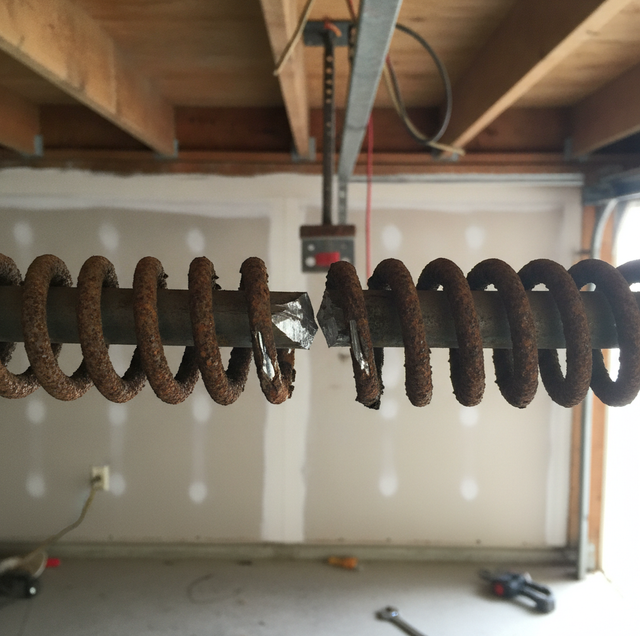
- A loud bang from the garage- A torsion spring under tension can let go with a sound like a firecracker or a gunshot, often when no one is even near the door. That noise is frequently the moment a spring snaps.
- The door suddenly feels very heavy- With a working spring, a door feels almost weightless. With a broken one, you are lifting the full dead weight of the door, which can be well over a hundred pounds.
- The opener strains or lifts the door only a few inches- An opener is sized to move a counterbalanced door, not the whole weight of a heavy one. If it groans, struggles, or raises the door a few inches and stops, a spring may be gone.
- A visible gap in the torsion coil- On a torsion spring, you can often see the break: a clean gap of an inch or two where the tightly wound coil has separated into two pieces.
- Jerky or uneven movement- A door that moves in fits, hesitates, or looks crooked as it travels may be running on a weakened or partly failed spring.
If you see or hear any of these, the safest move is to stop using the door and leave it in whatever position it is in. A door with a broken spring is heavy and unpredictable, and repeated attempts to force it up or down can make things worse or cause an injury.
Why Spring Work Is a Job for a Technician
It is worth being direct about this, because springs look simple and are anything but. A wound torsion spring holds an enormous amount of stored energy the entire time the door is closed. That energy does not disappear when the spring breaks; a partly failed spring can still release violently. Adjusting, unwinding, replacing, or re-tensioning a spring requires the correct winding bars, the right replacement parts matched to your door, and the training to do it in the proper sequence. The same goes for the lift cables, which are under tension alongside the springs. This is not a DIY project, and a technician exists precisely so that this dangerous step is handled safely.
There is one more thing a professional will tell you that saves a lot of frustration: on a door built with two springs, both should be replaced together. The two springs share the same age and the same cycle count, so when one breaks, the other is not far behind. Replacing only the broken one usually means a second failure and a second service call within a short window. Doing the pair at once is the standard approach for a reason.
So the real answer to how long garage door springs last is an answer about how hard they work. Rated in cycles, a standard spring covers most homes for the better part of a decade. Use the door constantly, and that shrinks; upgrade to high-cycle springs, and it grows. Keep the door balanced, the coils clean, and an eye out for the warning signs, and you get every cycle the springs were built to give.
Frequently Asked Questions
They are rated in cycles rather than years, and a standard torsion spring built for about ten thousand cycles lasts roughly seven to twelve years for a household that opens the door a few times a day. Door weight also sets the pace: a single door runs around 130 pounds while a double is often 200 pounds or more, and a heavier door loads the spring harder on every cycle, which shortens its real-world life below a lighter door's.
Because spring life is measured in cycles, and daily use varies enormously. A door serving a home office, or one with kids coming and going all afternoon, can run far past the average few cycles a day and burn a spring out in a few years, while a two-cycle-a-day home stretches the same spring across a decade. If you want the real number rather than a guess, a smart-opener app can actually log and count each cycle for you.
Yes. A high-cycle spring reaches its longer 20,000 to 30,000-cycle rating by using a longer run of heavier-gauge wire wound into more coils than a standard spring, which is why a technician has to measure your specific door and its existing spring before ordering the right one. They cost more up front, so they earn their keep mainly on a heavily used door where a standard spring would otherwise need replacing every few years.
A telling one is the opener that lifts the door only a few inches, strains against the full dead weight, and stops. That short-lift-then-stall behavior is a distinct signature of a broken spring, different from an off-track door, which tends to bind, scrape, or hang crooked rather than stall from sheer weight. You may also hear a loud bang like a firecracker when it snaps, feel the door turn suddenly heavy, or see a clean gap of an inch or two in a torsion coil.
On a two-spring door, yes. The two springs are a matched pair wound in opposite directions, one left-wind and one right-wind, so they balance the door together and are meant to be replaced as a set. They also share the same age and cycle count, so when one fails, the other is close behind, and swapping both at once avoids a second failure and a second service call soon after.
A wound torsion spring holds enough stored energy to cause serious injury if it releases suddenly. Unwinding, replacing, and re-tensioning it takes the right winding bars, matched parts, and training to do in the correct sequence, which is why spring work is left to a technician rather than done as a DIY project.
Have a technician check your spring's cycle wear before it snaps — and keep your door lifting safely for years. Quality Overhead Door serves Mesa and the East Valley. ROC #310144. Call (480) 838-8850.
