Loud Bang and Now the Garage Door Won't Open? Broken Spring
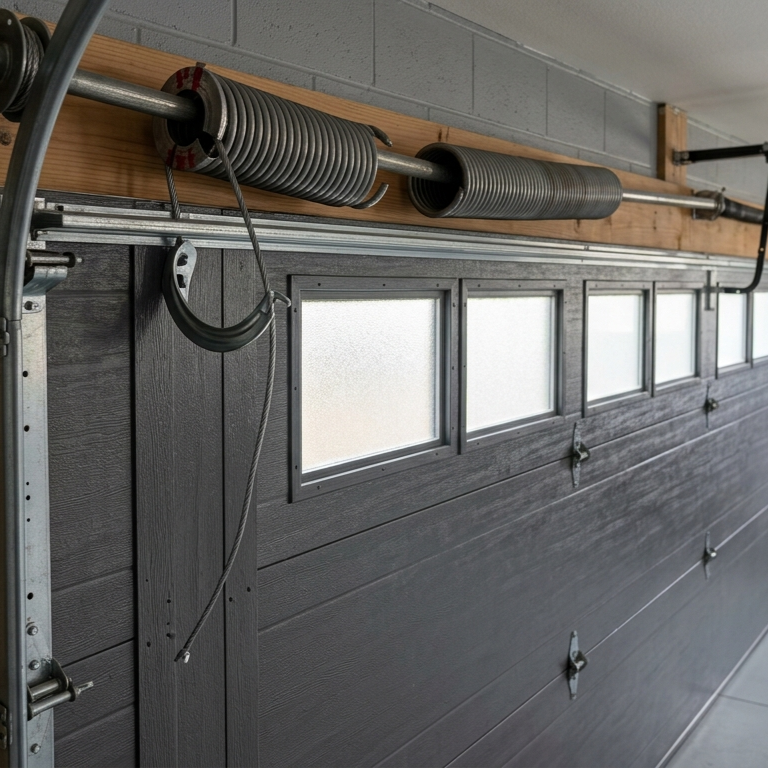
Quick Answer: That bang like a gunshot was almost certainly a torsion spring snapping. The spring stores enormous tension to counterbalance the door's weight, and when it breaks, your opener no longer has the help it needs — the door becomes too heavy to lift safely. Don't try to force it open or keep pressing the opener. Leave the door down, keep hands off the broken spring, and call a professional, because torsion-spring replacement under that much tension is seriously dangerous to DIY.
You heard it from across the house — a loud bang that made you think something had fallen or a gun had gone off in the garage. Now the door won't budge, or it lurched up a few inches and stopped, or the opener growls and gets nowhere. Nine times out of ten, that sound was a garage door spring letting go. Here's what happened, what to do in the next few minutes, and why this is one repair to leave alone.
First: What to Do Right Now
Before anything else, stop using the door. The instinct is to hit the opener button again or grab the bottom and heave — both make things worse.
- Don't keep pressing the opener. It's built to guide a counterbalanced door, not to lift the full dead weight of one. Forcing it strains the motor and can burn it out, turning one repair into two.
- Don't try to lift the door by hand. With the spring gone, the door's entire weight is unsupported. It can be far heavier than you expect and can slam back down hard.
- Don't touch the broken spring or the cables. There may still be tension in the system, and snapped cables can whip.
- Leave the door closed and your car where it is. If the car is stuck inside, that's a reason to call for same-day service, not to wrestle the door.
- Call a professional for the repair. This is a planned, tooled job — not a roadside fix.
Never try to replace or adjust a torsion spring yourself. These springs hold immense tension, and a slip during removal can cause serious injury or death. The tools, the technique, and the controlled release of that tension are what make it a professional job — this is the part of a garage door that actually hurts people.
What Actually Broke, and Why the Door Won't Move
Your garage door weighs far more than the opener can lift on its own — often well over a hundred pounds. The springs do the heavy lifting. A torsion spring, mounted on the bar above the door, winds up with tension and counterbalances that weight, so the door feels nearly weightless and the opener only has to nudge it along. When that spring snaps, the counterbalance vanishes. Suddenly, the opener is being asked to lift the door's full weight, which it isn't designed to do, so it strains, struggles, or moves the door a few inches and quits.
That's why a broken spring and a "dead" opener look the same from the inside: the opener may be perfectly fine. It's just lost its partner.
How to Tell It Was the Spring
You can confirm it without touching anything. Look up at the spring above the door from a safe distance and check for these signs:
| What you see or feel | What it means |
|---|---|
| A clear one-to-two-inch gap in the spring coil | The spring has snapped — the classic sign |
| The door looks crooked or hangs lopsided | One side lost its counterbalance |
| The door rises a few inches, then stops | The opener can't lift the unsupported weight |
| Slack, fallen, or tangled lifting cables | The system has lost tension |
A gap in the coil is the dead giveaway. A spring under tension is tightly wound; once it breaks, the two halves spring apart, leaving that telltale gap.
Why Springs Break
Springs don't fail at random — they wear out on a schedule, and a few things speed it up. The main one is simple cycle fatigue. Springs are rated by cycles, where one full open-and-close is a cycle, and a standard residential torsion spring is built for roughly 10,000 of them. With the average door opening and closing about 1,500 times a year, that works out to somewhere around 7 to 10 years before the metal fatigues and lets go — sooner for a busy household that runs the door constantly.
Other factors stack on top. Rust pits the wire and gives fatigue cracks a place to start, which is why a little lubrication on the springs goes a long way. The wrong spring size for the door's weight wears out early. And extreme temperature swings are a recognized stressor — a garage that bakes in summer heat and cools at night puts the metal through more stress cycles than a climate-controlled one. Heat isn't the single cause, but in a place like the East Valley, it's one more thing working against the spring.
What the Repair Involves
A technician will measure the spring — wire size, length, and inside diameter, all of which must match the door's weight, and replace it with the correct one, then re-tension the system and rebalance the door. There's a strong case for replacing springs in pairs even when only one broke: on a two-spring door, both were installed together and have cycled the same number of times, so the second is usually close behind. Matching a new spring to a worn one leaves the door unbalanced and often means a second service call within months. If your door uses high-cycle springs, they're worth considering for a heavy-use door or a hot garage, since they're built for far more cycles than the standard. The fastest path back to a working door is a professional spring repair, and if your car's trapped inside, same-day service exists for exactly this.
Frequently Asked Questions
You shouldn't. Without the spring's counterbalance, the door's full weight is unsupported, so lifting it by hand is dangerous — it can drop suddenly. And running the opener just strains the motor against the weight it can't handle. Leave the door down and call for repair; if your car is inside, ask for same-day service.
A standard torsion spring is rated for about 10,000 cycles, with one open-and-close cycle. With a typical household opening the door around 1,500 times a year, that's roughly 7 to 10 years. Heavy use, rust, the wrong spring size, and extreme temperature swings all shorten that lifespan. High-cycle springs last considerably longer for busy doors.
Temperature swings are a known stressor on spring steel. A spring near the end of its cycle life often gives out during a sharp temperature change — a cold snap or the heat of a garage in summer — because the metal contracts and expands under load. The temperature is usually the final straw, not the root cause; the spring was already near the end of its rated cycles.
On a two-spring door, replace both. They were installed at the same time and have cycled together, so when one breaks, the other is usually not far behind. Pairing a new spring with a worn one also leaves the door unbalanced, which strains the opener and often leads to a second repair within months.
No. Torsion springs store a tremendous amount of energy, and releasing or winding that tension without the right tools and technique is how people get seriously hurt. It's the single most dangerous part of a garage door. This is a job for a trained technician with the proper winding bars and experience.
Often, yes. If the opener motor runs but the door stays put or barely lifts, a broken spring is a leading suspect, because the opener can't lift the door's unsupported weight. It can also be a stripped gear or a disconnected trolley, so it's worth a professional look — but with a loud bang beforehand, a broken spring is the prime suspect.
A Loud Bang Is a Stop Sign, Not a Speed Bump
When the garage cracks like a gunshot and the door quits, the system is telling you the spring that does the real lifting has failed. The safe response is the boring one: leave the door alone, keep the opener off, and bring in someone with the tools to handle the tension. Forcing it risks a burned-out opener, a damaged door, or an injury — and none of that gets your car out any faster than a proper repair does.
Heard the bang and now your door won't open? — Get the spring measured, matched, and replaced safely, with same-day help if your car's stuck inside. Quality Overhead Door serves Mesa and the East Valley. ROC #310144. Call (480) 838-8850.
