Why Your Garage Door Shakes or Jerks: 8 Causes to Check
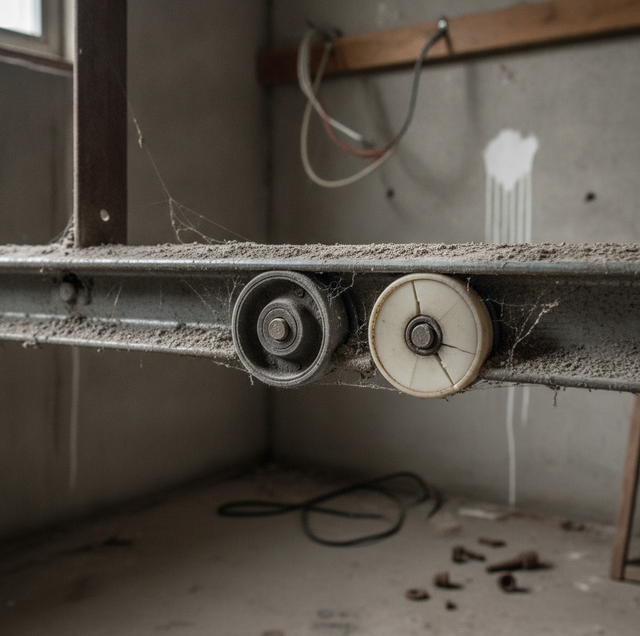
A garage door that works right is almost boring to watch: press the button, it lifts in one smooth pull, and settles at the top. When the same door starts to shudder, hop, or lurch partway up, something changed, and the door is telling you where.
Shaking and jerking are not one problem but a category of symptoms, and the useful question is not "is it bad" but "what is binding, and when." A door moves through a coordinated chain: an opener pulls, cables and springs carry the weight, rollers ride the track, and hinges let the panels flex around the curve. When one link is worn, dry, bent, or out of sync, the motion stops being smooth. Read the specific symptom, and you can usually name the culprit before anyone touches a wrench.
Quick Answer: A garage door shakes or jerks when part of the track, roller, spring, cable, or opener system binds or falls out of sync. Dry or worn rollers make it vibrate the whole way; a bent or misaligned track makes it catch at the same spot; a weak spring or slipping cable makes one side lag; a loose opener chain or worn gear makes the start lurch. Cleaning and lubricating rollers, hinges, and track, plus tightening hardware, cures the mild cases. Spring, cable, and track work is high-tension and belongs to a technician.
Read the Symptom Before You Grab a Wrench
Think of the door like a loaded wheelbarrow going up a ramp. Push it evenly on a clean ramp, and it rolls; let one wheel go flat, drop a rock in its path, or shove from one corner, and it wobbles, catches, or slews aside. The wobble tells you what went wrong. A garage door is the same, and four broad patterns cover most cases.
It shakes or rattles the whole way up: The vibration is fairly constant top to bottom, often with a gritty grinding note. This points at the rollers and track surface, not any single point: dry, worn, or dirty rollers do not spin freely, so they skid and hop instead of rolling, and the whole door buzzes.
It catches or jerks at the same spot every time: The door moves fine, then hits one point and hesitates, thumps, or shudders before continuing. Because it recurs at a fixed location, the track is the prime suspect: a bend, a dent, a section pinched too tight or too wide, or a bracket drifted out of alignment.
The start is jerky, then it smooths out: The first foot lurches, slaps, or stutters, but once going, the door runs cleaner. That signature usually lives in the opener: a loose chain or belt, a worn drive gear, or a tired capacitor that cannot deliver a clean pull off the line.
One side lags, and the door lifts crooked: Watch the top corners. If one side rises behind the other and the door looks like it is racking or twisting, the lifting force is uneven. That is a spring or cable problem, the pattern to treat with the most caution.
Rollers and Tracks: The Most Common Shake
Rollers are the small wheels on stems that ride inside the tracks; most residential doors run ten to a dozen. Fine grit works into the roller bearings and the track channel, dries out the lube, and turns a smooth glide into a skid. When a roller stops rolling and starts dragging, you feel it as a broad, gritty vibration and hear it grind.
Worn rollers compound it. Steel rollers with pitted bearings develop flat spots and slop, so they clatter and bounce; nylon ones can crack or lose their tread. Either way, the wheel no longer tracks true, and the door hunts side to side.
The track contributes when its surface is dirty or when old grease has turned to a sticky varnish that grabs the rollers. This is do-it-yourself territory: wipe the track channel with a dry rag, pick out pebbles and debris, and lightly lubricate the rollers, hinges, and bearing points with a proper garage-door lubricant. If a few rollers are visibly worn, replacing the slide-in nylon ones is a reasonable job for a homeowner. Leave the bottom-bracket roller alone, because that bracket is under cable tension.
When the Track Is Bent or Out of Alignment
A door that catches at the same spot is reading you a map: somewhere along its travel, the track has a defect that the rollers pile into every cycle. Common causes are a car nudge that dented the vertical track, a bent flag bracket, mounting lag screws that loosened so the track drifted from the wall, or a horizontal track that sagged and threw off the spacing.
With the door down and the room lit, sight down each track for a kink, a spot where the gap to the door edge changes, or a bracket that is no longer flush. A track pinched too narrow squeezes the rollers; one too wide lets them rattle and jump.
Minor bracket looseness, a careful homeowner can snug up, provided the fasteners hold the track to the framing and not the spring or cable assemblies. Straightening, replacing a bent section, or realigning a track that has moved is a technician's job. Bend it wrong, and you trade a catch for a jam, and a jammed door under spring load is a hazard, not an inconvenience.
Hinges and Loose Hardware
Between the panels sit the hinges that let the door articulate around the curve where the vertical track meets the horizontal. Each carries a pivot, and some carry a roller. As they wear, the pivot holes elongate, and the panels gain play, so the door flexes and shudders as it rounds the bend. Cracked hinges can let a section shift out of line.
Loose section hardware adds its own rattle. Doors ride through thousands of cycles a year, and vibration slowly backs out lag screws, hinge bolts, and bracket nuts, so a door full of loose fasteners buzzes even when rollers and springs are fine. Going around with the right nut driver and snugging every hinge bolt and bracket nut (not overtightening, and not touching spring or cable hardware) is one of the highest-value ten-minute jobs a homeowner can do, and a drop of lubricant on each hinge pivot helps too.
Springs, Cables, and Uneven Lift
This is where symptom reading matters most, because this part stores enough energy to hurt you. The springs, either a torsion spring on a shaft above the door or extension springs along the horizontal tracks, do the work of counterbalancing the door's weight. Cables transfer that force to the bottom of the door and wind onto drums as it lifts.
When one spring is weaker than its partner, or one has broken, the sides no longer lift together, so the door rises crooked, jerks, and stutters with one corner trailing. A cable that frayed or slipped off its drum does the same from the other direction: that side loses its lifting connection, and the door hitches. You may hear a bang, see a gap in a coil, or spot a cable hanging slack.
None of this is homeowner territory. A torsion spring holds hundreds of pounds of stored tension, and a cable under load can whip. Do not loosen a spring, adjust winding cones, or try to reseat a cable on its drum. Stop using the door and call a technician with the winding bars and training to release and reset that tension safely. This is the most important line here: springs and cables are pro-only, every time.
Could It Be the Opener, Not the Door?
Sometimes the door is healthy, and the opener misbehaves, and the tell is the start of travel. A stretched or loose chain slaps its rail and lets the trolley snatch the door into motion, so it lurches off the floor and settles once the slack is taken up. A loose belt drive does a quieter version of the same lurch.
Inside the opener head, a worn plastic drive gear skips teeth, making the door stutter or stall, often with a grinding whir as it barely moves. An aging motor capacitor cannot deliver the surge for a clean start, so you get a hesitant, laboring start, sometimes with a hum before anything happens.
A simple test separates door problems from opener problems. With the door fully closed, pull the red emergency-release cord to disconnect the trolley, then lift the door by hand.
- If the door glides up smoothly by hand but jerks under power, the fault is in the opener: chain tension, drive gear, or capacitor.
- If the door is hard to move, catches, or shakes by hand exactly as it did under power, the fault is in the door hardware: rollers, track, hinges, springs, or cables.
Chain and belt tension are usually adjustable per the opener's instructions, both of which are mild jobs. Replacing a drive gear or capacitor is a middling repair some handy owners tackle, and others hand off. If the hand test points to the door, especially with balance, call a pro.
The Hand-Lift Balance Test, Read Correctly
The balance test answers the biggest question: Is the door itself heavy, or is it only the opener struggling? Disconnect the opener with the release cord, raise the door to waist or chest height, and let go.
A properly balanced door stays put or drifts only slightly, meaning the springs carry the weight, and any shaking is more likely to be rollers, track, or hinges. If the door feels very heavy, slams back down, or shoots upward on its own, the counterbalance is off: a door that drops is undersprung or has a weakening spring, and one that flies up is oversprung. Either way, you have confirmed a spring issue, which returns you to the pro-only rule. Do not keep running an unbalanced door on the opener, because the extra load chews through the drive gear and shortens its life.
Dust, Heat, and Keeping a Door Smooth
Two environmental factors quietly accelerate every wear pattern above, and both cut both ways through the year. Airborne grit is relentless in a dry climate: it settles into roller bearings and the track channel, absorbs the lubricant, and turns it into an abrasive paste. That is why a door in a dusty garage gets shaky sooner than one in a sealed garage, and why regular cleaning pays off.
Temperature swings are the other factor, and not a one-season story. Heat expands metal and thins lubricant, so on a hot afternoon, a marginal roller or tight track binds more; cold mornings stiffen grease and make a dry roller drag until things warm up. A door on the edge of a problem shows it at its worst at either extreme, so steady maintenance and catching worn parts early keep it in the smooth middle of its range in any month.
The homeowner's lane is clear: clean the tracks, lubricate rollers, hinges, and bearings with the correct product, tighten loose hardware, swap worn slide-in nylon rollers, and run the balance test. Anything with a spring, a cable, a bent track, or an opener's internals belongs to someone trained to handle stored tension safely.
Frequently Asked Questions
Mark the track with chalk or a strip of tape to pinpoint the exact spot the door catches, so you know whether the trouble is in one location or the whole run. A flat-spotted steel roller thunks once per revolution, a rhythmic knock timed to the wheel turning over. A dry roller squeals continuously the whole travel, since the friction never lets up. A single fixed catch that lines up with your chalk mark points at the track; a repeating thunk or a steady squeal points at the rollers.
Use a garage-door-specific lithium or silicone spray. Apply it to the rollers (aim into the bearings where the wheel meets the stem), the hinge pivots, the spring coils, and the bearing plates the torsion shaft rides in, plus a light film in the track, not a heavy coat on the flat surface. Do not use WD-40: it is a solvent and penetrant, not a lubricant, so it strips existing grease and then attracts dust that gums the parts up faster than before. A thin, correct product two or three times a year beats a heavy, wrong one.
Read the signs before assuming. A broken torsion spring shows a visible 1- to 2-inch gap in its coil where the wire snapped, the clearest single sign. A cable that slipped off its drum leaves the door hanging visibly crooked on that corner, since it lost its connection to the counterbalance. A single-spring door binds differently than a two-spring setup, so knowing which you have shapes what you are looking for. All of these are high-tension repairs that call for winding bars and a trained technician, not a homeowner fix.
Yes, and the drive type narrows down which fault to expect. A chain drive lurches when the chain is loose, slapping its rail and snatching the door off the floor. A screw drive shudders if the rail lube is dry or cold, since the trolley rides directly on a threaded shaft that needs film to run smoothly. A belt drive is the smoothest of the three and the least likely to slap or lurch, so jerking on a belt unit usually points back at the door. To confirm, pull the release cord and lift by hand: smooth by hand but rough under power means the opener.
Pull the release cord, then lift by hand and let go at three points: knee, waist, and shoulder height. A balanced door should drift less than a couple of inches at each of those stops, which tells you the springs are carrying the weight correctly. More drift than that, or a door that slams down or shoots up on its own, means the spring tension is off, undersprung if it drops and oversprung if it climbs. Testing at three heights rather than one catches a spring that is close at mid-travel but wrong at the extremes. Any failure here routes you to a technician, since the balance is spring tension.
They matter a lot. Bare steel rollers with unsealed bearings run louder, transmit more vibration, and let grit into the bearing where it grinds and wears fast, the exact recipe for a shaky door in a dusty garage. Sealed-bearing nylon rollers spin more quietly and smoothly, keep dust out, and glide along the track's curve with far less noise and bounce. Upgrading tired steel rollers to good sealed nylon ones is one of the most reliable ways to quiet a door that shakes from roller wear.
Book a tune-up or repair — get a smooth, safe door without touching a spring yourself. Quality Overhead Door serves Mesa and the East Valley. ROC #310144. Call (480) 838-8850.
