Why Is My Garage Door So Loud Suddenly? Read the Noise
Quick Answer: A garage door that gets loud suddenly is telling you exactly what changed, grinding points to dry or worn rollers and bearings, a single loud bang means a broken spring you should not touch, popping usually means a roller jumping the track, and squealing means dry parts that need the right lube. Match the sound to the cause below.
For months, the door opened as background noise, the kind you stopped hearing. Then one morning, you hit the button, and the whole thing announced itself, a grind, a bang, a rattle that rolled through the wall and into the kitchen. A garage door has dozens of moving parts cycling together, and when one starts to fail, it rarely stays quiet about it. The good news is that the noise itself is a diagnosis. Each kind of sound points to a different part, and learning to read them tells you what is wrong and, just as important, whether it is safe to keep using the door.
Grinding or Rumbling: Dry or Worn Rollers and Bearings
A low grinding or rumbling that builds as the door travels is almost always coming from the rollers, the small wheels that ride inside the vertical and horizontal tracks. Most doors ship with plastic or steel rollers, and both wear. Steel rollers are durable but run on tiny ball bearings inside the wheel; when those bearings dry out or the cage wears, the roller grinds metal on metal and rumbles down the track. Cheaper plastic rollers simply flatten and chip until they no longer spin true and start dragging.
The other suspect is the bearings themselves. The torsion springs above the door ride on a shaft supported by bearing plates at each end and often a center bracket, and there are pulleys on the cable drums, too. When one of those bearings runs dry, it howls or grinds under the weight of the door. If the rumble seems to come from up high near the spring shaft rather than from the tracks, a worn end-bearing plate is a strong candidate, and that is a repair to hand off, because it sits inches from parts under high tension.
A Single Loud Bang: A Broken Torsion Spring
This one has a signature people never forget. A garage door spring failing makes a single, violent crack, loud enough that homeowners regularly call it in as a gunshot or something falling through the roof. What actually happened is that the torsion spring above the door snapped. Those springs store an enormous amount of energy to counterbalance a door that can weigh well over a hundred pounds, and when the steel fatigues and lets go, all of that energy releases at once.
Here is the part that matters most in this whole article: if you heard that bang and now the door is dead weight, or it opens a few inches and stops, do not operate it. A broken torsion spring is still under tension; the opener is now trying to lift the full weight alone, and a hanging cable or a second spring can fail next. This is not a wait-and-see or a fix-it-yourself situation. Leave the door down and call a professional. Most torsion springs are rated for roughly 10,000 cycles (one open and one close is a cycle), so a two-car household running the door four or five times a day is often knocking on that number somewhere in the seven-to-ten-year range. A sudden bang after years of quiet service is the spring reaching the end of its rated life, not a fluke.
Rapid Popping or Snapping: Rollers Jumping a Track or Loose Hinges
A staccato series of pops or snaps as the door moves is a different animal. Usually, it means a roller is riding a track that has been knocked out of alignment or slightly bent, so the wheel binds and then jumps free with a pop at the bad spot, over and over. A car bumper tap on the track, a bracket that has worked loose, or grit packed into the channel can all pull a section of track out of true.
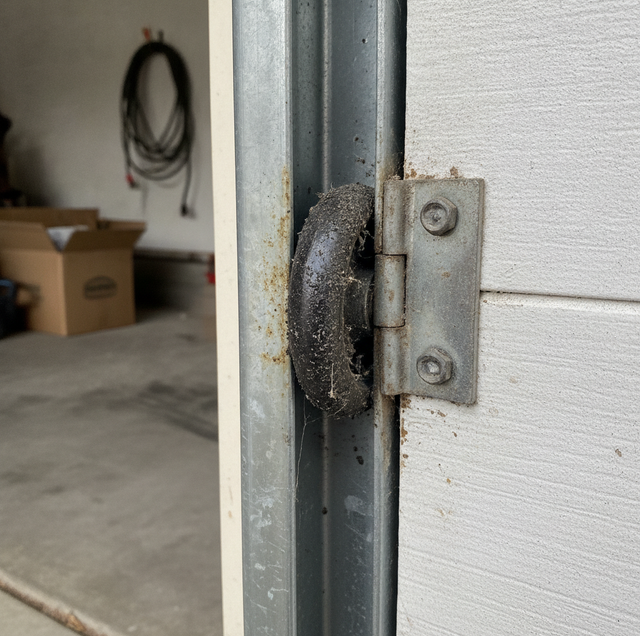
The same popping can come from the hinges that join the door's panels. Each section is connected to the next by hinges, and as the door bends around the curved part of the track, those hinges flex. When a hinge loosens, or its pin wears oval, it snaps as it takes and releases load. If the popping tracks to the seams between panels rather than to the tracks on the sides, worn or loose hinges are the likely source. Either way, a door that is popping is a door with something moving that should be fixed and firmly in place, and running it hard can turn a small misalignment into a panel that jumps the track entirely.
Squealing or Screeching: Dry Rollers and Hinges
A high squeal or screech, especially one that builds gradually and worsens, is the least alarming sound on this list; it is usually just friction. Rollers, hinges, and the spring shaft all need a film of lubricant to move quietly, and that film breaks down over time. Once metal starts rubbing dry, it squeals.
This is the one noise you can often quiet yourself, but the choice of lubricant matters more than people expect. Use a garage-door-specific lithium or silicone spray on the roller stems, hinges, springs, and bearing points. Do not reach for WD-40; it is a solvent and cleaner, not a long-term lubricant, and it strips existing grease and leaves a residue that attracts fine dust everywhere in a dry, dusty climate. Blown grit landing on an oily rail turns into a grinding paste. A proper lube two or three times a year keeps parts quiet and running clean. If you lube a squealing door and the noise comes right back within days, the parts are worn past the point where lube can help, not just dry.
Rattling or Vibrating: Loose Nuts, Bolts, and Brackets
A door that has started to rattle, buzz, or vibrate through the wall is usually just loose. A garage door is held together and to your house by dozens of nuts, bolts, lag screws, and track brackets, and every open-and-close cycle shakes them a little. Over hundreds and thousands of cycles, some back themselves out. There is a real local mechanism at work too: the daily swing between a broiling afternoon garage and a cooler night makes metal expand and contract, and that thermal cycling walks fasteners loose over time. The constant duty of a door that gets used many times a day does the same thing year-round, whether it's hot or not.
Going around the door and hardware with a socket and a wrench and snugging every fastener, the track brackets, the bolts on the hinges, the lag screws holding the tracks to the framing, the opener rail mounts, cures a surprising amount of rattle. Just do not touch the bolts on the bottom brackets at the corners: those anchor the lift cables and sit under spring tension, and they are a professional-only fastener.
Slapping or Clanking Chain: A Loose Opener Chain or Worn Sprocket
If the racket is coming from the opener rail overhead rather than the door itself, listen for a rhythmic slap or clank that keeps time with the motor. A chain-drive opener runs a bicycle-style chain along the rail, and over time, that chain stretches and sags. A loose chain slaps the rail and can jerk the door as it takes up slack. Most opener rails have a tensioning nut to take up that slack; if the chain is visibly drooping, that is the fix. A worn drive sprocket on the motor head can make a similar clanking as the chain skips over rounded-off teeth; that one is a repair, not an adjustment.
Scraping: A Door Out of Balance
A dragging scrape as the door moves often means the door is out of balance and rubbing where it should glide. When the springs lose tension, the door no longer floats on its counterbalance and instead leans its real weight into the tracks and seals, scraping as it goes. That leads to the single most useful test you can run yourself.
The Hand-Lift Balance Test
Think of a well-balanced door like a see-saw with equal weight on both ends; the springs offset the door's weight so precisely that the whole thing floats. When that balance is off, everything downstream wears and complains. To check it, pull the emergency release cord, the red handle hanging from the opener rail, with the door fully closed to disconnect it from the opener. Now lift the door by hand. A balanced door glides up smoothly and, this is the key part, stays put when you stop it around waist height. If it slams down or shoots up when you let go, or you have to fight it, the springs are no longer carrying the load correctly. That is a spring or balance problem, and because it lives in the high-tension part of the system, it is a job for a technician. To reconnect, pull the release handle back toward the door or run the opener, depending on your model.
Frequently Asked Questions
It depends entirely on the sound. A gradual squeal or a light rattle is mostly a maintenance flag and not urgent. A single loud bang, a door that has gone heavy or crooked, or a visible frayed cable is an emergency; these point to the spring-and-cable system that stores enough energy to break bones, and the door can drop. The practical rule: any new noise paired with the door moving unevenly, hanging tilted, or refusing to hold position means stop using it. Noise on its own, with normal, smooth travel, usually buys you time to schedule a look rather than call after hours.
Often, yes. Nylon rollers with sealed ball bearings run noticeably quieter than bare steel rollers or the basic plastic ones that come on many builder-grade doors, because the nylon wheel does not transmit the metal-on-metal ring down the track. Look for rollers with 11 or 13 sealed bearings rather than the open-bearing budget versions; the sealed bearing also keeps blown grit out of the wheel, which matters a lot in a dusty climate. It is one of the higher-payoff upgrades for noise, though it does not fix a track that is bent or a spring that is worn.
For a squealing or dry door, yes. Use a garage-door lithium or silicone spray and hit the roller stems where they enter the hinge, the hinge pivot points, the torsion spring coils up top, and the bearings at the ends of the spring shaft. Wipe the tracks clean with a rag, but do not grease the inside of the tracks themselves; rollers are meant to roll there, not slide through grease, and lubed tracks just collect grit. A light pass on each point, cycling the door a few times to work it in, is enough. Skip this only on the bottom brackets and cables.
New doors get loud for a few specific reasons. Fasteners settle and back off during the first weeks of cycling, so a new door often just needs its bolts and brackets re-snugged once. Factory doors can also arrive with the cheapest plastic rollers to hit a price, and those start complaining early. And a fresh installation that was not balanced precisely will run noisily from day one as the opener fights a door that the springs are not fully offsetting. If a door under warranty turns loud fast, that is worth reporting rather than living with; early noise usually signals an adjustment that was missed, not normal wear.
Only if the opener was the source. A belt-drive opener replaces the metal chain with a reinforced rubber belt and removes the slap-and-clank that chain drives make, so if your noise is that rhythmic overhead rattle, a belt drive is a real quieting upgrade. But if the racket is grinding rollers, worn bearings, loose hardware, or an unbalanced door, a new opener changes nothing; you have quieted the motor while the door itself keeps making its own noise. Diagnose where the sound lives first; the opener and the door are separate systems.
Generally, yes, though the effect is modest and indirect. A single-layer steel door is essentially a thin drum that resonates and magnifies every roller and hinge sound, while an insulated door (a steel skin over a polyurethane or polystyrene core, sometimes with a second steel back) is stiffer and deadens vibration instead of ringing with it. The insulation is sold mainly for temperature, and manufacturers market the quieting as a side benefit, so treat the "whisper-quiet" claims as marketing rather than a guarantee. A stiffer, heavier door with good rollers and correct balance is what actually runs quietly; the core just helps it along.
Book a noise diagnosis and tune-up before a small sound becomes a broken spring — get the door quiet and safe again. Quality Overhead Door serves Mesa and the East Valley. ROC #310144. Call (480) 838-8850.
