
Faux-Wood and Composite Garage Doors in Mesa, AZ
Get the warm look of wood on a steel or composite door that never needs refinishing in the Arizona sun. Compare printed and composite samples in daylight at our Mesa showroom, and get a free phone quote.
A quote over the phone is free. If you want a technician to come and measure the opening, that visit is $35. A service call on a door that has stopped working is $85.
- Women-Owned Family Business
- ROC #310144
- Licensed, Bonded & Insured
- 90-Day Labor Warranty
- Google Rated
- Amarr Dealer
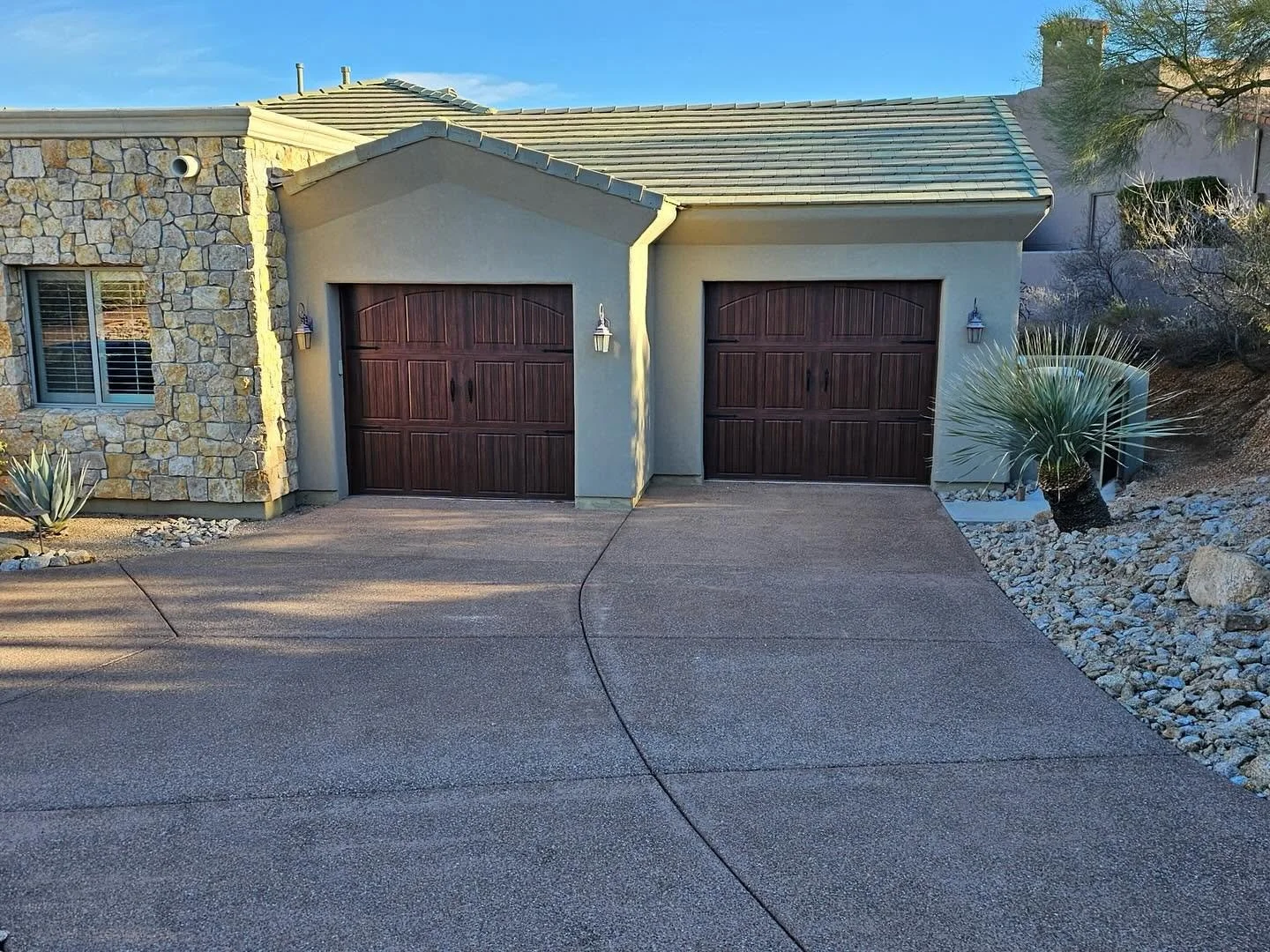
Plenty of people here want a wood door and should not buy one. Some of them are not allowed to; there is at least one community here whose architectural guidelines prohibit wood panels outright and permit a faux-wood texture instead. This page is about the three ways to get the look, which are not the same product and do not age the same.
Three Routes to the Same Look
They get sold interchangeably, and they are three different things.
Route One: Printed or Embossed Steel
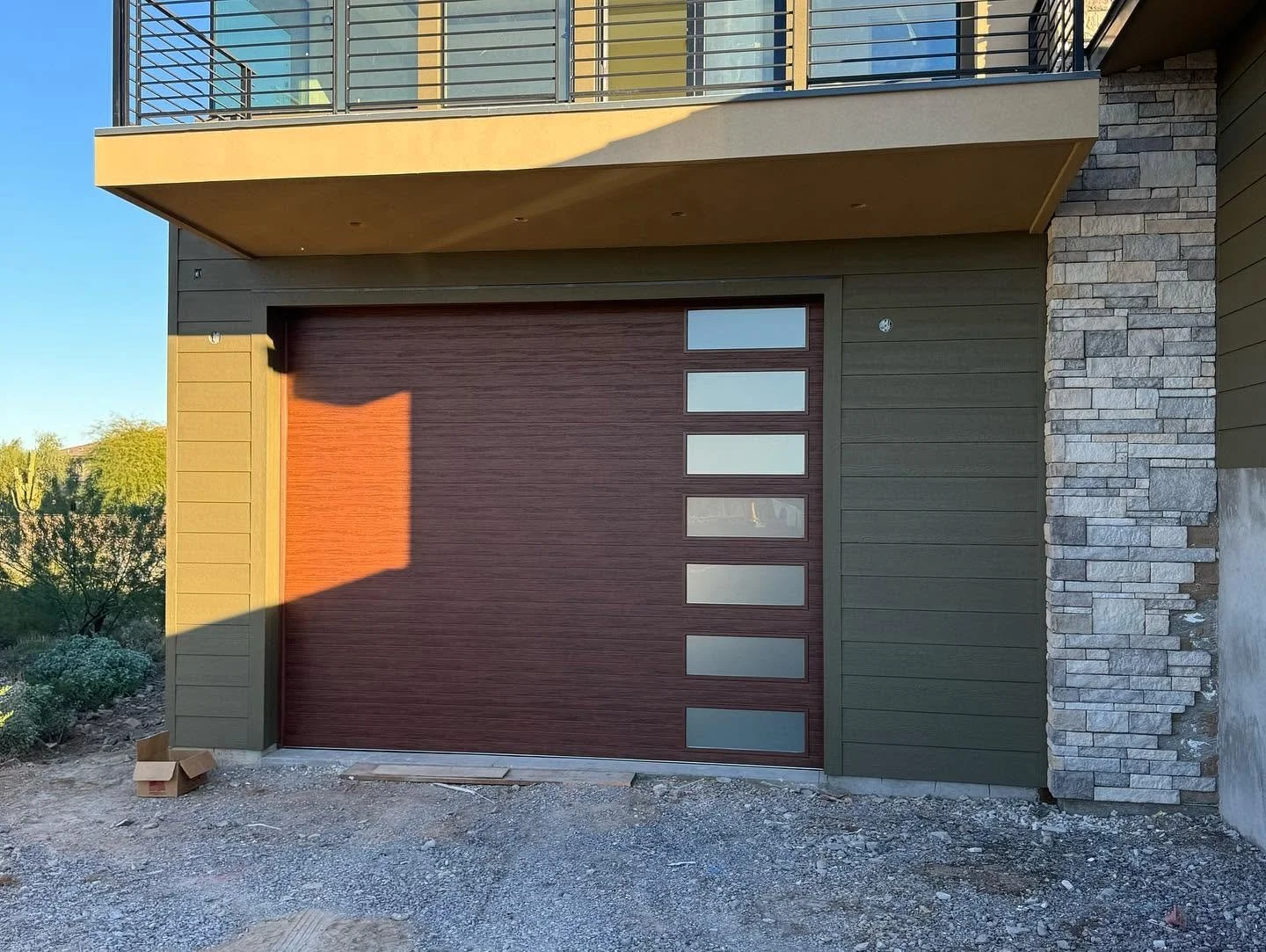
A steel door whose skin carries a wood-grain texture, a printed grain pattern, or both. The better versions use a digitally printed, non-repeating pattern, which is the detail that matters, because a repeating grain is what gives an imitation away at ten feet. Underneath, it is a steel door in every functional sense: the same gauge, the same construction, the same dent behavior, the same maintenance, which is almost none.
Route Two: Composite-Faced (Overlay) Door
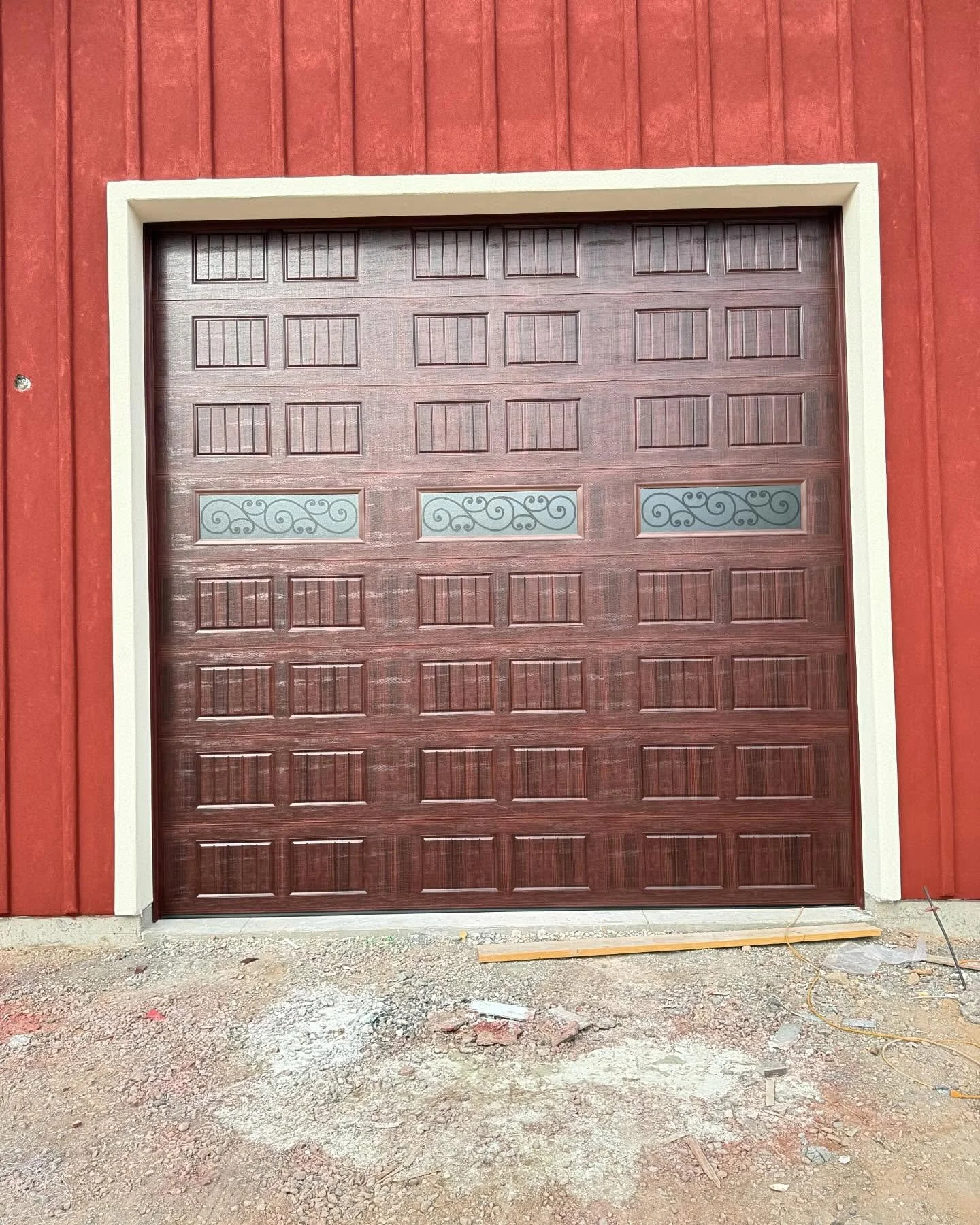
A steel or engineered core with a molded composite layer applied to the face, delivering real grain depth and genuine three-dimensional detail in the stiles and rails. This is the route that holds up under close scrutiny, and it is what most people mean when they say a faux-wood door looked real to them.
Route Three: Real Wood
Cedar, redwood, or a hardwood veneer over an engineered core. It is the only one of the three that actually is wood; it is the only one where damage can be sanded out, and it is the only one that comes with a refinishing calendar. Our custom doors page covers real wood in full, including what this climate does to exterior wood and the finishing clock that starts before installation.
So, plainly. Route one gives you the impression of wood with the ownership of steel. Route two gives you most of the appearance of wood with much of the ownership of steel. Route three gives you wood.
The Rule That Decides This for Some People Before They Choose
Some architectural guidelines here specify the material of a replacement garage door, and at least one prohibits wood. The published requirements of one association in this valley state that a replacement door must be of the roll-up multi-panel overhead type, that panels may be fiberglass, vinyl, or metal, that wood panels are not allowed, and that panels with a faux-wood texture finish are acceptable, with a manufacturer-applied color matching natural wood grain colors permitted in place of painting to the association's palette.
Read that carefully, because it is unusually specific and it is unusually helpful. If you live under guidelines like those and you wanted the wood look, the decision has already been made for you: route one or route two, not route three. These guidelines are public documents, and they govern what goes on your opening. Our Sun Lakes page sets out how the two permit offices there and the architectural requirements work together.
What we can do about it. We cannot make your submission, and we will not pretend to. What we can give you is the door's specification, dimensions, and finish in writing, plus the manufacturer's brochure or photograph that these guidelines typically require with a permit request, so the submission has something real in it.
And what we would check first. Whether your guidelines name a material at all, whether they constrain window placement, and whether they require a single color across the whole door. All three are commonly specified, and each can rule out a door you have already fallen for.
What These Doors Actually Do in This Sun
The reason to want one here is not only the look. It is the maintenance arithmetic.
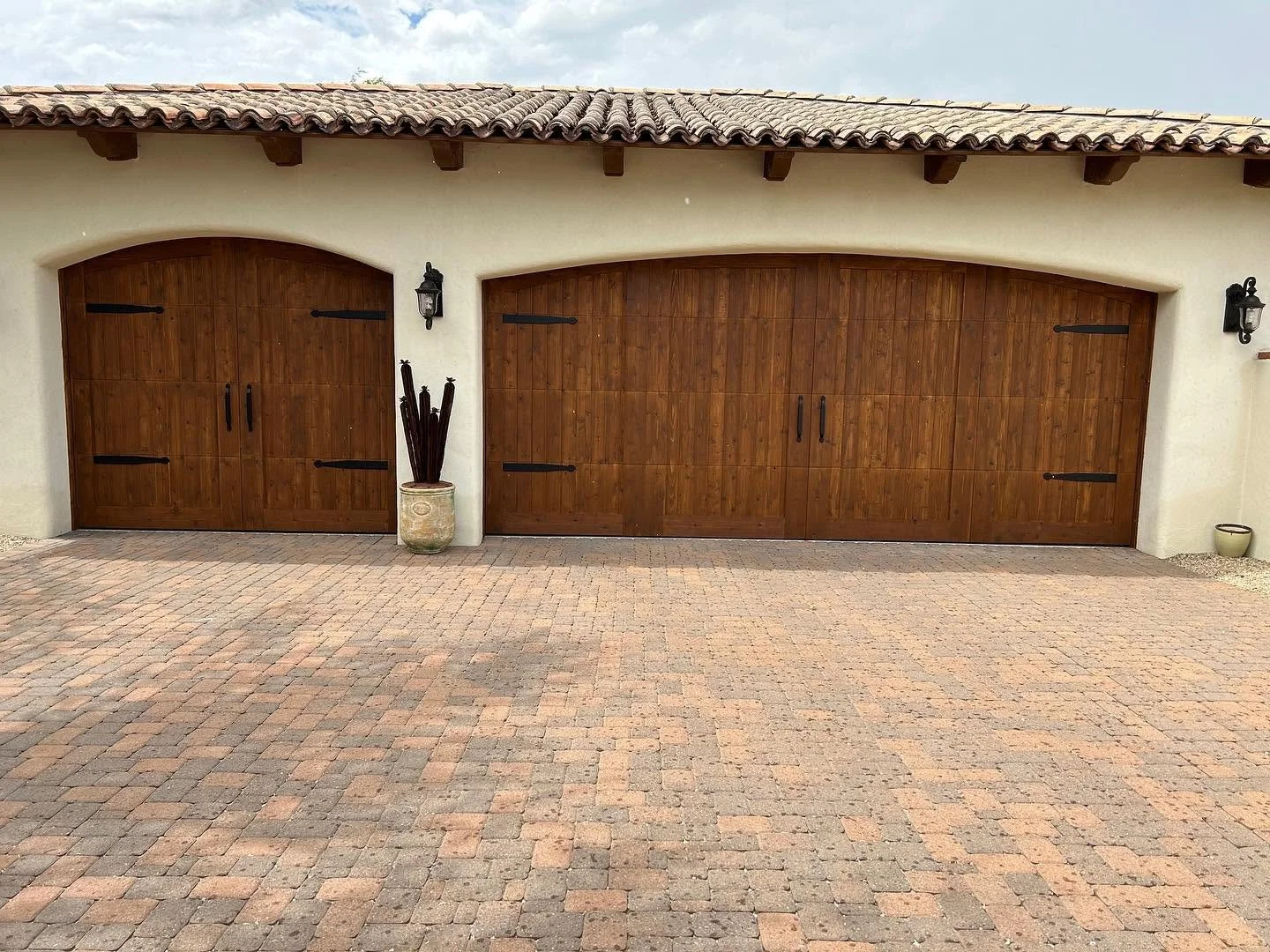
Real wood in a high-UV climate needs its finish renewed roughly every two to three years, compared with five or more in a milder climate, because ultraviolet light breaks down lignin, the polymer that holds wood fibers together. Skip it, and the grain starts taking up and releasing moisture unevenly, which drives stile separation and panel cupping. That is not an argument against wood. It is the commitment wood asks for, and it is worth knowing before you buy.
A printed or embossed steel door asks for essentially none of that. The grain is in or on the steel, and the factory finish over it is a baked powder coat. Steel finish warranties commonly cover fading and chalking on a prorated basis. Our steel doors page covers how that finish ages and where it eventually fails.
A composite overlay sits between the two, and this is where we will be careful. The face material is not wood and does not need a refinishing calendar, but it is a layer bonded to a substrate, and a bonded layer can delaminate at an edge where moisture has worked under it. The failure mode that matters on any overlay or veneer product is edge delamination, which, unlike a wood door's checked finish, cannot be sanded and refinished away.
So the three questions to put to whoever is quoting you are what the face is made of, what it is bonded to, and how the edges are sealed. Two doors that look identical in a showroom can respond very differently, and the third answer is the one that determines what the door looks like in year ten.
Where the Printed Grain Gives Itself Away, and Where It Does Not
This is the thing people worry about, so here it is without the brochure language.
At normal viewing distance, a good printed or composite door is convincing, which is why these doors sell as well as they do. How close you can get before that stops being true depends on the depth at the joints, and our carriage house doors page works that through at each distance, because it is the same question in a different style.
The tell to look for is repetition, and it is easy to miss until you know to look for it. An older or lower-specification printed grain repeats its pattern across the panels, and once you have seen it, you cannot stop seeing it. It is the one tell that gets worse the longer you own the door, because it is the only one you look at from inside your own driveway every day. A non-repeating digitally printed pattern is the current answer to that, so ask whether the door you are quoted uses one.
And here is the part a brochure cannot tell you. Printed grain reads differently in direct Arizona sun than it does on a page or a screen, because this light is harder and more directly overhead than the light the photograph was taken in. This is the single best reason to look at a sample in person, and it is why the showroom exists. Our showroom and parts counter page has the hours.
What We Fit
We are an Amarr garage door dealer, and Amarr's Northwoods collection is published as carrying a multi-hued, digitally printed wood-grain pattern. Its carriage collections carry stamped and overlay designs in steel.
We also install and service Clopay, whose Canyon Ridge range is a composite line, published in Elements, Chevron, Carriage House (in four-layer and five-layer construction), Louver, and Modern variants. We are not in Clopay's dealer program, and we say so because it is checkable.
No door is stocked. Doors are built after they are ordered, which is why the lead time is worth asking about before you settle on a finish. A made-to-order door requires a 50% non-refundable deposit.
What we will not do is tell you on a web page which collection is right for your elevation. Bring a photograph of the front of the house and the color of your stucco, and that conversation takes about ten minutes with samples in front of you.
What Changes Behind a Heavier-Looking Door
The three routes do not weigh the same, and weight is the specification that decides the hardware.
A printed or embossed steel door weighs as much as its steel construction. The grain adds nothing. If you are replacing a plain steel door with a printed one of the same construction, the counterbalance is doing the same job.
A composite overlay door is heavier, sometimes substantially, because there is a second material bonded to the face of every section. That changes three things: the spring set has to be wound for the real weight, the opener has to be sized for what it is now lifting, and the hinges and rollers are carrying more through every cycle.
So a composite door is not a like-for-like swap for a plain steel one, and a quote that carries over the existing springs is a quote that has skipped the arithmetic. Our spring repair page sets out how weight is established, and the details determine whether the door lifts correctly on day one.
What we do about it. We weigh the door on paper before the factory builds it, specify the spring set with the order, and answer the opener question then instead of on install day. On a heavier door, the cycle rating is a question too, because a bigger door working a standard spring is a shorter-lived spring. Our high-cycle springs page has that decision.
What Affects the Price
Which of the three routes you take is the largest factor in the price.
Construction underneath the face. A single-layer steel door and a three-layer insulated door with the same faux-wood finish are different doors with the same appearance. Our steel doors page has that comparison.
Whether the grain is embossed, printed, or a molded overlay.
Windows and decorative hardware, which on a carriage-look door are most of the effect and are frequently constrained by an architectural committee. Our carriage house page covers the hardware question.
Color matching, where a custom match is added to the order as its own line and carries its own lead time.
Financing is available through Wisetack.
Frequently Asked Questions
Will a faux-wood door fool my neighbors?
From the street, usually. Up close, the stiles and rails are the tell rather than the grain, and a molded composite overlay answers that better than a printed steel skin does.
Does a faux-wood door need refinishing?
No, and that is the main reason to buy one. The grain is in or on the panel, and the factory finish over it is a baked powder coat. A real wood door in this sun needs its finish renewed every two to three years.
Is a composite door as tough as steel?
Different, in a way worth understanding. The face material resists the dents and dings that crease a steel skin, and instead introduces a bonded layer with edges. Ask what happens at the edges.
My HOA says no wood. Does a faux-wood door comply?
Often yes, and at least one set of published guidelines in this valley says so explicitly, permitting panels with a faux-wood texture finish while prohibiting wood ones. But read your own guidelines and do not take our word for it, because they differ by community and some also constrain color, window placement, and hardware.
Can you match my front door or my shutters?
Sometimes, and a sample of the trim or stucco you are matching settles it faster than a color name. A manufacturer's wood-tone finish is a fixed set of colors; a custom match is a different order.
Is this the same thing as a carriage house door?
No, and they get confused constantly. Faux-wood is about the material and finish. Carriage house is about the style, the look of a swinging barn door on a sectional that goes up like any other. You can have either without the other, and most people want both. Our carriage house page covers that side.
What about fiberglass? I have seen fiberglass faux-wood doors.
They exist, and they are a real product. We do not sell them because the door lines we supply, Amarr and Clopay, are not where we source fiberglass, and we would rather tell you that than order through a channel we do not have. If a fiberglass door is specifically what you want, say so on the phone, and we will tell you plainly that we are the wrong company for it.
Which route suits most houses here?
Printed or embossed steel on an insulated construction, because it covers the look, maintenance, and heat in one purchase. Composite goes on houses where the door is a major elevation feature, and someone is going to look at it closely.
Can a faux-wood finish be added to the door I already have?
No. The grain is part of the panel, pressed or printed or bonded at the factory, so it is a door replacement rather than a treatment. What can be added to an existing door is insulation and new hardware, and our insulation page covers that.
Will the printed grain fade?
The finish over it ages the way any factory finish does, chalking and fading under enough years of UV while the panel beneath stays sound. Our steel doors page covers that clock.
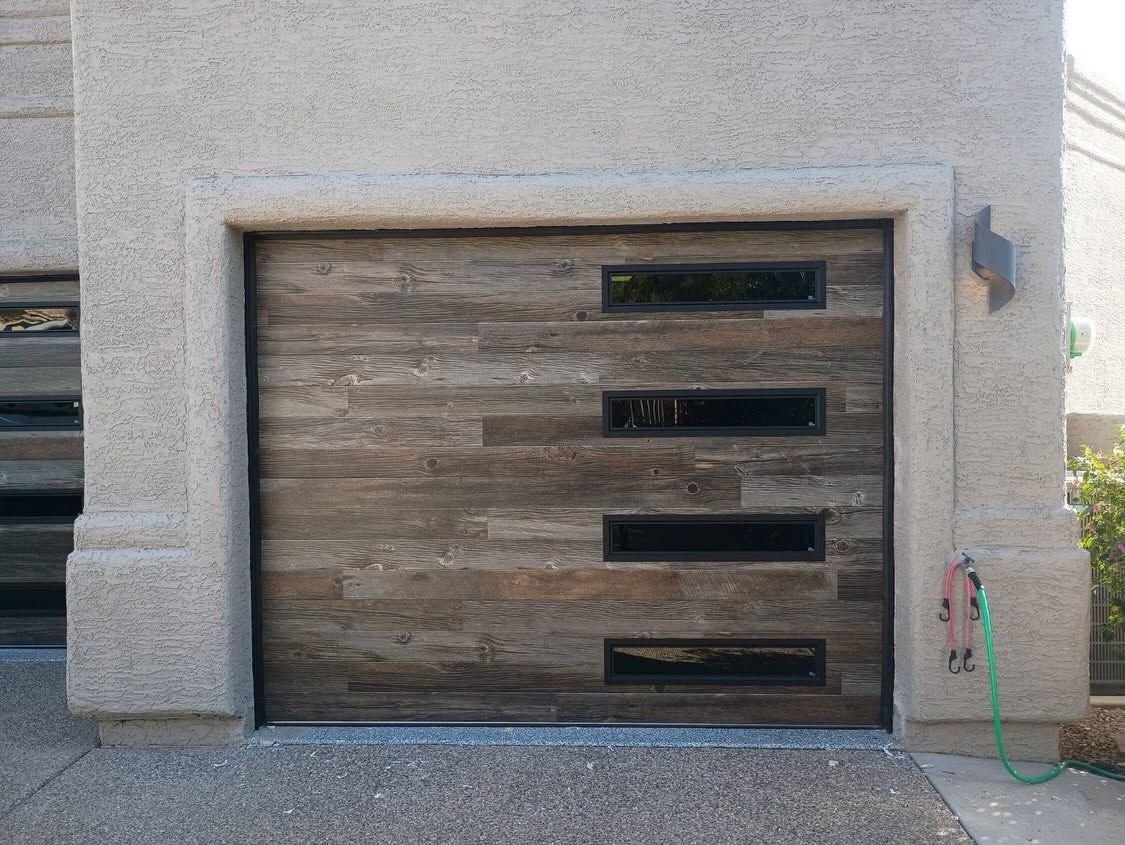
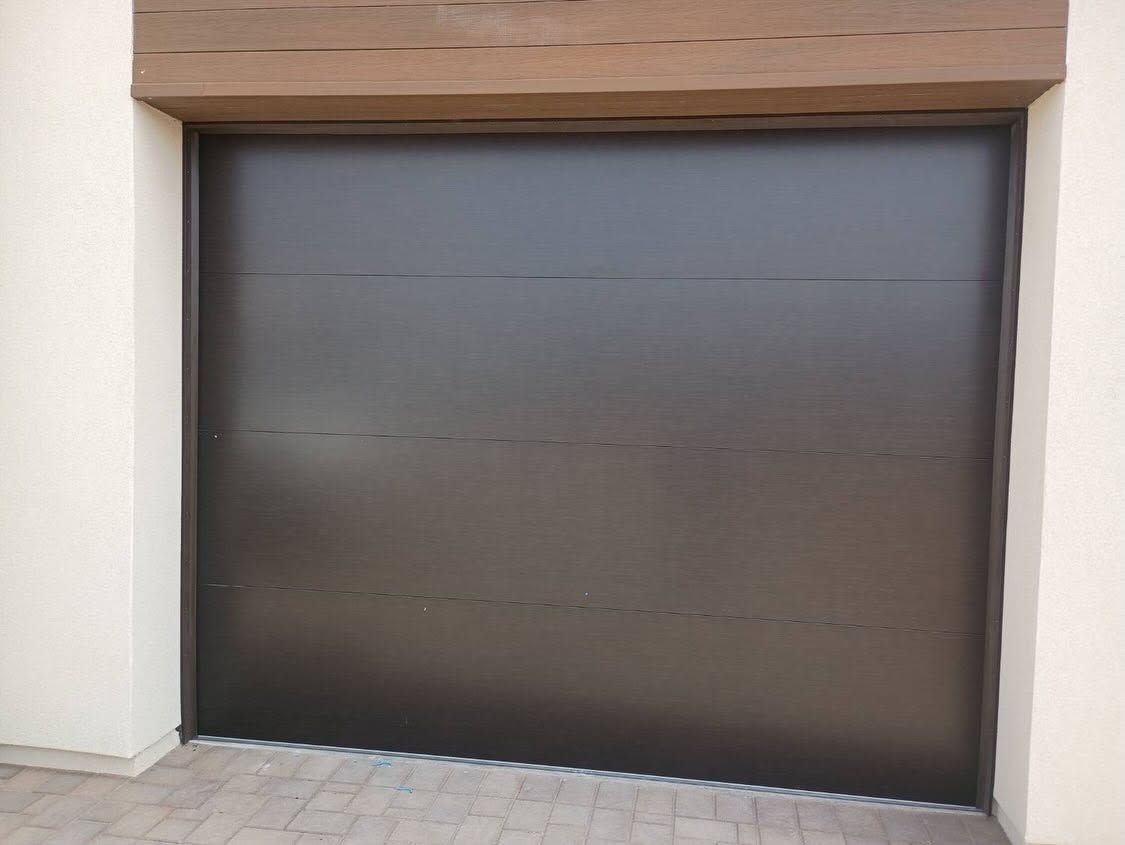
Faux-Wood Doors We Have Installed
What Customers Say
"couldn’t be more happy with the finished product. Joani helped me find the doors that I wanted"
Where We Work
Garage door repair and service across the Phoenix metro:
- Mesa,
- Gilbert,
- Chandler,
- Tempe,
- Scottsdale,
- Phoenix,
- Queen Creek,
- Apache Junction,
- Glendale,
- Peoria,
- Ahwatukee,
- Fountain Hills and
- Paradise Valley.
Look at a sample in this light before you choose a finish.
Printed grain photographs better than it looks, and composite looks better than it photographs, which is the whole reason to stand in front of both. The showroom is in Mesa, open 7:00 a.m. to 3:00 p.m. Monday to Friday.