
Garage Door Balance & Spring Adjustment in Mesa, AZ
Door hanging crooked, feeling heavy or refusing to stay open? We weigh the door, set the springs to it, and tell you straight when adjustment won't be enough.
The service call is $85, covering a 22-point inspection and the first half hour of labor. A person answers after hours, and after-hours and weekend work carries a $250 call fee.
- Women-Owned Family Business
- ROC #310144
- Licensed, Bonded & Insured
- 90-Day Labor Warranty
- Google Rated
A garage door should be almost weightless. The springs carry it, the opener only guides it, and a correctly balanced door will sit still three or four feet up when you lift it by hand.
When that drifts, the door doesn't stop working. It just starts quietly costing you things: the opener carries weight it wasn't built for, the rollers press into the track at an angle, and the remaining spring life is spent faster than it should be.
And there is a safety consequence most people never hear about. An opener works by sensing how much force it takes to move the door, so a door already fighting the motor changes what it reads as normal. Which is why Chamberlain and LiftMaster state in their own support guidance that an unbalanced garage door may not reverse when it's supposed to.
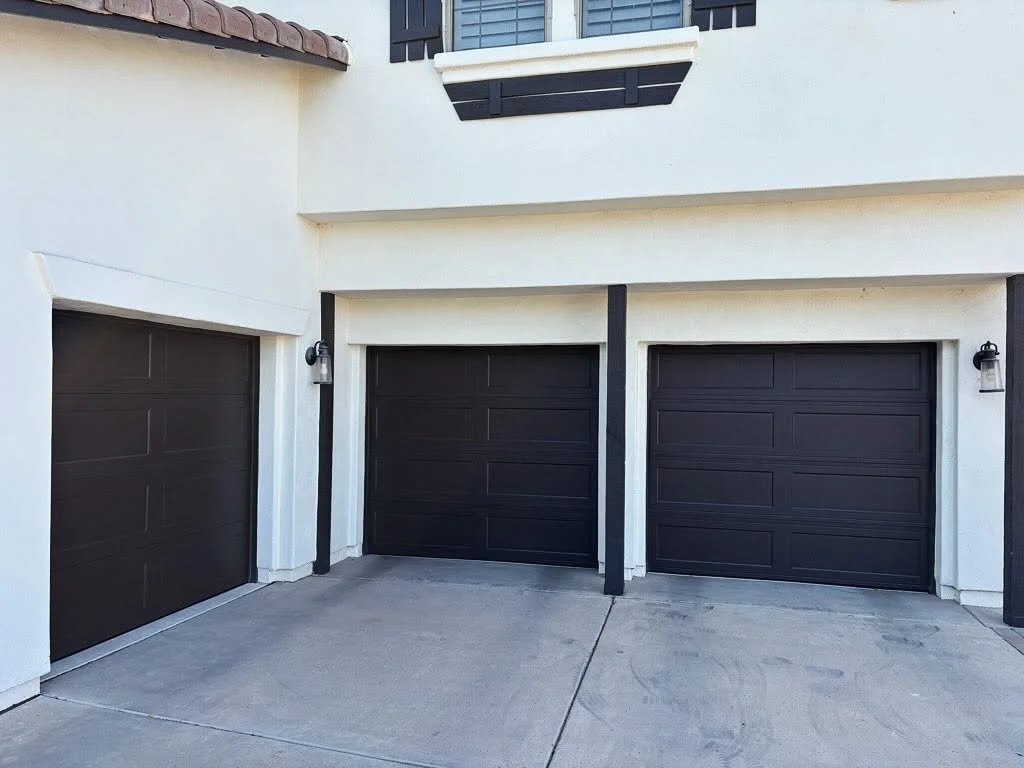 Spring adjustment, Mesa & the Phoenix metro
The Test, and How to Do It Safely
Two minutes, no tools. Not for a door you suspect has a broken spring: a bang, or a clean gap between two coils, ends it before it starts.
1. Close the door fully, then unplug the opener.
2. Pull the emergency release cord, the red handle on the rail.
3. Lift the door by hand to three or four feet off the floor and let go, keeping your feet clear.
That height is DASMA's own criterion, not a rule of thumb.
A balanced door stays where you left it. Chamberlain's instruction is more forgiving than the version most sites publish: a door that rises or falls slowly and gently is acceptable. What isn't, in their words, is a door that slams shut or shoots upward with force.
A door that runs down to the floor is under-tensioned: the springs have fatigued, a spring has broken, or tension has been lost somewhere.
A door that pulls itself up is over-tensioned. Less common, harder on the opener on the way down, and worse for the springs than people realize.
A door that's very heavy to lift usually means a broken spring. Stop, set it down, leave it closed. You can often confirm it without touching anything: a clean gap between two coils is a break.
A door that goes up crooked, or binds, is a different fault: a cable, a drum, a track, or one side losing tension.
Four Faults That Look the Same and Aren't
"My door won't stay open" is one sentence covering four different problems, and searching that phrase mostly returns advice about resetting the opener. Some of that advice is right, for one of the four. Here's how to tell which one you have, because the fix is different every time.
It stops partway under power but holds fine by hand. That points at the opener, or at something the door is catching on: force limits, travel limits, a photo eye out of alignment, a dragging roller, a track out of plumb. This is the one the reset advice is written for. If the door also fails by hand, you're in the next category.
It won't hold partway when you lift it by hand. Now you're looking at the counterbalance, because with the opener disconnected, the springs are the only thing holding the door up. This is the out-of-balance door in the strict sense, and it's what the rest of this page is about.
It drops the last foot and lands hard. Under-tension. The springs aren't holding enough of the weight at the bottom of travel, so the door arrives rather than settles, and it does that on every close. There's a second consequence worth knowing: an under-wound door taken all the way up will often throw its cables off the drums, leaving you with a door off its track on top of a balance problem.
It creeps upward on its own, or won't stay closed. Over-tension. Less common, and the one people blame on a possessed opener. It's harder on the springs than it looks, and it makes the door fight the motor every time it closes.
The two-minute test above is what separates them, which is why it's worth doing before anyone quotes you anything.
What Puts a Door Out of Balance
Ordinary spring fatigue. Springs lose torque as they age, gradually, which is why nobody notices until the door is well out of true.
A broken spring on a two-spring door. The survivor is doing all the work alone, and the door lifts crooked as well as heavy.
One cable or drum losing tension. A cable that has unwound a wrap, skipped a groove on the drum, or stretched more than its partner leaves one side lower than the other. That presents as a crooked door, and the fix is a repair.
Weight added to the door. This one trips people up constantly. Anything bolted or glued to a garage door changes the weight the springs were calculated for: a retrofit insulation kit, decorative hardware, a replacement section of different construction, or a repaint. Paint has weight, and enough coats will take a door out of spec.
Springs wound wrong. DASMA names a failure mode of its own here. A torsion spring with too little stretch sits with its coils scraping against each other every time the door moves, while too much stretch lets the spring snake along the shaft and rub anyway. Either can arise from the original winding or develop later from side-to-side shaft movement. It's a counterbalance fault that usually announces itself as a noise, which is why our noisy door page and this one keep pointing at each other.
A section replaced with one of different construction. Sections differ by insulation and glazing, so a swap changes the door's mass.
Temperature, briefly. Springs are marginally stiffer cold and softer hot, so a borderline door can read differently on a January morning than on a July afternoon. It's real, it's small, and it doesn't fix itself. A door that misbehaves only in one season is already sitting on the edge.
Adjustment or Replacement?
Adding a turn is cheap today, but on a tired spring it can cost you the spring sooner. Here's how we decide.
Adjustment is the right answer when the springs still have life in them, the door has drifted, a recent change to the door's weight needs compensating for, or the two sides have gone out of step.
Adjustment is the wrong answer when the spring is at the end of its cycle life, and here's why that matters. Adding tension costs cycle life, and it costs a lot of it. A long-standing technical reference in this trade puts the reduction at up to 45% from a single additional turn, and around 25% from as little as half a turn. So over-tensioning a tired spring to buy a few more months of decent balance can consume a large fraction of what that spring had left.
Which means the real question isn't "can this be adjusted?" Almost anything can be adjusted. The question is whether adjusting it buys you a year or borrows three months from the rest of the spring's life. A technician who measures the door and reads the spring can tell you which. One who reaches for the winding bars without measuring cannot.
Why This Isn't a DIY Job
Not because the steps are complicated. Because of what's stored in the spring.
A wound torsion spring holds enough stored energy to cause serious injury, and the tools for it are winding bars, not screwdrivers. The two failures we hear about most both come from the same place: something used as a winding bar that wasn't one, and a bar released before the tension was.
On the number of turns, you'll find sites confidently stating a figure for a seven-foot door. DASMA, the door industry's own standards body, declines to publish one. It says the number of turns should always follow the garage door manufacturer's installation instructions. It warns in both directions: too much torque puts excessive force on the rest of the counterbalance and endangers the person applying it, while too little leaves a door that drifts down from its open position over time.
That refusal is itself the useful information. The turn count follows from the specific door, its weight, and its drum size. A number from the internet is a number for somebody else's door.
What the internet number actually is. The figure you'll find repeated is a quarter turn for every three inches of door height, which works out to roughly seven and a half turns on a standard seven-foot door with four-inch drums. That comes from trade sources rather than from a standard, and it assumes a great deal: standard lift, standard drums, a door of ordinary weight. High-lift hardware or non-standard drums change it completely. It's a starting estimate for a technician who intends to verify it against the door in front of him, not an instruction for a Saturday.
How the door's weight actually gets established. With a scale, and with the counterbalance disabled first. DASMA describes exactly that method for checking whether accumulated coats of paint have pushed a door past what its springs were specified for. Garage doors weigh anywhere from 90 pounds to more than 500, so "it feels about right" is not a measurement and shouldn't be treated as one.
Extension springs are a different job. Doors with springs running along the horizontal tracks have no winding cones at all, so there's nothing to wind. Balance on those is set by where the spring anchors and by the pulleys and cables: same principles, different hardware, and the same reasons not to do it yourself.
What a homeowner can safely do: run the balance test above, tighten loose hardware, keep the tracks clean, and lubricate correctly. What nobody should do: touch the winding cones, the bottom brackets, or the cables.
What an Unbalanced Door Costs You
The opener. It was sized to guide a near-weightless door. Carrying real weight strips gear sets, burns out motors, and shortens the machine's life.
The springs themselves. An unbalanced door loads unevenly, and DASMA's own wording is that a door that isn't running smoothly causes premature wear on other important door components.
Rollers and track. A door hanging crooked presses its rollers into one side of the track and wears both.
The safety reverse. Because an opener senses force rather than seeing an obstruction, a door that's already resisting changes the baseline. The manufacturer's own warning is that an unbalanced door may not reverse when required, turning a comfort problem into a safety issue.
And the cables. A door that lands unevenly loads its two cables differently on every close, and uneven cable loading is one of the things our cable page covers in detail.
What Affects the Price
Adjustment alone, which is the smallest version of this visit.
Whether both springs need it or one side has gone out of step.
Whether the springs are actually done, in which case you're pricing replacement instead.
Cables and drums if one side has lost tension.
Track or roller work if the door has been running crooked long enough to wear things.
Whether something was added to the door that the counterbalance now has to match.
A scheduled visit, or an after-hours or weekend call-out at $250 instead of $85.
How the Visit Goes
- 1.
You call, and we schedule it.
After hours, a person answers the phone.
- 2.
Text reminder before the appointment, and an ETA text on the day.
- 3.
The technician runs the balance test with the opener disconnected and watches how the door behaves through full travel.
- 4.
He weighs the door if it's in question, which is the only way to know what the counterbalance should be.
- 5.
He checks both sides.
Cables, how they wrap on the drums, bearings, and whether the two springs are doing equal work.
- 6.
He reads the springs.
Wire size, length, cycle rating (where known), and how much life is genuinely left.
- 7.
You get an estimate, and if the honest answer is replacement, it says so.
- 8.
You decide.
Nothing happens until you've approved it.
- 9.
Tension is adjusted to the door's actual weight in controlled increments with winding bars.
- 10.
He re-tests by hand, then under the opener, and checks the safety reverse.
- 11.
You pay by card, check, cash, Zelle, or Venmo. Financing is available through Wisetack.
Why Bring Us Out
We measure before we wind. The turn count follows from the door's weight and its drums, not from a figure that suits seven-foot doors in general.
We'll say when adjustment is borrowing against the spring. The cycle-life cost of extra tension is real, and it's on this page so you can weigh it yourself.
We check both sides. A crooked door is frequently a cable or drum problem that looks like a balance problem, and adjusting tension won't fix it.
We check the safety reverse afterward. Every time, because that's the system an unbalanced door affects most.
Any brand, any age, including extension-spring systems, one-piece tilt-up doors, Wayne Dalton TorqueMaster, and doors we didn't install. No minimum job or invoice.
If we get it wrong, we make it right. Ninety days on our labor, and every manufacturer's parts warranty is honored.
Catching It Early
Do the balance test once a year. It takes two minutes, and it's the most useful thing a homeowner can do for a garage door.
Do the safety reverse test at the same time. Lay a two-by-four flat on the floor in the door's path and close it. The door should touch the wood and reverse to fully open. If it doesn't, the force setting needs attention and the door isn't currently safe. Then test the photo eyes separately by waving something through the beam as the door closes. They're two different safety systems and a door can pass one and fail the other.
Watch the door land. It should meet the floor across its full width at once. One corner touching first means a cable or drum, not the springs.
Tell us if you add weight to the door. A retrofit insulation kit, new hardware, a repaint, a replaced section. Any of those changes what the springs were set for, and a balance check afterward is a small job that prevents a large one.
And if the opener sounds like it's straining, believe it. That's the machine telling you it's carrying something it shouldn't be.
What Mesa Customers Say
"Quality Overhead Doors supplied and installed the two doors on our three car garage. The quality of the supplied products was tops and the technicians are the best. After we moved in and settled QOD sent a technician out to adjust and fine tune the operation of the two doors. Service at its best. Thank you!"
Frequently Asked Questions
How do I know if my garage door is out of balance?
Do the test in the section above. Close the door, unplug the opener, pull the release, lift by hand to three or four feet, and let go. It should hold. Chamberlain's own guidance allows for a slow, gentle drift either way; what fails the test is a door that slams shut or shoots up with force, or one that has to be fought to lift at all.
My door won't stay open halfway. Is that dangerous?
It means the springs aren't holding the door's weight anymore, so the opener is. It isn't an emergency the way a broken spring is, but it's wearing the opener every cycle, and it undermines the safety reverse. Get it looked at.
Can the springs just be tightened?
Sometimes, and that's a real answer. What matters is whether the spring has life left. Adding tension costs cycle life, as much as 45% from one extra turn by the published trade figures, so tightening a tired spring can spend most of what's left in it. The technician should tell you which situation you're in.
How many turns should my springs have?
There's no universal number, and anyone who gives you one without knowing your door is guessing. DASMA's position is that the turn count follows the door manufacturer's installation instructions, because it depends on the door's weight, height, and drum size.
Can I adjust the tension myself?
Please don't. A wound torsion spring holds enough stored energy to cause serious injury, and it needs proper winding bars used in a specific sequence. Lubrication, tightening loose hardware, and the balance test are the homeowner jobs here.
My door goes up crooked. Is that a spring problem?
Often it isn't. A crooked door is frequently one cable or drum losing tension, and adjusting spring tension won't fix it. Both get checked.
Why is my door heavier in summer?
Springs are marginally softer when hot and stiffer when cold, so a door sitting close to the edge of balance will read differently across the year. It's a small effect. What it tells you is that the door is already borderline.
I added an insulation kit and now the door struggles. Why?
Because you changed the weight and the springs were set for the old one. How much a kit adds depends entirely on the product, and the published figures range from a few pounds to several dozen with no agreement between them. Which is exactly why the door gets balance-tested afterward. Our insulation page covers this in full.
Does an unbalanced door really affect safety?
Yes, and it is the consequence worth knowing. Openers detect obstructions by force, so a door that's already resisting changes what the machine reads as normal. Chamberlain and LiftMaster's own guidance warns that an unbalanced door may not reverse when required.
My door slams down the last foot. What is that?
Under-tension, almost always. Chamberlain treats a door that slams shut as a failed balance test, and it's worth acting on.
My door creeps up on its own. Is that even a thing?
Yes, and it's over-tension, though the opener is where most people look first. It's less common than the drifting-down version, and it makes the door work against the motor every time it closes.
Do you adjust extension springs as well as torsion?
Yes. Extension systems have no winding cones, so the adjustment is a different procedure involving where the spring anchors and how the pulleys and cables are set. We work on both, and on Wayne Dalton TorqueMaster systems.
What's the difference between balance and alignment?
Balance is whether the springs are carrying the door's weight correctly. Alignment is whether the door is running square in its tracks. They get confused constantly because a door out of alignment feels heavy and a door out of balance runs crooked. Both get checked on the same visit.
How long does an adjustment take?
Usually under an hour on-site. Longer if cables, drums, or bearings turn out to be involved.
How often should I have the balance checked?
Once a year is sensible, and it's part of a tune-up. Our tune-up page sets out the full 22-point inspection it sits inside. Also, any time you've changed something about the door's weight.
Will you tell me if the springs are past adjusting?
That's the point of measuring, and it's why the cycle-life numbers are published on this page. You should be able to check our reasoning.
Where We Work
Balance and adjustment across the Phoenix metro:
- Mesa,
- Gilbert,
- Chandler,
- Tempe,
- Scottsdale,
- Phoenix,
- Queen Creek,
- Apache Junction,
- Glendale,
- Peoria,
- Ahwatukee,
- Fountain Hills and
- Paradise Valley.
Do the two-minute test and tell us what the door did.
Stayed put, drifted down, pulled up, or went up crooked. Each of those points at something different, and knowing which one you have is most of the diagnosis.