

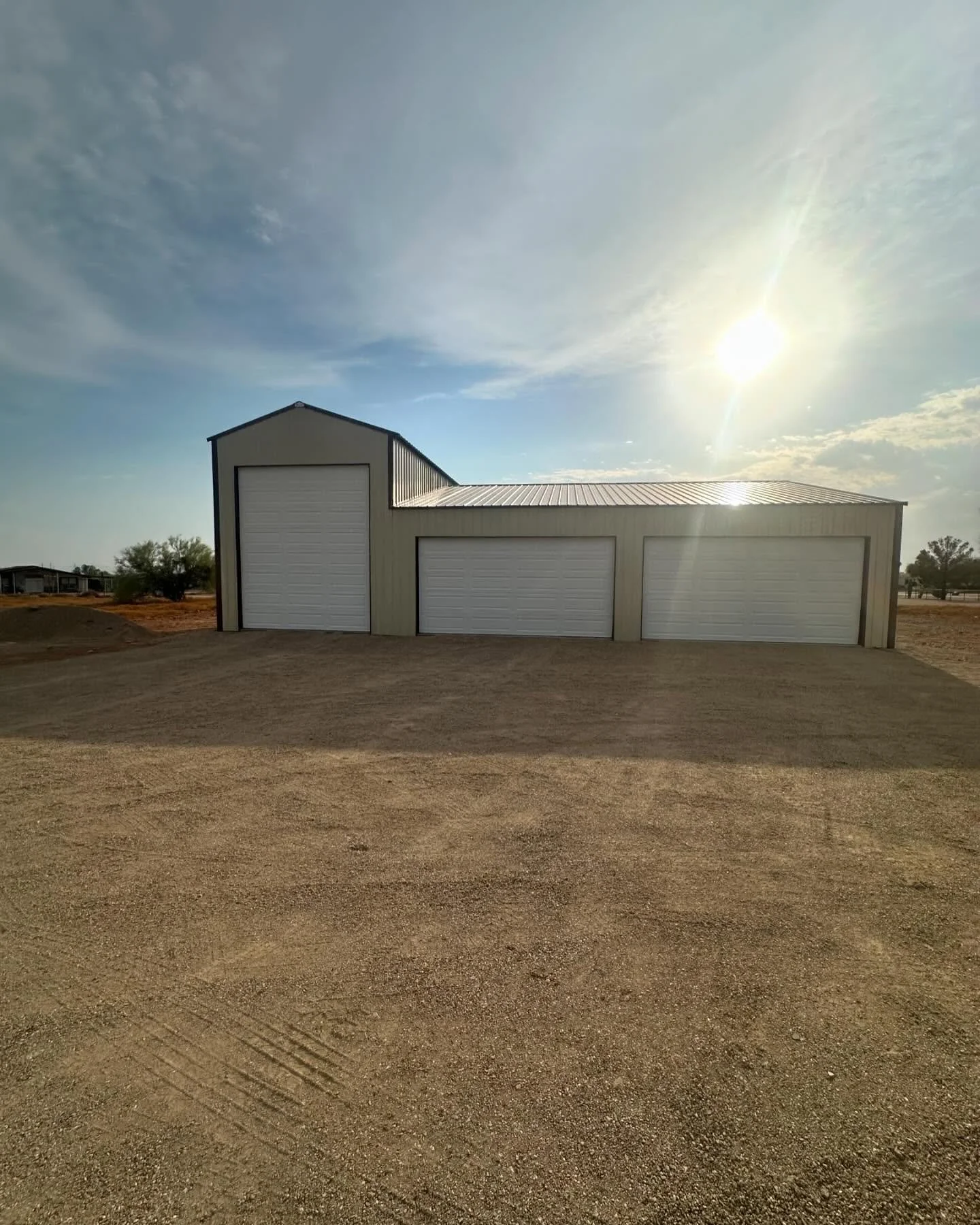
Self-Storage Door Repair and Replacement in Mesa, AZ
Bent bottom bars, curtains out of the guides, springs and latches repaired one unit at a time, on any brand, across Mesa and the Phoenix metro. Women-owned, family-run, ROC #310144.
The service call is $85, covering a 22-point inspection and the first half hour of labor. A person answers after hours, and after-hours and weekend work carries a $250 call fee.
- Women-Owned Family Business
- ROC #310144
- Licensed, Bonded & Insured
- 90-Day Labor Warranty
- Google Rated
A storage door's curtain is one piece. The corrugated sheets are lock-seamed into a single curtain, which is why a dented storage door is a different conversation from a dented rolling steel door, where individual slats pull out and are replaced.
That fact decides most of what follows: what can be repaired, what has to be replaced, and why the honest answer to "can you just fix that panel" is usually no.
It Is Not a Small Garage Door
A storage unit door is built differently from a garage door: no panels, no lift cables, no rollers in a track. Here is how the three door types compare.
| Part | Self-storage roll-up | Commercial rolling steel | Residential sectional |
|---|---|---|---|
| Curtain | One lock-seamed 26-gauge sheet | Individual interlocking slats | Four or five hinged sections |
| Counterbalance | Torsion springs inside a barrel, dead axle, no lift cables | Springs inside a heavier barrel | Torsion spring, cables and drums |
| Retained by | Curtain edges riding in guides | Slat ends in guides, windlocks | Rollers in track |
| Latch | Slide latch bolted to the curtain | Slide locks or step plates | Lock on the center stile, or the opener |
| One damaged element | Cannot be isolated | Slat replaces individually | Section replaces individually |
And here is the non-obvious part. A commercial sheet door often uses the same 26-gauge curtain as a storage door, and it is a single seamed piece, too. What separates them are the guides, the barrel, and the brackets: 2-inch guides in 18-gauge, up to 4 inches deep, against 12-gauge. A commercial rolling steel door is different again, with individual slats in 22- to 18-gauge, which is the one where a single slat can be replaced.
The Fact That Decides Repair or Replace
Janus, the category's largest manufacturer, defines the curtain in its own maintenance manual as an assembly of curtain panels seamed together to form a single-piece curtain, and its Model 650 specification describes continuous corrugated sheets roll-formed from 26-gauge steel and lock-seamed together.
That is the economics of the product. Parts suppliers in this category sell springs, bottom seals and astragals, latches, hasps, cylinder locks and touch-up paint. What they do not sell is an individual sheet, because a sheet is not a part. A curtain is supplied whole, as a curtain-and-barrel assembly.
What that means when a truck backs into a unit:
Damage confined to the bottom bar is often repairable. A published upgrade kit replaces the bottom bar and adds reinforced clips and floor-anchored support angles, the one manufacturer-published partial upgrade to an existing door.
Damage to the curtain itself means a new curtain, which on a storage unit costs close to a new door. We tell you that at the quote, not after.
Damage to guides, latch, springs or head stops is parts work.
A published second opinion. A door manufacturer's product chief, writing in the trade press, put it this way: a failed spring does not mean the door is finished, and the steel curtain rarely fails on its own because curtains hold up for decades. He names three things that warrant replacement: fleet age, a rebrand, and curtain damage beyond reasonable repair.
Whose Door Do You Actually Have?
Facility owners often believe they have doors from four or five manufacturers. Usually they have doors from one, under several names.
Janus International lists BETCO, ASTA America, ACT, Kiwi II and TMC among its own companies. BETCO's footer reads "Janus International Group, LLC d/b/a BETCO", ASTA's product sheets are headed "by Janus International", and Janus acquired DBCI in 2021. Janus and DBCI publish the 650 shop drawing under the same drawing number, so they are the same door.
Trac-Rite is the best known of the manufacturers outside that group, and not the only one: SteelBlue, Amarr, Clopay and Wayne Dalton all publish in this category too.
 Self-storage doors in Mesa, AZ
And there is one real engineering split, which changes what a technician finds on a service call. Janus-family doors use a dead axle. In Janus's own words, a live axle rotates as the door moves while a dead axle remains static, and Janus supplies a dead axle because it eliminates pushing or shifting and allows a straighter travel path in the guides. Trac-Rite publishes a live axle: the axle rotates in a bracket bearing during operation.
Why you care. The two wear and are serviced differently, and a technician who assumes one on a facility running the other is working blind. It also settles the parts question.
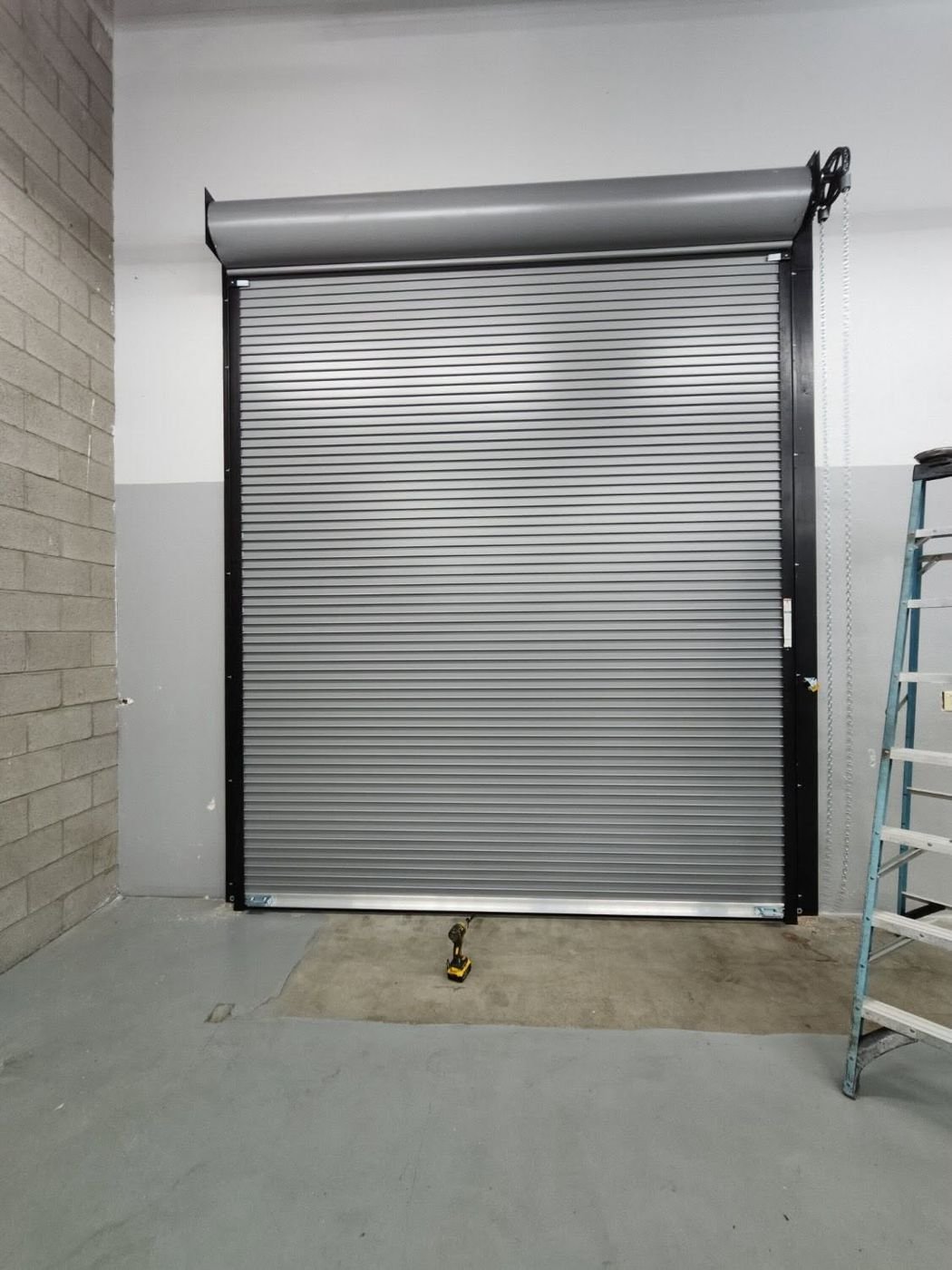 Self-storage doors in Mesa, AZ
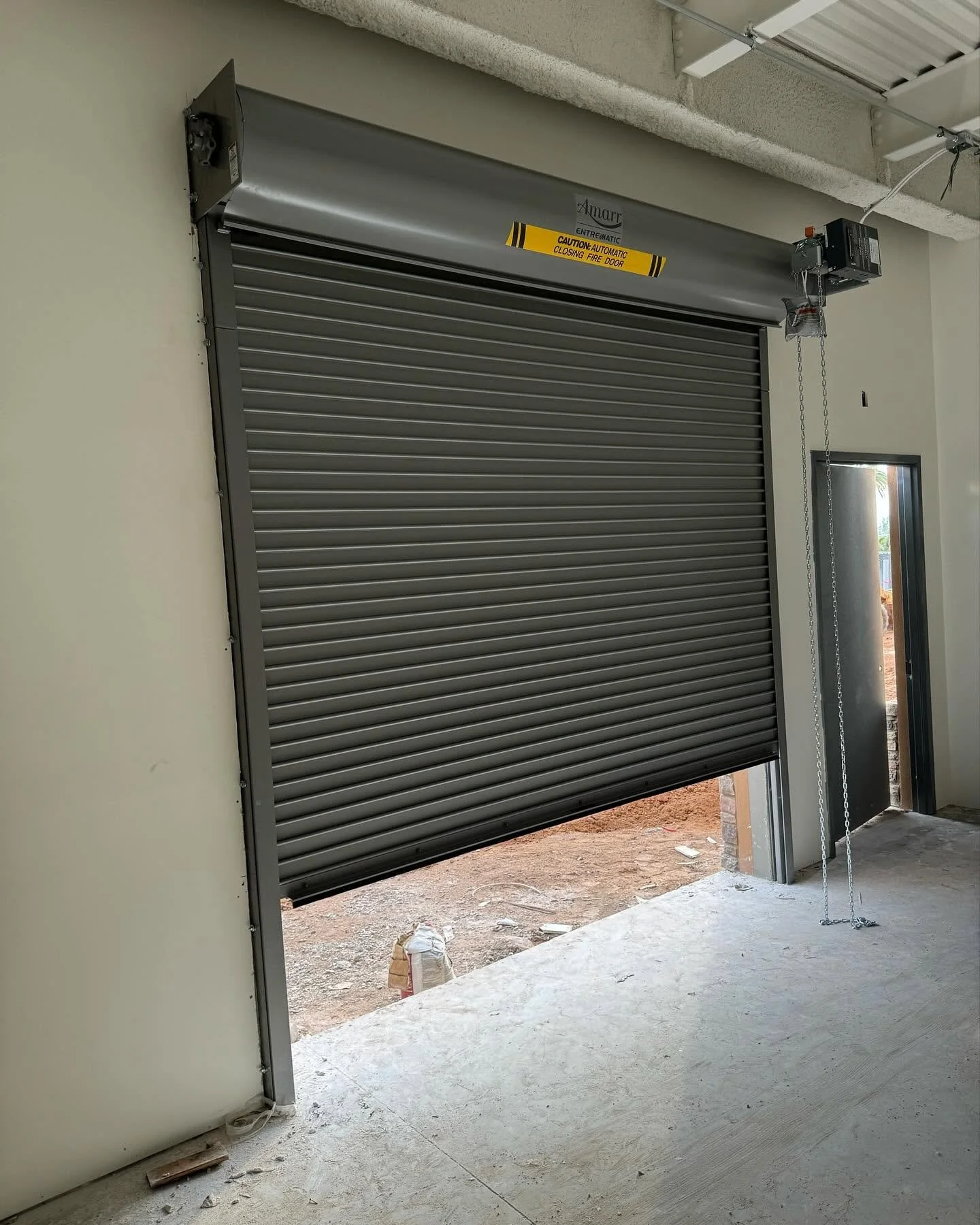
We install and service all of them. We are a dealer for LiftMaster and Amarr, and Amarr's rolling sheet range includes a self-storage model, so on that one we quote as a dealer. On the rest, we are a service company.
What Goes Wrong, in the Order Facilities See It
| What happened | What it usually is | Repair or replace |
|---|---|---|
| A tenant or a truck hit the bottom of the door | Bent bottom bar, sometimes with the angle deformed into the guides | Repair, often with a reinforced bottom bar |
| Curtain has come out of a guide | Impact, a bent guide, or a failed head stop or clip | Repair, then find the cause |
| Curtain is creased, punched or torn | Impact | Replace. The curtain is one piece |
| Door will not stay up | Counterbalance losing tension, or head stops | Repair |
| Door drifts down on its own | Spring tension | Repair |
| Door is hard to lift, easy to lower | Tension too low | Repair |
| Door is hard to lower, easy to lift | Tension too high | Repair |
| Latch will not engage, or has been forced | Latch or hasp damage | Repair. Bolt-on, so a part you can have on site before we come |
| Guides bent, crushed, or pulling off the jamb | Impact, or fasteners never fully installed | Repair or guide replacement |
Two of those are the manufacturer's own diagnostic language: easy to close and hard to open means tension needs increasing, and the reverse means it needs decreasing.
And one rule that is not negotiable. The same manual states that a determination of counterbalance repair must result in the door being taken out of service until repairs are complete. A door with a failing spring is not one to leave rented.
Where We Fit on Your Site, Stated Plainly
"Self-storage doors" covers several different businesses, and we are only one of them.
What we do is the door, one at a time. Repair and door-by-door replacement, a unit or a run of them, any brand and any age. The counterbalance, the bottom bar, the guides, the head stops, the latch, the curtain.
We do not hold your parts catalog. Bottom bars, guides, latches, head stops and springs come through your supplier or the manufacturer, who know which revision your doors are and stock to it. Tell us what is arriving and when, and we will be there to fit it.
We do not survey your site, and we would rather say so than turn up with a clipboard and a quote for everything. And full-facility replacement is the manufacturer's own program, run through its network of contracted installers.
What Your Site Staff Can Check
None of this involves touching the counterbalance, and all of it comes from the manufacturer's published maintenance guidance.
Operating force. Manual operation should not exceed about 30 pounds, or 35 where a hand chain is installed. If your manager is putting a shoulder into a door, that is a measurable finding.
Where it should sit when open. Raised fully, the door should bring the bottom bar to rest against the head stops, and the bar should stay there. A door that creeps down is telling you about its tension.
How it should feel through travel. Published guidance is that operation should be easy at and near the open and closed positions and may need more effort through the middle. Normal on a coiling door. Uniformly heavy is not.
The guides. They must not be bent, crushed, or damaged in a way that binds the curtain or bottom bar at any portion of travel, and fasteners must be present and secured in every existing hole. Missing fasteners are common and straightforward to put right.
Head stops. Securely fastened at the top of the guides, they stop the bottom bar from traveling out and the curtain from unrolling into the unit.
And one prohibition. Windlocks should never be removed from a curtain. If a door has had them taken off to cure a binding problem, that is a finding.
Where the checking stops is the spring. These doors do have a counterbalance: oil-tempered helical torsion springs inside a barrel on a dead axle, and anyone who says otherwise has not opened one. The manufacturer warns that extreme spring tension can cause serious injury or death and that all repairs and adjustments must be made by trained rolling door technicians. The safety label adds that the door must be fully opened when adjustments are made, the opposite of the instinct.
Sizes Are Built to the Opening, Not Picked From a List
There is no such thing as a standard self-storage door size. These are made to order. Trac-Rite, the only manufacturer we found that publishes the increment, instructs you to measure the inside jamb-to-jamb width and sill-to-header height and give the size in one-inch increments.
Published ranges start around 2'8" and run to 10 feet on the common Janus models, and to 12 feet by 12 feet on Trac-Rite's light-duty 944.
Your unit label is not your door size. A 10x10 unit does not take a 10-foot door. Janus's own guidance is that doors on a 10-foot-wide unit are commonly 8 feet by 7 feet, and that swing doors are common on units five feet wide and under.
And clearance decides more jobs than width. Published figures for a common light-duty model give vertical headroom of 15½ inches to 7'4" and 17 inches at 10 feet, with 3½ inches of side room. Trac-Rite publishes 18 to 19 inches of back room, plus one more inch of each for an insulated door.
Which is what makes measuring the whole job. A manufacturer states plainly that these are non-returnable, made to the customer's specifications, and cannot be resold once they leave the factory. A mis-measured door is one you pay for in full.
The Federal Rule Aimed Squarely at You
Self-storage facilities have their own section in the 2010 ADA Standards for Accessible Design, and we rarely see it cited. Section 225.3 requires self-service storage facilities to provide individual storage spaces complying with the standard, in accordance with Table 225.3:
| Total spaces in the facility | Minimum required to be accessible |
|---|---|
| 1 to 200 | 5 percent, but no fewer than 1 |
| 201 and over | 10, plus 2 percent of the total over 200 |
And section 225.3.1 adds the part people miss. Accessible spaces must be dispersed throughout the various classes of spaces provided, so you cannot satisfy the requirement by making them all the same size. They are not required to be dispersed among buildings in a multi-building facility.
Be careful how the numbers get used. The standard's operable parts section sets a five-pound limit, and on its face, that governs the latch, handle, or pull. Janus reads it more broadly, stating that the door must be tensioned to a maximum of 5 pounds to fully open and selling its 650 on that basis, while its own manual sets the operating force at around 30 pounds. Two different measurements, so ask which one an ADA claim refers to.
What manufacturers do publish are accessibility kits: a pull between 15 and 48 inches with a loop large enough for a fist, a nylon rope on the bottom bar in the same range, a Braille plaque outside the unit, and full-width ramping on exterior units.
Where we sit, stated plainly. Accessibility kits and the scoping question both belong to other people: the kits to the manufacturer and the installer who fits them, the scoping to your architect. What we do is the door itself. A door that binds, drags, or will not balance fails a five-pound pull test, whatever hardware is bolted to it, and that part is ours.
When a Door Is Worth Replacing
Nobody publishes a service life for these doors. We found warranties and one spring rating: Janus publishes a spring cycle life of 15,000 on its sheet line, which is a spring number. No manufacturer publishes an expected lifespan or a replacement interval, so we judge each door by its condition, not its age.
The two defensible numbers both come from Janus. Its service guidance says that if a door is over ten years old and the springs are breaking, it can be a good idea to replace the entire door. Its 2021 investor deck put roughly 60 percent of self-storage facilities over 20 years old, which is a statement about buildings, but it is also the age at which the category starts treating a site as a renovation candidate.
Our own rule, labeled as ours. One failed spring on a sound door is a repair. Recurring failures over the past ten years, a damaged curtain, or guides re-drilled more than once are the signs that replacing the door beats servicing it. What we will not do is call a door finished because it is old.
Why the Facility Program Is Not Ours
It is a manufacturer-run product, and the numbers say why. Janus's own investor disclosure states that it performs 75 percent or more of installations for self-storage projects through 135 contracted installation companies, at a pace it reports as 63 doors in two days at one facility. Nobody competes with that on scheduling and disposal, and we are not going to pretend to.
Door-by-door service is a different purchase, and most facilities need it far more often, because those failures arrive one at a time and on no schedule.
One thing worth borrowing from a facility owner quoted in a manufacturer case study. His worry before the program started was whether the new doors would integrate with the existing frames. That is a jamb and guide question, answered by measuring, and it is the same question on one door as on six hundred.
Security, and Where We Stop
Latches are the part that gets attacked. Published options range from a standard slide latch that accepts all industry padlocks, including 7/16-inch shanks, through cylinder-lock provisions, to latches with no padlock holes at all. Some resist wrenching and prying.
A detail buried in the specifications. Janus states that its latch slide exhibits magnetic properties that can activate guide-mounted security sensors, and Trac-Rite states that its latch bar is compatible with magnetic security systems. If your door-position alarms have become unreliable, the latch is the suspect before the sensor.
On smart entry, we will be precise. The hardwired interior system requires specific manufacturer door models. The newer external smart lock is marketed as a retrofit for many door types without running low-voltage wiring, but the manufacturer never names any other maker's doors as supported, so we will not promise a fit we cannot see in writing. The system itself is not our trade. What we do is make the door underneath sound: a straight bottom bar, undamaged guides, correct tension, and an intact latch. A smart lock on a door that binds is a smart lock that gets blamed.
Sun, Dust and Your Paint Warranty
Manufacturers do write about weather in general terms. Janus says prolonged exposure to sun, wind and extreme temperatures takes a toll, and recommends wiping dust off guides and curtains between tenants. What nobody publishes is a desert-specific figure: no heat derate, no hot-climate interval, no reduced service life. The only environmental exclusions in the paint warranties are coastal. So we will not put a number on the desert. What we can give you is documented.
The paint warranty is worth reading before you pick a color. The current published schedule runs forty years on film integrity and thirty-five years each on chalk and color change, across the standard range. Colors are priced in tiers on these charts, and the tiers are not warranty terms. If a supplier tells you a color carries a shorter term, ask to see which schedule that came from.
Fade is measured as more than 5.0 Hunter Delta-E units on vertically installed panels, with chalk assessed per an ASTM method.
What to do with that in Mesa. Pick the color you want, get the paint schedule that applies to the doors actually being quoted, and keep it with the job file. It is the document a fade claim is settled against years later.
What Happens on the Visit
- 1.
We identify the door, manufacturer and model where the label survives, dead axle or live axle where it does not.
- 2.
We work the door by hand and check it against the published force figures.
- 3.
We look at the guides full height, the head stops, the clips and every fastener hole.
- 4.
We assess the curtain honestly,
Because that is the line between a parts job and a door.
- 5.
We measure the opening, plus headroom, side room and back room, because the door is built to those numbers.
- 6.
We tell you what is repairable and what is not,
unit by unit, as a list you can budget from.
- 7.
We take the door out of service if the counterbalance is the finding, because the manufacturer's instruction says to.
Why Bring Us Out
We use the words the manufacturer uses. Curtain, guides, bottom bar, barrel, head stops, astragal. Not tracks, cables, and panels, which describe a different product.
We tell you when it is a spring and not a door. A ten-year-old door with a broken spring and a sound curtain is a spring.
We measure before we order, because a mis-measure on a non-returnable door is the full cost.
If we get it wrong, we make it right. Ninety days on our labor, manufacturer parts warranties honored. Family-owned, women-owned, ROC #310144, licensed, bonded, and insured.
Self-Storage Doors We Have Installed
What Mesa Customers Say
Frequently Asked Questions
Can you replace just the damaged part of the curtain?
No. The curtain is corrugated sheets lock-seamed into a single piece, so an individual sheet is not a part. Damage to the bottom bar, guides, latch, or springs is a different and much smaller conversation.
How long should a storage door last?
No manufacturer publishes a door service life or a replacement interval, so treat any page quoting one with suspicion. Janus rates the springs on its sheet doors at 15,000 cycles, which is a spring number, and treats spring breaks on a door over ten years old as a reason to consider replacing it.
What size door does a 10x10 unit take?
Not a 10-foot door. The manufacturer's guidance is that a 10-foot-wide unit typically requires an 8-by-7 door. Doors are built to the framed opening in one-inch increments, which is why every quote starts with a measurement.
How many of my units have to be accessible?
The 2010 ADA Standards, section 225.3, require 5 percent, but no fewer than 1, for facilities with up to 200 spaces, and 10 spaces plus 2 percent of the total over 200 for larger facilities. They must also be dispersed across the classes of space you offer, so they cannot all be your smallest unit. Scoping is a question for your architect, and accessibility kits are provided by the manufacturer. What we can tell you is whether the door itself opens the way the standard assumes it does.
Do you do whole-facility door replacements, or supply the parts?
Neither. Facility programs are the manufacturer's, and parts come through your supplier. Door by door, with parts you have on site, is what we do, and we do it constantly. The whole boundary is set out above.
Where We Work
Self-storage door repair and replacement across the Valley:
- Mesa,
- Gilbert,
- Chandler,
- Tempe,
- Scottsdale,
- Phoenix,
- Queen Creek,
- Apache Junction,
- Glendale,
- Peoria,
- Ahwatukee,
- Fountain Hills and
- Paradise Valley.
Send us a photo of one door and the unit count.
The photo tells us the manufacturer, the guide depth, and whether the bottom bar has been hit. The unit count tells us whether this is one door or a budget. Send those, and we will come back door by door rather than with one number for the whole facility.