Jackshaft Garage Door Opener Conversion in Fountain Hills, AZ
Free up your ceiling with a wall-mounted jackshaft opener, or add high lift for a car lift or taller storage. We measure your Fountain Hills garage against the manufacturer's requirements before we quote.
Not sure which you need? See our high-lift and jackshaft conversion page.
A phone quote is free. A visit to measure the opening and provide a quote is $35. On a failed door, the service call is $85, covering the 22-point inspection and the first half hour of labor, and $250 after hours and on weekends.
- ROC #310144
- Licensed, Bonded & Insured
- Women-Owned Family Business
- 90-Day Labor Warranty
- Google Rated
Garage doors have been this family's trade in this valley since 1997, without a break, and we are still family-owned and operated. We do this conversion anywhere in the Phoenix metro where we take service calls.
A jackshaft opener moves the motor off the ceiling and onto the wall, freeing the space above the door for storage, lighting or a car lift. High lift sends the door up the wall before it turns, so you get more clear height. Whether your garage can take either comes down to a handful of measurements, listed below.
The Eight Figures a Manufacturer Already Printed
LiftMaster publishes installation requirements for its residential jackshaft units, and that is the line we fit. Eight of them decide this job, in print before anybody looked at your garage.
Half the list is about the bar above the door. The unit turns that bar, so the list opens with a torsion system: with no bar there is nothing to drive. The bar has to be one inch. The gap between the side wall and the bar's end has to be at least 8.5 inches, and that gap is where the unit sits. The bar also has to reach at least an inch and a half beyond the bearing plate.
The rest is about the door, the track, and the drum. No more than 54 inches of high lift. A door no taller than 14 feet, no wider than 18 feet and no more than 180 square feet, all three at once. A track radius of 15 inches, with 12 inches the published minimum. And the drum sets a weight ceiling: a 3- to 3.9-inch drum carries a door up to 430 pounds, and a 4- to 6-inch drum up to 850 pounds.
Those eight are one maker's residential line; another maker's unit carries its own numbers.
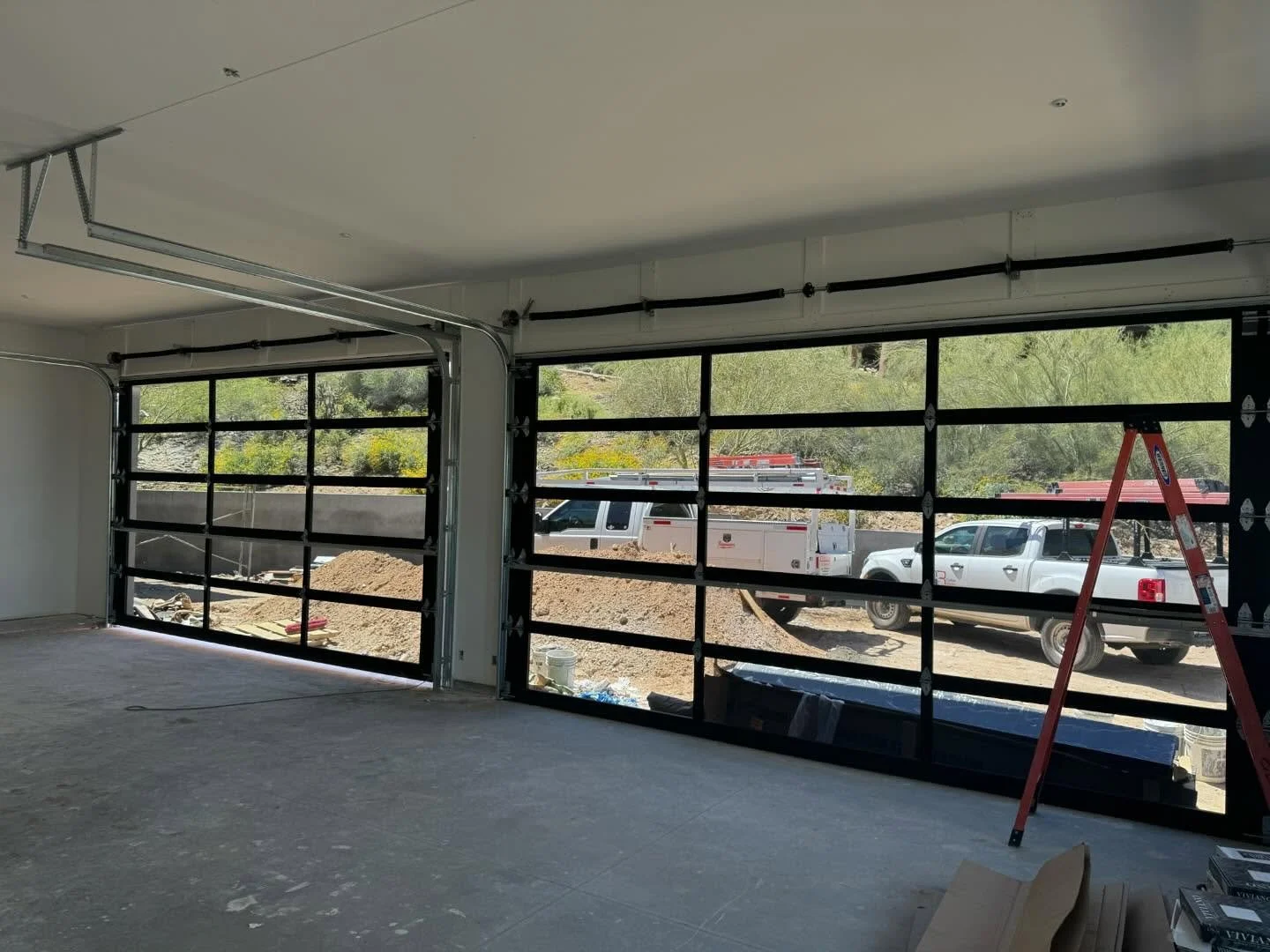
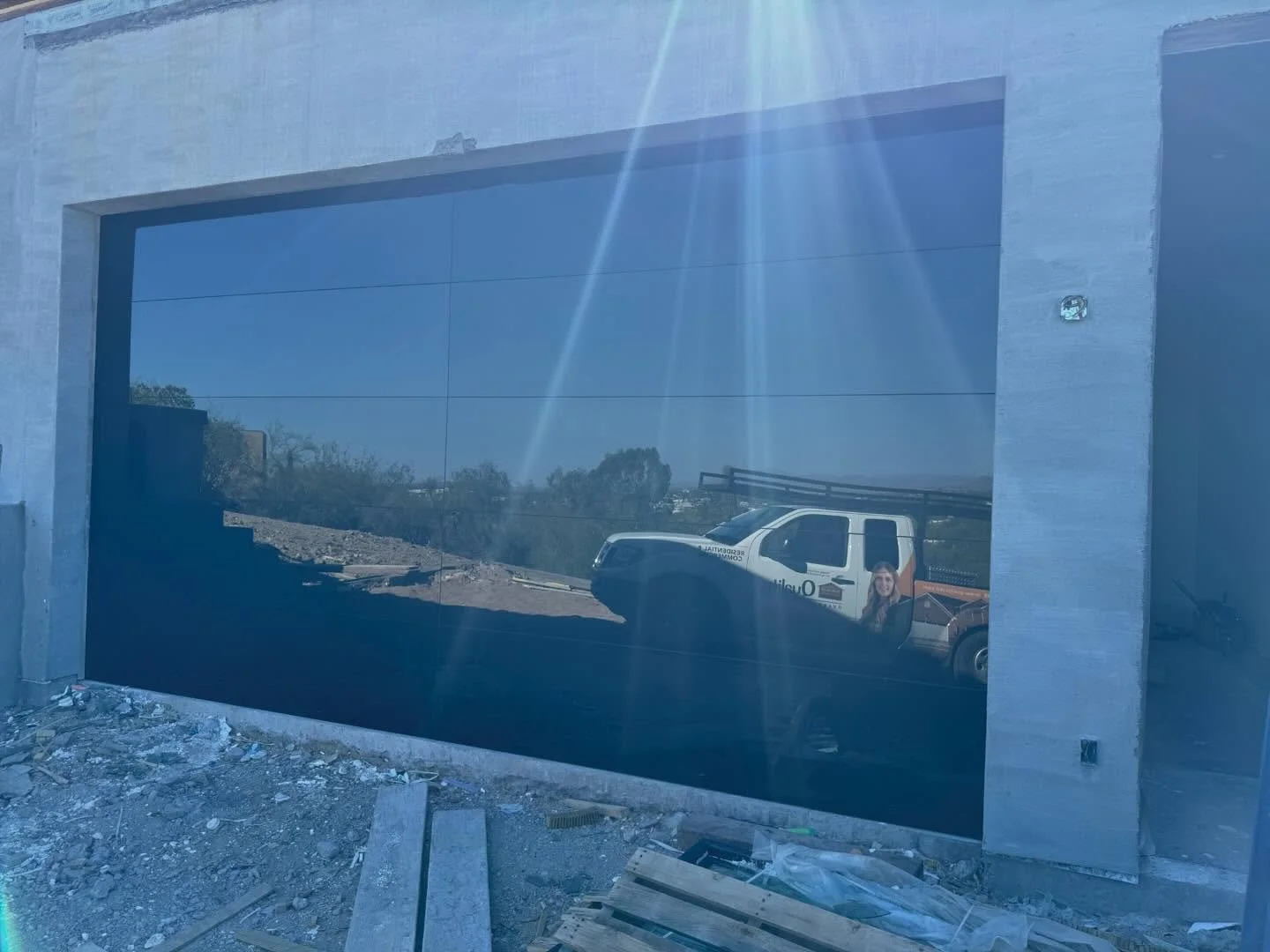 Jackshaft opener in Fountain Hills, AZ
The Six Figures That Exist Only in Your Garage
The other six are published nowhere, because they exist in one building, and a technician takes five at the opening.
Two are vertical. Headroom, measured from the head of the opening up to whatever hangs lowest over it: a ceiling, a truss, a duct, a sprinkler line or a light. And the lift the door has to gain, which is determined by the height of what you are putting under it.
Two are horizontal. Side room on each side of the opening, since the unit has to occupy one of them. And backroom, the depth the horizontal track needs behind the opening once it is higher.
Two are not read off a tape. The door's real weight, which picks the drum and meets the weight ceiling above. And what the roof above the opening is actually built of, which is a framing question.
What This Job Does Not Include
A conversion reaches the hardware above the opening and the machine that drives it. Six things sharing that garage have another owner.
The structure above the opening. We take on no structural work, so framing that would carry new track belongs to a trade that does.
Power at the surface the unit mounts to. A circuit or an outlet to run the opener from is an electrician's work, and that happens first.
Stucco, drywall, framing, and the jamb itself. A builder owns all four, and owns whatever is left of an opening a vehicle has been into. Garage screens and retrofitted windows belong there too.
Keys and locks. Nobody here cuts a key, changes a barrel, or rekeys a door. A locksmith has that trade start to finish.
A motor built before the photo-eye rule. Secondary entrapment protection has been required on residential garage door operators manufactured on or after January 1, 1993. The motor on an opener with no photo eyes is one we leave alone. The door we still service, and we will quote a replacement head.
Two kinds of work the job never reaches. Mobile and manufactured homes. And home warranty dispatch, on hold at present.
Where a Printed Figure Meets a Measured One
Three of the published eight have a measured figure opposite them, and the job is settled where each pair meets. The job installs a fourth outright.
54 inches against the lift you need. That is the published ceiling on high lift under one of these units, so where you need more travel than that, the lift and the wall unit cannot both happen.
430 or 850 pounds against the door's weight. The drum sets the figure, and the door has to come in under it; because no garage has a record of that, a technician establishes it on site.
8.5 inches against the side room there is. The unit needs that gap, and whatever stands in that gap counts against it.
A 15-inch radius, with 12 inches the minimum. That figure comes with the new track, so where the curve above your door is tighter than the unit allows, the track is part of the work.
The Day, and the Last Two Things the Technician Does on It
1. The counterbalance comes off first, and so does the track where the lift is changing.
New track, new drums, new cables, and a new spring set go up, each specified for that door, and the door's own sections stay where they are.
2. The unit goes on the wall, and its two settings are set to the geometry the door now has. Travel limits set the positions where the door stops, and the force setting limits the effort it may use before it reverses.
3. With the opener disconnected, the technician lifts the door by hand. That reading tells him whether the new spring set matches the door, and he takes it on every visit. DASMA, the trade's own standards body, publishes that nobody untrained should be removing, repairing or adjusting springs or the parts they are anchored to, and that a door with a broken spring should not be operated until the spring is replaced. On this job, all of those parts change at once.
4. He tests the automatic reverse last, on any door that has an opener over it, and checks the photo eyes while he is there. It is one of the twenty-two inspection items.
What Fountain Hills Asks About, and What the Figures Ignore
This town has paperwork about ground. Fountain Hills' Zoning Ordinance includes a section on Land Disturbance Standards, and where it applies, the application requires a survey by a registered land surveyor or civil engineer, topographic contours, and cross-sections perpendicular to the slope. The same section routes a plan of development or a grading plan to the Town Engineering Department and to the Community Development Department before Fountain Hills issues a zoning clearance.
What a conversion changes, and where it stops. This job changes track, drums, cables, a spring set, and which surface the opener sits on, and it leaves the opening and the grade where they are. Whether paperwork attaches to a job is the town's to answer.
The printed eight do not move with the ground. A one-inch bar is a one-inch bar and 180 square feet is 180 square feet, in a Fountain Hills garage cut into a slope as on a flat lot. The figures the ground changes sit above the opening, which is why the six are measured there.
Frequently Asked Questions
How do I tell whether there is a bar above my door?
Stand inside and look above the opening. A bar spanning the opening, with one or two springs on it, is torsion. Two long springs along the horizontal tracks, one on each side, with no bar across the middle, is an extension-spring system. That is the first thing we ask about.
Does a conversion need a permit?
Fountain Hills adopted the 2024 International Codes effective September 1, 2025, and the exemption list the town amended into that code carries no door item. The Town's Community Development Department is where an address gets its answer.
What is on the estimate, and when is it paid?
The track, drums, cables, spring set, and opener are listed separately, and the estimate is emailed before anything is ordered. A made-to-order door and a special-order part each require a 50% non-refundable deposit at the time of order; an ordinary repair requires nothing up front. We carry the common parts, and a drum and spring set matched to one door's weight are ordered in.
Can you say over the phone whether my door will take a jackshaft?
A phone quote is free and accurate for what it covers, and the door's width and height, and whether a bar runs above it, are worth including. A diagnosis is separate: nobody here settles a specification on a door no one has looked at.
Does the warranty work differently on a conversion?
Ours covers labor for ninety days and does not transfer when the house is sold. A part's warranty comes from its maker, stays with the house through a sale, and depends on the product.
Where We Work
Garage door repair and service across the Phoenix metro:
- Mesa,
- Gilbert,
- Chandler,
- Tempe,
- Scottsdale,
- Phoenix,
- Queen Creek,
- Apache Junction,
- Glendale,
- Peoria,
- Ahwatukee,
- Fountain Hills and
- Paradise Valley.
Five of the six measured figures are taken at the opening. The sixth is already yours.
The height of whatever is going under the door sets the lift, and that figure is yours. A phone quote is free. A technician takes the other five at the opening, and a visit made to measure and quote is $35.