Loading Dock Leveler Not Sitting Flush: Repair or Replace?
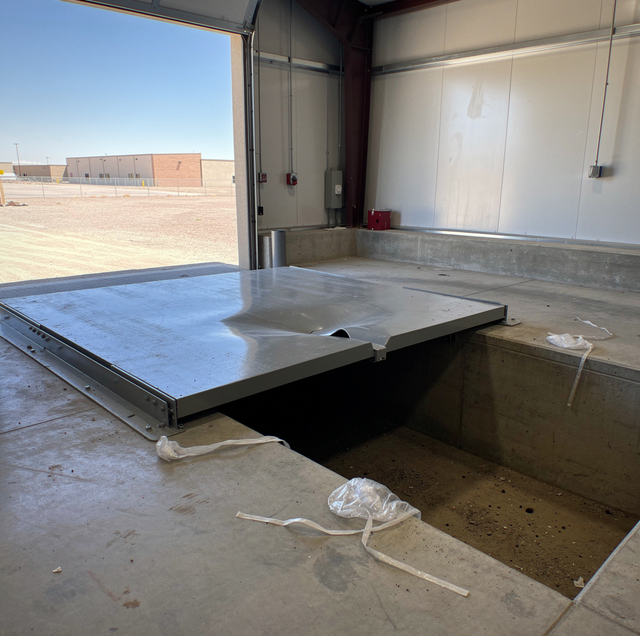
You are standing at the dock door when your forklift driver eases a loaded pallet jack onto the leveler, and the deck rocks instead of holding still. The lip meets the trailer bed at a visible angle, not flush, and for one bad second the load leans before the driver catches it for you.
You already know this leveler has been acting up for weeks: slow to lower, groaning under load, sitting a little proud of your dock floor even after the door comes down behind it. Your next call is whether you fix that deck again or pull it out and replace it, and the answer depends on which failure sits in front of you, not on how many years you have run it.
Why a Loading Dock Leveler Stops Sitting Flush
A loading dock leveler is built to do one simple thing well: rest flush with your dock floor when it is stored, then pivot down to meet the trailer bed the moment a driver backs in. When the deck stops sitting flush, whether it sits high, sits low, or rocks under the first pallet that crosses it, something specific in the mechanism has changed. It is rarely the whole unit failing at once.
Six things typically explain a deck that will not sit flush: a warped deck or a bent frame from impact, a worn hold-down or a tired main spring, low hydraulic fluid, a lip that will not retract, debris jammed in the pit, or a mechanical unit that can no longer keep pace with today's trailers. Each leaves its own signature, and matching the signature to the cause separates a simple repair from a deck that needs to come out.
Debris is a cause that facility staff can make worse without meaning to. A dropped strap, a broken pallet slat, or accumulated grit in the pit can stop the deck mid-cycle or hold it slightly proud of the floor, and the instinct is to look down into the pit or reach under the deck to clear it out by hand while the door is open. That instinct is exactly where this stops being a maintenance question and becomes a safety one.
Leave the pit and the raised deck to a dock technician working under lockout/tagout with the leveler secured, and never reach under or climb in yourself to clear debris, because a dropped deck or lip can crush you.
A Warped Deck or a Bent Frame From Impact Damage
A deck that will not sit flush and shows visible dents or dishing has usually taken a hit. A platform unable to rest flush, with visible indentations in the deck, points to impact or overload damage: a forklift striking the deck at speed, the leveler run beyond its rated capacity, or years of use with no maintenance behind it.
A warped deck is not a cosmetic problem. A warped deck affects weight distribution and places abnormal stress on the hydraulic components and mounting points around it. Hence, the damage keeps spreading outward from the point of impact even after the dent itself stops changing shape.
This failure leans hardest toward replacement, not another repair. A frame bent at its mounting points rarely straightens back to true, and a deck that keeps failing at the same corner after repeated patches is telling you the frame, not the surface, is the problem.
A Worn Hold-Down or a Tired Main Spring
Two mechanical parts hold the deck once it's stored, and if either one wears out, what you see at the dock door changes. The hold-down mechanism, made up of paws, paw springs, and a ratchet, keeps the deck locked down when the leveler is not in use. If the paws, paw springs, or ratchet are damaged or worn, the leveler pops up unexpectedly.
The main lifting spring is the other half of the mechanism and carries the actual load. That same source notes that the main lifting springs store tremendous mechanical energy and remain under constant tension even when the deck appears still. When a spring loses tension or breaks, the deck becomes hard or impossible to raise, and it may slam down or sit unevenly in the pit, well short of flush.
Neither part is something your crew should touch. Adjusting spring tension, swapping a broken spring, or releasing the hold-down by hand is work for a trained dock leveler technician, never for facility staff, because a spring under load can release that stored energy the instant a paw or a ratchet tooth lets go. A single worn paw or a slack main spring is still a parts repair if the deck and frame around it stay sound. A leveler that keeps losing its hold-down or its spring tension on an older mechanical unit is usually past the point where one more repair buys much time.
Hydraulic Trouble Behind a Deck That Won't Move Predictably
A deck that raises, lowers, or crosses unevenly, sometimes with a whining sound from the power unit, usually points to a hydraulic problem, not a mechanical one. Low hydraulic fluid is a common culprit, traced to a leak somewhere along the system: at a seal, at a hose, or at the cylinder itself.
A slow leak can run for weeks before you notice, since a leveler that is losing fluid still works, just less predictably each cycle: a little slower to raise, a little less firm on the way down, a whine that gets louder as the fluid drops. Finding the actual leak point, not just topping off the reservoir, keeps the same fault from showing up again soon after the last service call.
A puddle under the power unit or a damp hose clamp is often the first sign, worth a look on any walk of your dock.
A Lip That Won't Retract or Stay Down
The lip is the hinged plate at the front edge of the deck that extends out and rests on the trailer bed to bridge the gap. When it will not retract fully, or will not stay down once it is extended, the causes cluster around three parts: a bent lip plate, broken lip tension springs, or a hinge fouled with debris or years of grit.
A bent lip usually comes from the same impact events that damage a deck: a forklift catching the edge, or a trailer pulling away before the lip has fully retracted. Broken tension springs and a fouled hinge are routine parts replacements for a technician, and neither one, on its own, is a reason to consider replacing the whole leveler.
What Tilts the Deck Toward a Full Replacement?
Repair and replace both stem from the same causes listed above, and the table below sorts them by the direction they usually lean. Structural damage to the deck or frame leans toward replacement because the metal itself is compromised. Worn parts, a leaking seal, or a jammed pit lean toward repair, since a technician is swapping a component rather than rebuilding the unit beneath it.
| What You See | Likely Cause | Repair or Replace |
|---|---|---|
| Deck won't sit flush, dents visible in the deck | Warped deck or bent frame from impact | Structural, leans replace |
| Deck pops up, won't stay down when stored | Worn hold-down (paws, paw springs, ratchet) | Repair |
| Deck hard to raise, may slam or sit unevenly | Main spring lost tension or broke | Repair; recurring on an older unit leans replace |
| Deck won't move predictably; whining sound | Low hydraulic fluid from a leak | Repair |
| Stops mid-cycle, won't store | Debris jamming the pit | Repair, cleared by a technician |
| Lip stuck out or won't retract | Bent lip, broken springs, fouled hinge | Repair |
| Trailer drops, lip won't stay flat entering | Mechanical leveler can't float with the trailer | Consider upgrading the drive type |
The pattern most worth watching is a repair that keeps recurring on the same older mechanical unit. A single hold-down repair on a sound leveler is routine maintenance. Repeated hold-down or spring repairs on one leveler within a short stretch, on a unit that has also started showing early frame stress, are a different signal: the parts keep failing because the unit around them is wearing out as a whole, and your facility is usually better served by a new deck than by one more repair to the old one.
What Tilts a Facility Toward Upgrading the Drive Type?
A mechanical leveler holds its deck at a fixed position once the hold-down engages, which works fine on a dock where trailers sit still and level. Modern trailer suspensions do not always cooperate: as a trailer is loaded or unloaded, the bed rises and falls under the shifting weight, and a mechanical deck locked in one place cannot follow it. This occurs most often with mechanical levelers that cannot float with trailer movement, a failure pattern sometimes called stump-out, where the trailer drops away from a lip that stayed put.
Stump-out is not a defect you repair once and close out. It is built into how a mechanical hold-down works, and it tends to show up more as trailer fleets change and the same leveler ages. A facility running mixed trailer heights, or serving carriers whose equipment changes often, feels this gap sooner than one serving a steady fleet. The same source notes that facilities dealing with recurring stump-out are often better served by replacing a mechanical leveler with a hydraulic or air-powered model, a design it credits with improved float, so the deck can follow the trailer bed through the whole cycle without staying locked in one spot.
Before a new deck is quoted at all, it is worth asking which of these two problems you are actually solving: a worn part on a leveler that still fits the job, or a leveler whose entire design no longer matches the trailers that use your dock every day. Answering that matters more than counting the years on the nameplate.
Frequently Asked Questions
Flush means your deck rests level with your dock floor when the leveler is stored, with no lip, dip, or ridge for a wheel to catch. Even a small mismatch, a fraction of an inch at one corner, is enough to hang a pallet jack you are pushing or tip a forklift wheel as you drive it on.
A light dent in your deck panel can sometimes be pressed flat rather than replaced, especially on a newer unit with no other damage. A frame bent at the mounting points is different: those points carry the full load path, and once one shifts, your deck rarely holds flush, which is why a technician checks the frame first, before you approve any repair.
Most replacements finish within a single full day once your leveler and crew are on site. That estimate still depends on your leveler's size and customization, so ask the installer to confirm your timeline before you schedule trailers around the dock bay going out of service that day.
A scheduled maintenance visit covers hydraulic fluid changes, seal replacement, and mechanical adjustment- the same items an installer checks during your new install. It should also include greasing your lip hinge, checking the paw spring tension on the hold-down mechanism, and inspecting the deck and frame closely for early denting. Catching a loose paw or a weeping seal there is what keeps your leveler off this list.
Not automatically, but it is worth checking on your side. Levelers installed in the same year and run under the same duty cycle tend to wear at a similar pace, so if your records show two units went in together, have the second inspected while the crew is on your site fixing the first.
A mechanical leveler stores lift force in a spring and locks your deck at height with a hold-down, which is why it cannot float when a trailer bounces or settles under load, and why stump-out hits it most often. Hydraulic and air-powered models are credited with improved float and safety, though a hydraulic unit still requires fluid, seals, and hoses to be checked on schedule rather than only after a leak occurs. Replacing your older unit is also your chance to reset the lip length and rated capacity to match your dock's trailers, not the ones it was built around years ago.
A dock leveler inspection puts a technician on the deck, the hold-down, and the hydraulics — you get a same-day read on the failure and whether this unit is worth repairing again or ready to come out. Quality Overhead Door serves Mesa and the East Valley. ROC #310144. Call (480) 838-8850.
