
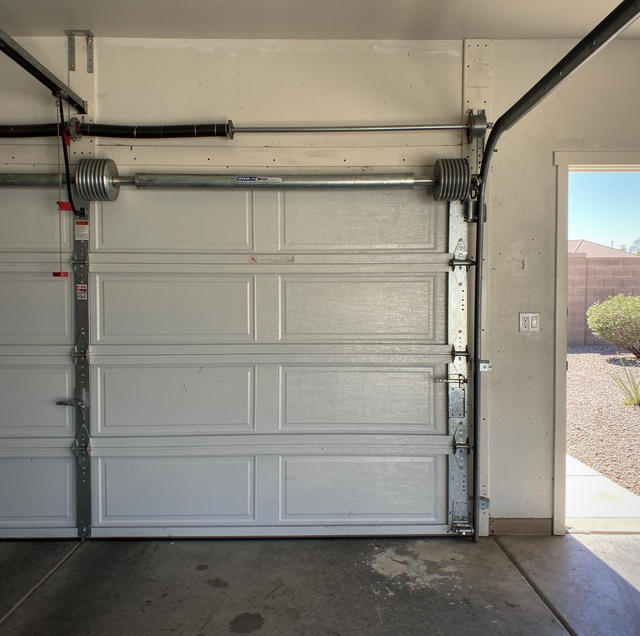
Two different machines hold up garage doors, and they sit in different places overhead. Coiled steel on a horizontal bar, right above the top of the door, means the door counterbalances by torsion. A long coil running parallel to each overhead track, with a pulley and a cable at its front end, means extension springs. One glance from inside the garage separates those two layouts, with nothing touched along the way.
The answer matters beyond curiosity. The two systems store the same kind of energy in different places; they fail in different ways, and a break on one looks nothing like a break on the other. Knowing which one hangs over your car tells you what to watch for, what to avoid, and what to say when you call for a repair.
Where Each Spring Sits on the Door
A torsion system is built around a steel shaft that spans the width of the opening, fastened to the wall above the header. The spring, or a pair of them, slides over that shaft and anchors to a bracket near its middle. At each end of the shaft sits a grooved drum, and a lift cable runs from each drum down the side of the door to a bracket at its lower corner. Seen from below, the entire assembly reads as a single line of hardware above the opening. A coil on a bar that runs across the backs of the tracks, near the ceiling, is still torsion-mounted where headroom is short.
An extension system puts nothing on the wall above the header. Instead, one spring runs along each side, above the horizontal section of track, anchored at its back end to the hanger that holds the track to the ceiling. The front end of each spring carries a pulley. A cable threads through that pulley and a second, fixed pulley near the front of the track, then drops to the lower corner of the door. Looking up, you see two long coils reaching toward the back wall, one on each side, with cables and wheels clustered near the opening.
Door position: With the door closed, extension springs lie stretched out along the tracks; with it open, they draw up short. A torsion spring stays put on its shaft in both positions because it twists in place rather than moving. The closed-door view is enough to identify either one, so there is no reason to run the door just to look.
How Each Type Lifts the Door
A torsion spring stores its energy by twisting. As the door comes down, the cables pay off the drums and turn the shaft, which winds the spring tighter. On the way up, the spring gives that twist back, the shaft turns the other way, and the drums reel the cables in, lifting the door from both bottom corners at once. Because both drums are fixed to one shaft, the door's two sides are tied together. Neither side can rise unless the other rises with it.
An extension spring stores its energy by stretching. When the door lowers, the cable draws the pulley toward the front of the garage and pulls the spring out along the track. Opening the door lets the spring contract, and the pulley hauls the cable back up. Each side has its own spring, its own pulley, and its own cable, and nothing links the left side's lift to the right side's. The two springs have to be matched so each one pulls its half of the door with equal force.
That difference, one shared shaft against two independent sides, runs through the rest of this comparison. It decides how the door behaves when a spring breaks, what can go flying when one does, and what a technician has to match during a replacement.
Torsion and Extension Springs Side by Side
| Torsion spring | Extension spring | |
|---|---|---|
| Where it sits | On a steel shaft above the door opening | Alongside each overhead track, one per side |
| How it lifts | Twists as the door closes, then turns drums that reel in both cables together | Stretches as the door closes, then pulls its own side's cable through a pulley |
| What holds it if it breaks | The shaft it is wound around | A containment cable through the center of the coil, if one was installed |
| What a break looks and sounds like | A sharp bang, then a split coil on the shaft and a door that stays level but heavy | A bang or snap, then a coil hanging loose, a dangling pulley, or a door that lifts crooked |
| What replacement involves | Releasing the wound tension from the old spring and winding the new one to the door's weight | Replacing both side springs as a matched pair and checking pulleys, cables and containment |
What Holds a Spring When It Breaks
This is the difference that carries the safety stakes. A torsion spring is wound around the shaft it drives, so when the steel fractures, the broken coils remain on the shaft, with no path off the bar.
An extension spring is held only at its two ends: the hanger at the back and the pulley and cable at the front. When one breaks while stretched, both halves let go at once with nothing along the length of the coil to stop them. The part that keeps them in place is a containment cable, sometimes called a safety cable, threaded through the middle of the spring and fastened at both ends of the track. With it, a broken spring drops and hangs on that cable. Without it, the pieces, the pulley, and the hardware at the end can whip across the garage toward whatever is parked or standing there.
You can check for that cable from the floor. Look through the coils of each extension spring for a thin cable running down the center, separate from the lift cable that wraps the pulley. If you can see one on each side, the springs are contained. If the middle of the coil is empty, the system has no containment, and those springs are loaded every time the door is closed.
An extension spring without a containment cable through its center can throw metal across the garage when it breaks. Do not unhook, loosen, or stand beside it while the door moves; keep people and cars clear and have a technician inspect it.
Signs of a Break on Each System
On a torsion door, the loss is shared. Because one shaft turns both drums, a broken spring removes counterbalance from the entire width of the door at the same moment, and the door stays level while turning heavily. The evidence sits on the shaft above the opening, in the coil itself.
On an extension door, the loss lands on one side. The spring on the other side still pulls its half, so the door can rise with one corner leading, rack in its tracks, or stop partway as the unsupported side drags. The evidence sits along the track: a coil hanging from its containment cable, a coil on the floor, or a pulley dangling on a slack cable marks the broken side.
On either system, a door that has lost a spring stays down with the opener off until the spring is replaced.
When you call, say where the springs sit, whether the door is up or down, and whether a containment cable runs through each extension spring. Those details tell the technician which parts and equipment the visit needs.
Replacement Work on Each Type
The energy in a torsion spring lives in its wind, the turns of twist stored on the shaft. The job centers on that wind: it comes off the old spring under control and goes onto the new one, with the cables and drums still under load. The new spring is sized to the door's weight, its height, and the drums on the shaft. The spring on the door is a starting point for that sizing, not proof that it was right.
An extension spring stores the least energy when the door is fully open, with the coils drawn up short, so the work is planned around the door's position, with the door held securely in place. Both side springs are replaced together, because each side's pull has to match the other's for the door to rise level. The pulleys, lift cables, and containment cables are part of the same visit: a pulley with a worn bearing or a cable with broken strands carries the same load as the spring, and a new spring hung on tired hardware inherits its weakness.
On both systems, the finished job ends with the door's balance checked by hand, so the new springs are confirmed against the door they are lifting.
Why Either Spring Is a Technician's Job
Both systems are loaded whenever the door is closed, and the load is not carried only by the coil. On a torsion door, the bracket at the center of the shaft, the cones at each end of the spring, and the bottom brackets that hold the cable ends all carry that stored energy. On an extension door, the rear hanger, the hooks or eye bolts at each end of the spring, the pulleys and the cable anchors carry it. Loosening any one of those parts releases energy into the others, which is why unhooking, winding, adjusting, or even measuring a spring puts hands inside a loaded system.
Measuring looks like the harmless part. Ordering a matching spring means reading the wire size, inside diameter, and length, and, on a closed door, that means using a tape and fingers against the coils and brackets that hold the door's full counterbalance. A technician takes those readings as part of the job, with the tension already accounted for.
Frequently Asked Questions
It marks the spring's pound rating. Extension springs carry a color code tied to the weight they are built to lift, but the colors repeat every 100 pounds, so two springs with the same paint can be rated a full 100 pounds apart. Color alone cannot identify a replacement.
The cable doubles back through the pulley on the spring's front end, so the spring stretches about half as far as the door travels. On a 7-foot door, that works out to roughly 42 inches of stretch, which is why a spring about 2 feet long at rest can counterbalance it.
No. A wall-mounted opener, sometimes called a jackshaft opener, bolts to the end of the torsion shaft beside the door and drives the door by turning that shaft. An extension-spring door has no shaft for it to turn on, so it pairs with a ceiling-mounted opener that pulls a trolley instead.
The finish describes how the wire was treated, not how the spring works. Oil-tempered spring wire carries a dark finish, while galvanized wire has a dull silver coating that resists rust. Torsion and extension springs both come in either finish, so the coil color says nothing about which system you have.
A rolling steel door counterbalances on torsion, but you will not see the spring. It sits inside the barrel at the top of the opening, the same pipe the steel curtain wraps around as the door rises, and it stays hidden inside the hood that covers the coil.
The ends come in a few shapes: an open loop, a double loop, or a clipped end fastened with a separate clip. The end is formed from the same wire as the coil, so a spring that breaks at its loop is replaced whole, the same as one that breaks in the middle.
A door that turns heavy or lifts crooked after a bang needs springs matched to its weight — the replacement is sized to the door, and the cables, drums or pulleys, and any containment cables are checked before it moves again. Quality Overhead Door serves Mesa and the East Valley. ROC #310144. Call (480) 838-8850.