Extension-to-Torsion Spring Conversion in Phoenix, AZ
Replace the long extension springs over your tracks with a torsion spring on a shaft above the door. It stays on the shaft if it breaks and makes a wall-mount jackshaft opener possible. We measure your garage first on a $35 visit.
A phone quote is free. A service call on a failed door is $85, covering the 22-point inspection and the first half hour of labor. After hours and weekends, $250. A measuring visit, $35.
- ROC #310144
- Licensed, Bonded & Insured
- Women-Owned Family Business
- Google Rated
A conversion is not a better spring installed where the old one sat. It is a different counterbalance machine above the same opening, and the first question is what that opening can carry.
What a Torsion System Needs That an Extension System Does Not
An extension spring stretches. A torsion spring twists. Extension springs run horizontally above the tracks on each side and are pulled longer as the door closes. Torsion springs sit on a shaft above the opening, and cables wound onto drums at each end turn that shaft as the door lowers.
So a torsion system needs a shaft, and an extension door has none. It runs the full width of the opening; it does not exist on your door today, and it is why this is a different machine and not a part swap. The extension system comes out entirely: springs, pulleys, cables, and whatever they were anchored to.
The shaft has to be carried, and that is hardware on the header. End-bearing plates at the jambs, a center bearing, and, on a conventional system, a center spring anchor bracket, which is where the load ends up; some OEM kits wind from the end plates and need no center pad. The drums are matched to door height and track radius, the cables are new, and the springs are sized to the door's weight.
And balance is then set somewhere else. An extension door has no winding cones at all, so there is nothing to wind: balance on that family is set by where the spring anchors and by the pulleys and cables. A torsion system moves the adjustment onto the shaft. Neither family is homeowner work: the counterbalance on both is under load whenever the door is down.
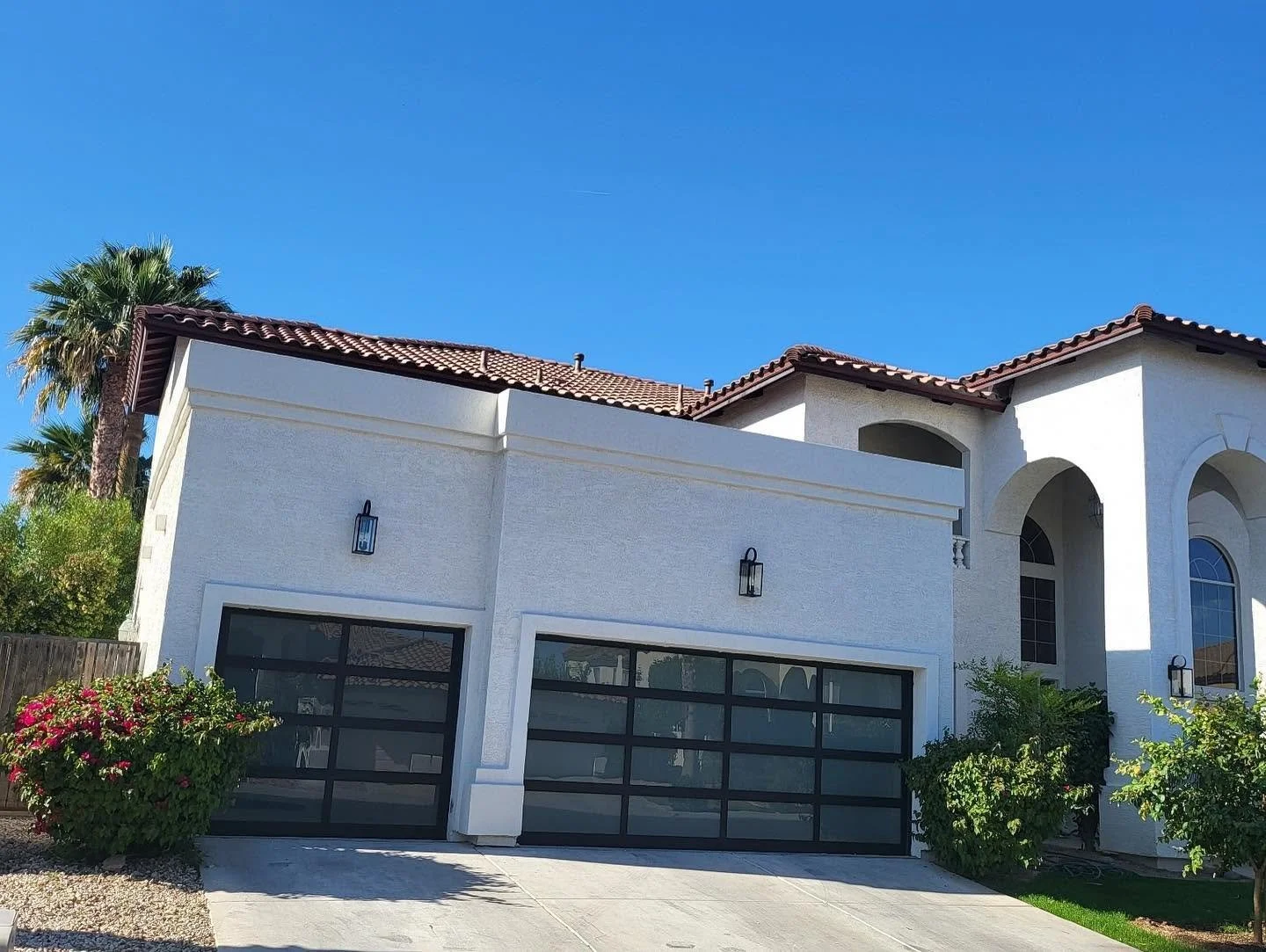 Spring conversion in Phoenix, AZ
The Three Things Above the Opening That Decide It
All three are measurements, taken in the garage.
Headroom, and the number is hardware and not physics. Headroom is the distance from the top of the opening to the lowest thing above it, which may be the ceiling or a truss, a duct, or a sprinkler line. Amarr's table gives, on 12-inch radius track, 12 inches for extension and 12 for torsion, 15 with an opener for both: at equal radius the manufacturer publishes the families as identical. Clopay publishes 10 inches for extension against 12 for torsion, and Garaga 8½ against 12, so a conversion can raise the requirement.
The header, and what it is being asked to hold. A torsion system puts its load into the header above the opening; an extension system carries it back along the horizontal tracks and their supports. Amarr publishes a 2-inch by 6-inch minimum spring anchor pad, and DASMA asks for load-bearing members that are structurally sound.
Clearance for the shaft, across the whole width. The shaft is continuous from jamb to jamb, so an obstruction anywhere along the run matters even where the middle is clear, and the bearing plates need the jamb faces at each end. A conduit, a water line, or shelving in the way is a finding about the garage, not the door.
Phoenix Spring Conversion FAQ
Do I have to convert because an extension spring broke?
No. Replacing extension springs is an ordinary repair and a complete solution in its own right. Conversion is a separate decision, and a break is a reasonable moment to have it.
How much headroom does a conversion need in my garage?
Usually about 12 inches above the opening for standard torsion hardware, and as little as about 4.5 inches with low-headroom rear-mount hardware. Manufacturers differ, so we measure yours on a $35 visit before quoting.
Is my extension system a safety problem?
It can be if the springs have no safety cables running through them. DASMA states that a door with extension springs needs a safety cable running through the springs and secured to the wall or ceiling at each end, that a broken spring may cause injury, and that a cable can help contain it. Where there is none, the instruction is to call a local dealer for a safety inspection.
Someone told me torsion springs last twice as long. Is that in a standard?
No. Our spring conversion page sets out the four documents we checked, and none of them carries that comparison.
Can you convert a one-piece tilt-up door?
The sectional counterbalance standards are limited to sectional doors, so a one-piece door falls outside them. We service one-piece doors. What we will not do is say from a web page whether yours can be converted, because that family has no sections and no horizontal track above your car.
The Four Answers That Are No
Each ends the conversation for a published reason, and you should hear it before a price.
The door carries a wind-load label. Clopay's own torsion conversion kit is published as not available for use on stock wind-load doors, and DASMA's guidance on substituting components is that non-identical parts may weaken the assembly and a certifying agency may invalidate the certification.
The door's weight falls outside the available kit range. Conversion kits are cataloged by door size and by weight band, in ranges like 109 to 133 pounds and 219 to 243 pounds. A door outside every band has no listed kit.
The headroom is below the low-headroom thresholds. Published low-headroom torsion configurations reach down to around 4½ inches with rear-mounted hardware. Below that, the published remedy is structural work on the opening and not a spring change, which is a different trade. If the opening itself has to change, our Phoenix page sets out what counts as exempt work in Phoenix and where that stops.
The header or the anchor pad will not carry it. Settled against the published pad requirement, and where the answer is no, we say so.
Why the Opening Gets Measured First
Our Phoenix page carries the housing figures and the city's older stock. The part that matters here is narrow: a Phoenix address tells you nothing about what is above your opening.
It does not predict the counterbalance family on the door, or the headroom, which depends on a ceiling and on whatever has been run across it since. It does not predict the condition of the header, whether a spring anchor pad was ever installed, or whether extension springs have containment cables.
And we are not going to improve on that by guessing a proportion. No source states what share of Phoenix doors runs either family. What we have instead is a $35 visit that answers those questions for your garage.
What Customers Say
"Quality Overhead Door is a very reliable company, great fair pricing and on time. I would highly recommend them."
What the Choice Changes, Once the Opening Has Said Yes
Facts about the two machines, and no further.
Where the spring is when it fails. A torsion spring is on a shaft above the opening and stays on the shaft when it breaks. An extension spring with a containment cable through it also stays where it was, because that cable is threaded through the spring and anchored at both ends. The configuration with neither is what a technician looks for on an extension door.
What the standard asks of either family. ANSI/DASMA 103 requires that a counterbalance spring be restrained on the inside or the outside, and that the restraint hold the spring, its end loops and its pulleys when the spring is destroyed. It asks for restraint, and not for a spring type.
Whether a wall-mounted opener is possible. A jackshaft opener drives the torsion shaft directly. No shaft, no jackshaft. On an extension-spring door, the conversion is the prerequisite.
Why No Number Comes First
The kit is selected by what your door weighs, and that weight is measured or calculated from the door's construction. A figure offered before it is a figure for somebody else's door.
On the visit, in order. The technician checks whether the extension springs have containment cables, measures headroom, side room and backroom, records the track radius, establishes the door's weight, checks the header and the anchor pads, and looks for a wind-load label. The balance check happens, as it does on every visit. Then the estimate is emailed, and nothing is ordered until you approve it. A converted door that will not hold where it is left has been converted badly, and that check finds it.
On what is paid when. A conversion kit and high-cycle springs are special-order, and a special-order part carries a 50% deposit, non-refundable.
Scope on This Job
Ours: the counterbalance in either family, containment cables, the shaft, bearings, drums, cables, the balance check and the safety reverse test, on any brand and on doors we did not install. No minimum job.
Outside our scope: structural work on the opening, framing, jambs, drywall and stucco. Locks and rekeying. Any new circuit, which is an electrician's job first. Mobile and manufactured homes. The motor on an opener with no photo eyes. Home warranty dispatch, on hold.
Winding, tensioning, and releasing a counterbalance are not homeowner work in either family.
Where We Work
Garage door repair and service across the Phoenix metro:
- Mesa,
- Gilbert,
- Chandler,
- Tempe,
- Scottsdale,
- Phoenix,
- Queen Creek,
- Apache Junction,
- Glendale,
- Peoria,
- Ahwatukee,
- Fountain Hills and
- Paradise Valley.
Tell us what you can see above the tracks from the floor, with the door closed.
Two long springs running back above each track, or a bar across the opening. That answer tells us which family we start from. It does not settle whether your opening will take a conversion, because the headroom, the header, and the shaft run are measured on the day.