Garage Door Weather Seal Replacement in Tempe, AZ
New bottom, side and header seals and thresholds for Tempe garage doors, on any brand. We check why the old seal wore out, fit the right profile, and reset the opener so the door seals and closes properly.
A quote over the phone is free. A service call for a failed door is $85, covering the 22-point inspection and the first half hour of labor. After hours and on weekends, it is $250. A visit to come out, look and quote is $35.
- ROC #310144
- Licensed, Bonded & Insured
- Women-Owned Family Business
- 90-Day Labor Warranty
- Google Rated
A bottom seal wears where it touches, and what it touches is the floor. The shape it has worn into is a record of how the door above it has been landing.
On a Tempe seal, the old rubber comes off, and new rubber goes on. What the strip looks like when it comes off determines whether that was the whole job.
The Two Things Rubber Records
Two separate things happen to a seal, and they leave different marks.
Compression. Rubber squeezed in one place long enough stops springing back and holds the squashed shape. That is a set, and a set records load: where the edge above it has been bearing, and how hard.
Abrasion. Rubber dragged across a surface polishes, scuffs, feathers, and, in time, tears. That records movement: the edge traveling across the floor as it arrives, or arriving at a lean.
Reading the old seal tells us whether new rubber is the whole fix or whether the door is landing crooked, so you do not pay for a seal that wears out again in months.
Both are read off the part in hand, along the full length and on both faces. That needs nothing except the strip being off the door, which this job does anyway.
What the strip cannot tell you is what it was closing against. The slab and the frame belong to the building. If your driveway slopes toward the garage, a bonded threshold may be the fix, and our weather stripping page explains when.
Light and wear are two different readings. A seal flattened solid can still be in contact along its length and show no daylight at all, and a strip installed last month can show daylight with nothing worn about it. So the part gets read even where the gap already answered the question somebody called about.
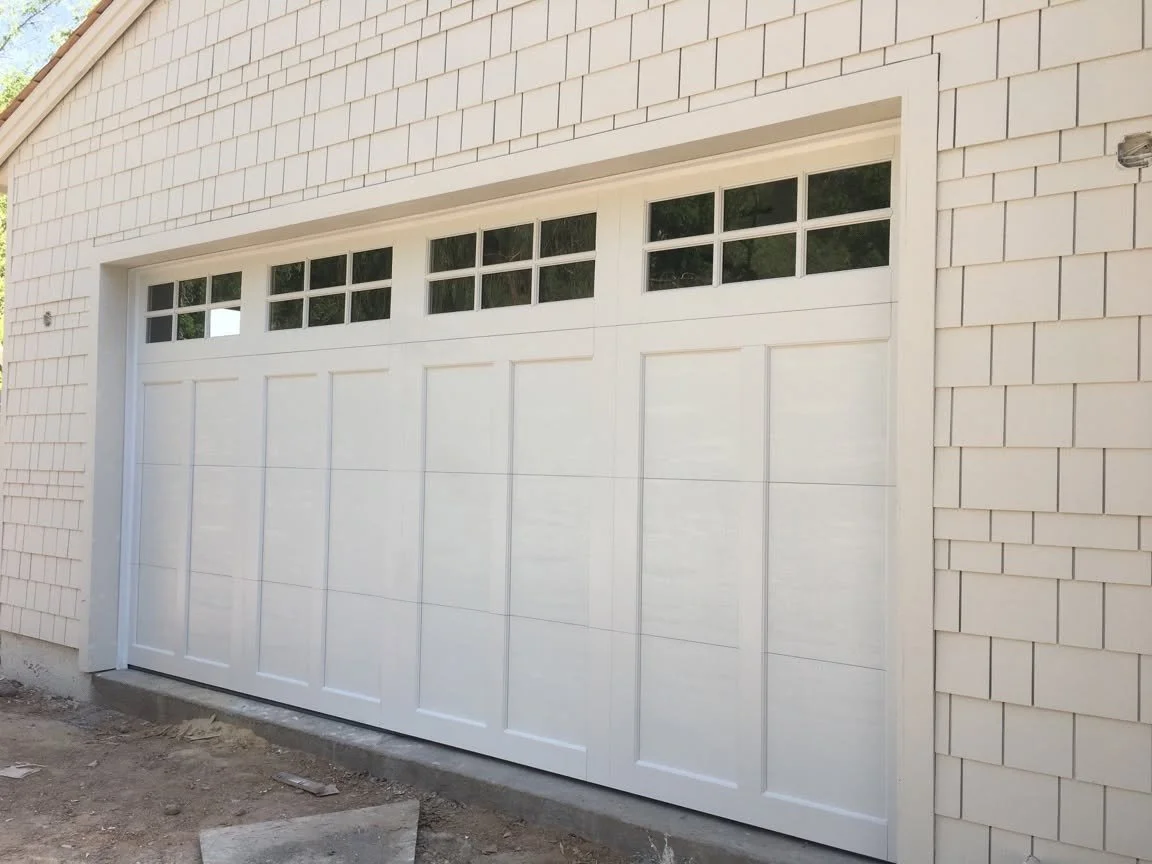 Weather sealing in Tempe, AZ
Four Patterns, and What Each One Puts on the List
Even along the width. A set of roughly the same depth end to end means the bottom edge has been meeting the floor along its whole length. The rubber is the finding and new rubber is the job.
Heavy at one end, barely marked at the other. The landing is off, or the floor beneath it is. What the strip adds is extent: an end carrying no set at all was never in contact, and that is visible on the part. Which of the three failures sits behind a one-sided gap is on our weatherstripping and bottom-seal page.
Crushed through the middle with the ends still full. The edge has been bearing hardest at its center. On a sectional door, two items are on the list: the stiffness of the bottom section across its span, where struts and reinforcement are work we do, and the opener's down-force and travel limits, last set against whatever thickness was on the door then.
Polished or feathered on one face. Contact is arriving unevenly from front to back, so the question is how the edge meets the floor, not how much of it does.
The rubber goes on either way. None of these readings stops a seal from being replaced. They change what else is written on the estimate beside it: a part, or a part and a conversation about the door's geometry.
Which Family the Door Is, and Why That Is Asked on a Tempe Call
Everything above describes a sectional door, where the astragal sits in an aluminum retainer along the bottom section and that section comes down flat.
A one-piece tilt-up does not come down flat. The slab pivots into the opening, so its bottom edge arrives on an arc, and where there is no retainer channel, the seal fastens straight to the bottom rail. Both change what a worn strip reports on, so none of the sectional reading carries over to it.
On a one-piece, what the strip presents to the technician is the arms, the jamb hardware, and how the slab sits in them. The family itself, how it pivots and how its balance is set in steps, is on our Tempe spring repair page. We work on both.
So we ask whether your door is sectional or one-piece before we look at the wear. Our Tempe page carries what the census says about the age of the city's garage stock, and no street, ZIP code or year on a deed narrows that to the door on your house. It is one question on the phone, and it changes what a technician reads when the strip comes off.
What Customers Say
Tempe Weather Seal FAQ
The old seal was worn about the same all the way across. Does that mean the door is fine?
It means the bottom edge has been landing along its full length, which is the finding that makes new rubber the whole job. It says nothing about what is above that edge, which the rest of the 22-point inspection covers.
One end of our old strip is barely marked. What does that tell you?
That the end was not reaching the floor, and had not been for long enough to take a set. The answer is at the landing or the floor, and new rubber alone leaves the next strip in the same position.
Which visit is this, the $35 or the $85?
If the door has failed, the $85 service call, which covers the 22-point inspection and the first half hour of labor. If you want somebody to come out, look and quote, the $35 visit. After hours and on weekends, it is $250. A special-order profile takes a 50% deposit, and a phone quote is free.
Does a door have to be out of square for a seal to wear unevenly?
No, which is why the shape of the wear matters more than the amount. Wear through the middle with the ends full points at the span of the bottom section and at the opener's down-force. Wear at one end points at the landing or the floor.
We have a one-piece tilt-up. What does its seal report on?
A different set of parts: the arms, the jamb hardware, and where the slab sits in them. We service both families, and we ask which you have first.
Does any of this change which seal you fit?
No. The profile is decided by the channel it keys into, and that is a measurement off your retainer. What the wear changes is whether anything above the channel is worked on at the same time.
Somebody already replaced ours. Can it still be read?
Not the strip that came off. That record went out with the part. What is left is where the new seal makes contact and where it does not, and how the opener's limits were left.
Scope on This Job, and What Happens Before We Leave
Ours. The astragal and its retainer, the side and header seals, whole-stop molding with the wood, a floor-mounted threshold bonded to the slab, and struts and reinforcement where needed for the bottom section. Any brand, any age.
Not ours. Concrete: repairing, grinding, leveling or replacing a slab is another trade, as are the jamb and the framing. Locks and rekeying. A new outlet or circuit, an electrician's job before ours. Garage screens and window retrofits. Mobile and manufactured homes. The motor on an opener with no photo eyes. Home warranty dispatch, on hold at present. There is no minimum job.
The seal is on the inspection anyway. Point 16 of the 22 is the weather seal and bottom astragal, point 17 the perimeter weatherstripping, so a Tempe call about something else still puts both in writing. The estimate is written and emailed; it names the seals and, separately, whatever the wear pattern adds, and nothing is installed until you approve it.
The old strip goes in your hand. That is the part of this job worth holding on to, because it is the only record of how the door was landing before new rubber hid it. Where the door runs on an opener, a taller strip means the limits get reset to it, and our weather seal page carries why that matters. We test the safety reverse before we go, and the balance gets checked, as it is on every visit.
Where We Work
Garage door repair and service across the Phoenix metro:
- Mesa,
- Gilbert,
- Chandler,
- Tempe,
- Scottsdale,
- Phoenix,
- Queen Creek,
- Apache Junction,
- Glendale,
- Peoria,
- Ahwatukee,
- Fountain Hills and
- Paradise Valley.
Ask whoever changes your bottom seal to hand you the old one.
The strip in your hands answers a question the new one cannot. If you are booking with us in Tempe, three things are worth saying on the phone: whether the daylight is even end to end, whether one end of the old rubber looks untouched, and whether the door is sectional or a single slab. Not knowing is an ordinary answer.