Garage Door Spring Repair in Tempe, AZ
Torsion, extension and tilt-up springs repaired on any brand in Tempe, with containment cables fitted where they are missing.
A service call is $85, including the 22-point inspection and the first half hour of labor; after hours and weekends it is $250.
- ROC #310144
- Licensed, Bonded & Insured
- Women-Owned Family Business
- 90-Day Labor Warranty
- Google Rated
A bang from the garage, then a door that lifts a foot and stops, or one that suddenly weighs what it actually weighs. That is a spring, and in Tempe there is a second question that comes with it.
If Your Springs Run Above the Tracks, This Section Is the One That Matters
Our Tempe page explains why the city still has so many of them: on Census figures, four in ten Tempe homes predate 1980, and extension springs are common on doors of that age. What that page does not do is tell you what to ask for. This one does.
An extension spring stretches. A torsion spring twists. The long springs running horizontally above each track are extension springs. They pull against pulleys and cables to counterbalance the door, storing their energy along their length.
A containment cable is a steel cable threaded straight through the spring, anchored at both ends. It does one job, and it does it well: when the spring breaks, the pieces stay on the cable.
Without one, a failing extension spring does not stay where it was. It is under load, anchored at one end, and when the steel that has been cycling for thirty years finally lets go, the released half travels. That is the whole argument, and it is why we raise it on an extension door whether or not you called about the springs.
Retrofitting one is straightforward. The cable runs through the spring and anchors to the same points the spring system already uses. It does not change how the door behaves, it does not change the balance, and it is not a modification to the door.
And the limit, which is worth stating. A containment cable contains the spring. It does nothing about the lift cables, nothing about the door's weight, and nothing to hold the door up if the counterbalance fails. It addresses one hazard and leaves the rest of the system where it was.
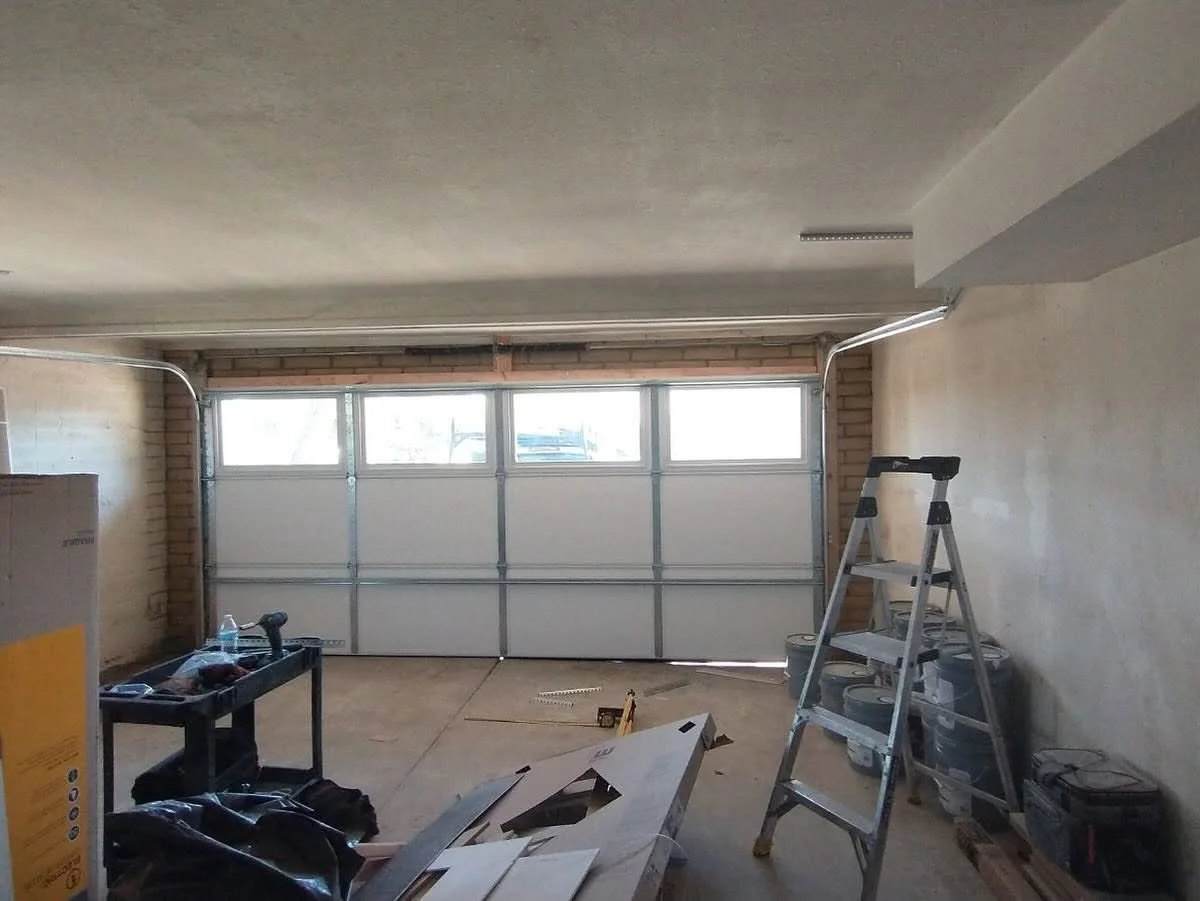 Spring repair in Tempe, AZ
On an Extension Door, the Spring Is Often Not the Part That Failed
This is the part that surprises people who have only ever dealt with a torsion door.
A torsion system is short. A bar, springs, drums, cables, bearings. Few moving parts, and when one goes it is usually obvious which.
An extension system has more in it. Two springs, two pulleys at the spring end, two more at the track end in many configurations, two lift cables, and the S-hooks or clips that hold it all together. Every one of those is a wear item, and on a door of that age, they have had decades of cycles.
So the diagnosis starts wider. A door that has gone crooked on one side is as likely to be a cable off a pulley or a seized sheave as a broken spring. A door that jerks on the way up is often a pulley that no longer turns freely. A hook that has opened up under load drops one side without any spring breaking at all.
Which is why, on this housing stock, we quote after we look, and why a number given over the phone for a Tempe extension-spring door is a number for a job somebody has not seen.
And If Your Door Is a Single Slab That Swings Out
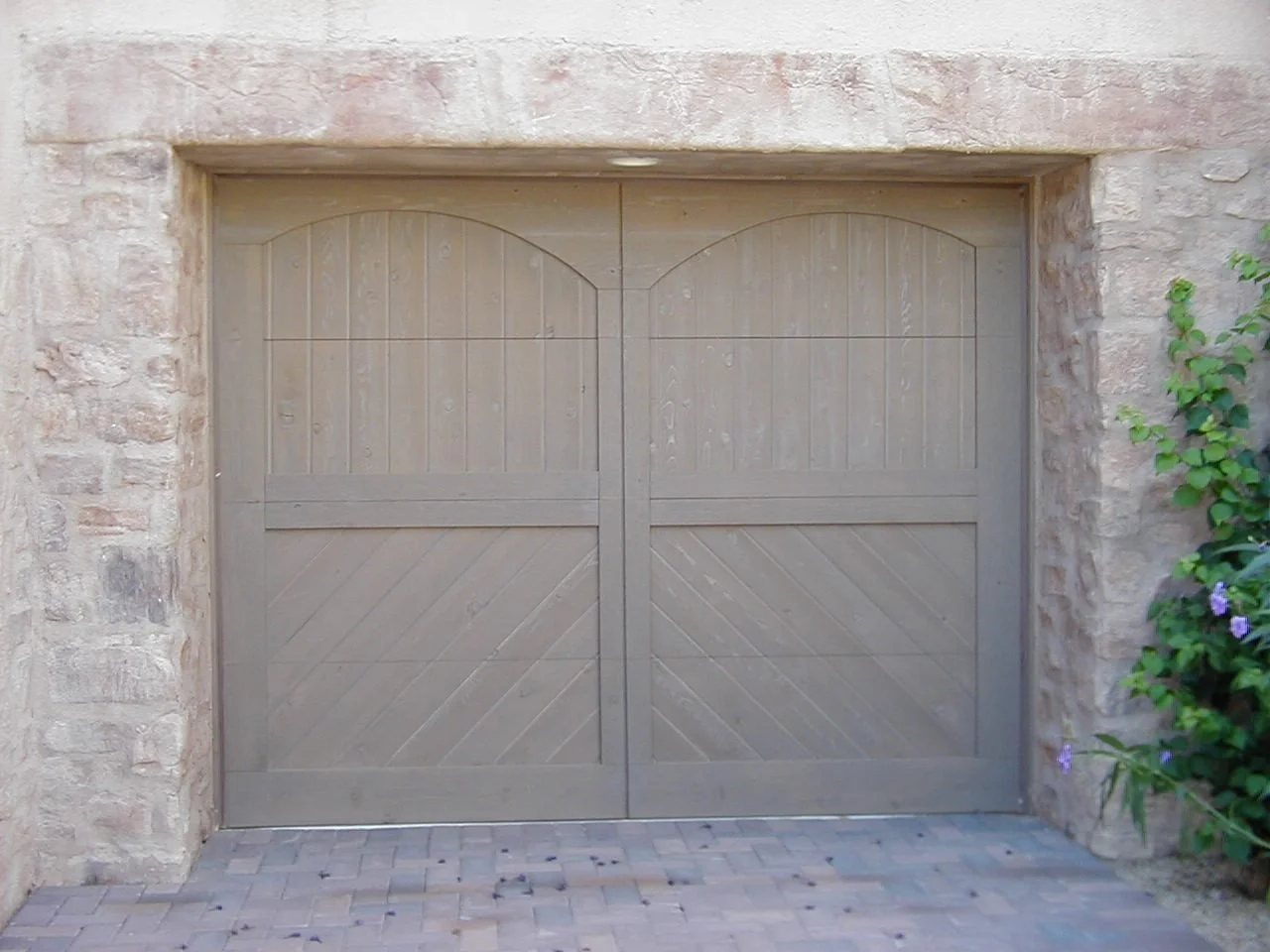
Tempe still has working one-piece tilt-up doors, and they are a third counterbalance family with their own logic.
The door pivots. It hangs on arms at each side and swings out and up as it opens, so the whole slab travels through the opening in one movement. On the jamb-hardware type, which is most of what has survived here, there are no sections, no hinges between panels, and no horizontal track above your car. Track-type one-piece doors also exist and are set up differently, which is why we ask which one you have.
On the jamb type the springs sit at the sides. They work against the pivot arms, and the adjustment is made by moving the spring's anchor point along a set of holes, so the balance is set in steps. Getting it right is a matter of the right spring on the right hole for the weight of that particular slab.
They are not a job to improvise. The spring is under load whenever the door is down; the anchor is the thing holding it, and a spring that comes off an anchor at the wrong moment moves with the arm. That is work for somebody who does it every week.
What we can and cannot promise. The hardware is generally findable: springs, arms, brackets, pivot pins. A replacement slab for a door nobody has made in decades is a different matter, and if yours is cracked or delaminating, we will tell you that before we quote a spring.
People are usually pleased to hear we work on them. A tilt-up door that has been running since the seventies has earned some respect, and there is no reason a well-kept one should not continue to do so.
What We Do on the Visit
Identify the family first. Torsion or extension, how many springs, what configuration of pulleys and cables, and what the door actually is.
Weigh the door. Disconnected, on a scale. Extension springs are specified by the weight they must lift, so the number matters as much here as it does for a torsion door.
Replace in pairs. On an extension system, an uneven pull is worse than on a torsion one, because the two sides are pulling independently.
Look at everything the spring pulls against. Pulleys, cables, hooks, brackets, and the track ends they mount to. On an older door, these are frequently the reason for the call.
Fit the containment cables if they are missing. We will tell you what that involves and let you decide, and we will say clearly that we think you should.
Balance and test. With the opener disconnected, the door should hold roughly where you leave it. Then the safety reverse with the opener back on.
And tell you what we found on the rest of it. On a door of this age, there is usually something we noticed and did not touch: a track fixing that has worked loose, a bottom seal that has run out, a roller with nothing left in the bearing. That list will be sent to you in writing. What happens next is your decision.
Tempe Spring FAQ
How do I tell which kind of springs I have?
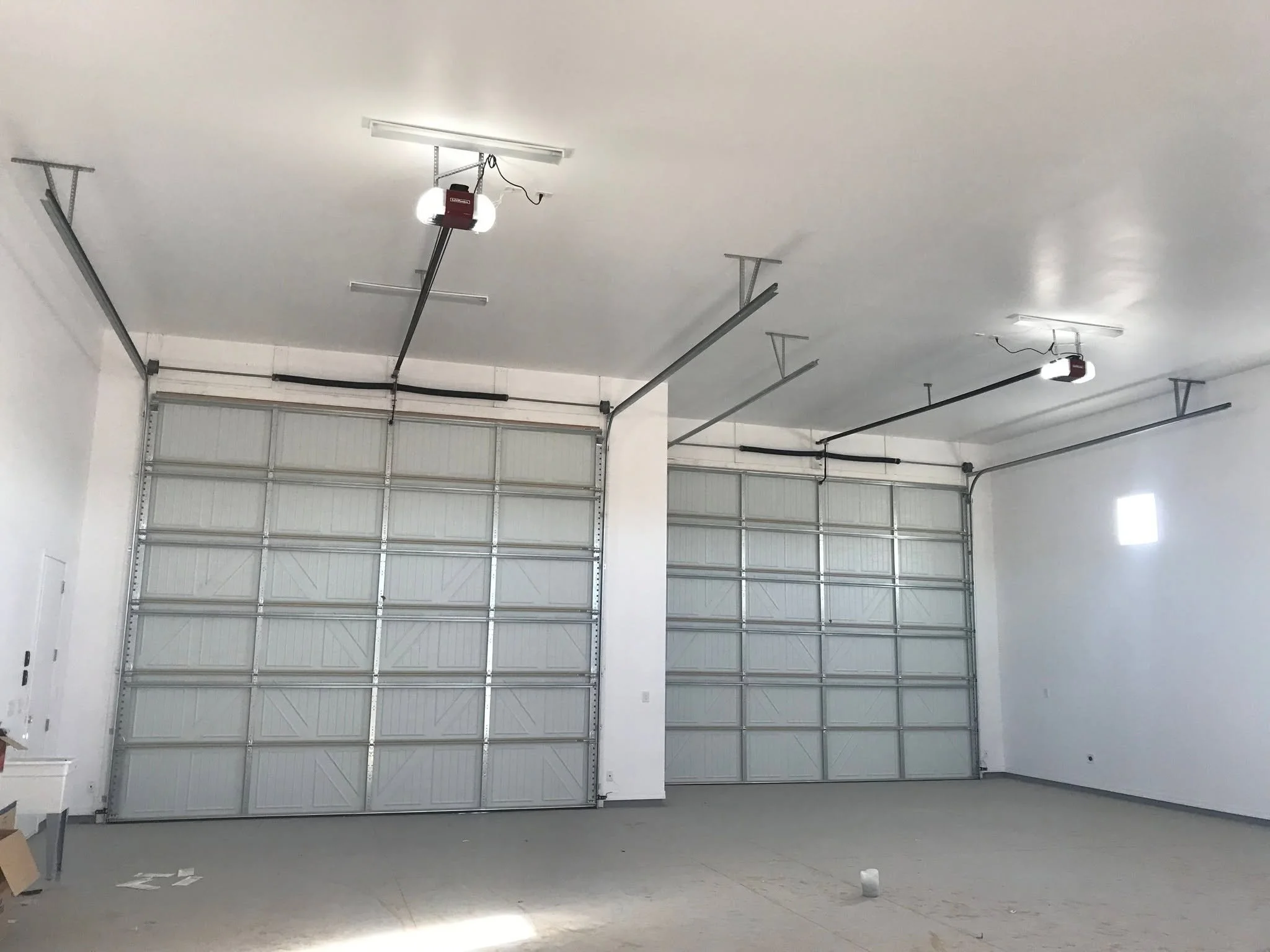
Stand inside with the door closed and look up. A bar running across the wall above the opening with one or two springs wound around it is torsion. Two long springs running back from the top corners, above the horizontal tracks, are an extension system.
My extension springs have no cable through them. How urgent is that?
It is not an emergency while the springs are intact, but it is worth fixing soon, because a spring that breaks without one can whip across the garage. It is a small job, and we can fit them on any visit.
Can I convert to torsion?
Often. It is a decision to make when the springs are due anyway, because that is when the pulleys and cables are coming off regardless, and our Tempe page sets out what the opening has to provide.
Is a spring with no containment cable something a home inspector would flag?
Many inspectors do note it. Either way, a containment cable is a small, inexpensive fix, and we can fit it before a sale or inspection.
Are extension springs less safe than torsion springs?
That is not the question we would ask. A torsion spring is on a bar above the opening, and it stays there when it breaks, which is a real difference. An extension spring with a containment cable through it also stays where it was. The system that is worth worrying about is the one with neither the bar nor the cable, and that is the one we look for on an older door.
Keep the System or Convert It
Both are real answers and the right one depends on the door.
Keeping it makes sense when the door is sound, the hardware is in reasonable condition, and the opening does not suit a torsion conversion. Extension springs are not a defective design. They were standard for decades, and there are plenty of them still working.
Converting makes sense when the springs are due, the pulleys and cables are due with them, and the opening will take a torsion bar. You end up with fewer parts under load and a counterbalance that behaves differently when it fails.
And on a door where the sections themselves are tired, the conversation is a different one, and we will tell you that too. New springs do not address what is actually failing on a door whose sections have already been patched twice.
Scope
What this page covers: torsion and extension springs, containment cables, lift cables, pulleys, drums, bearings and the balance test that proves the work.
Outside our scope: a new outlet or circuit for an opener, which is an electrician's job before ours. Jamb, framing, drywall and stucco. Locks, handles and rekeying. Garage screens and window retrofits. Mobile and manufactured homes. Home warranty dispatch is currently on hold.
And the motor on an opener with no photo eyes stays untouched. We will do the springs and provide you with a quote for a replacement head. Our Tempe page sets out that rule in full and why it comes up here more than anywhere else.
There is no minimum job.
What Customers Say
"Excellent service. My repairman was very knowledgeable and highly experienced repairing garage doors!"
Where We Work
Garage door repair and service across the Phoenix metro:
- Mesa,
- Gilbert,
- Chandler,
- Tempe,
- Scottsdale,
- Phoenix,
- Queen Creek,
- Apache Junction,
- Glendale,
- Peoria,
- Ahwatukee,
- Fountain Hills and
- Paradise Valley.
Look up before you call, and tell us what you see above the tracks.
Two long springs or a bar across the opening. That one answer changes everything we bring.