Garage Door Spring Repair in Chandler, AZ
Torsion and extension spring repair for Chandler homes of every age. We weigh the door, size the springs to it and balance it before we leave, with ninety days on our labor.
Office hours are Monday to Friday, 7:00 a.m. to 3:00 p.m. A person answers after hours, and after-hours and weekend work carries a $250 call fee.
- ROC #310144
- Licensed, Bonded & Insured
- Women-Owned Family Business
- 90-Day Labor Warranty
- Google Rated

A bang, then a door that lifts a foot and stops. Or a door that suddenly feels like it weighs what it actually weighs. Either way, that is a spring.
There is a question here before all the others, and it decides how the rest of the call goes.
In Chandler We Ask the Year Before We Ask the Symptom
Census figures put Chandler's median build year at 1997, with roughly four in ten homes built this century and about one in ten predating 1980. Our Chandler page sets out what that split means for the city. That split is what decides how a spring call goes here.
Chandler homes run from the 1970s to new builds, so the year your house was built tells us which spring system you likely have before we arrive.
So the first question is the build year, and it sorts the call into one of two conversations.
The post-2000 conversation. Torsion spring on a bar above the opening, current parts, a known door. The spring is a wear item that has reached the end of its rating. We can usually tell you the shape of the job from the year, the door size, and whether it is insulated, before anyone drives out.
The pre-1980 conversation. Now the possibilities open up. Extension springs running horizontally above the tracks, with no torsion bar at all. A one-piece tilt-up door on pivoting arms. Hardware that has been replaced piecemeal by three different companies over forty years. All of it is workable. All of it means the quote waits until we have looked.
And 1997, the median, is exactly the transition. Torsion springs were standard by then, but the doors are old enough that a section may have been replaced, an opener swapped, or a spring already changed once by somebody who sized it for a different door. Those are the calls where the year alone falls short, and the door has to be weighed.
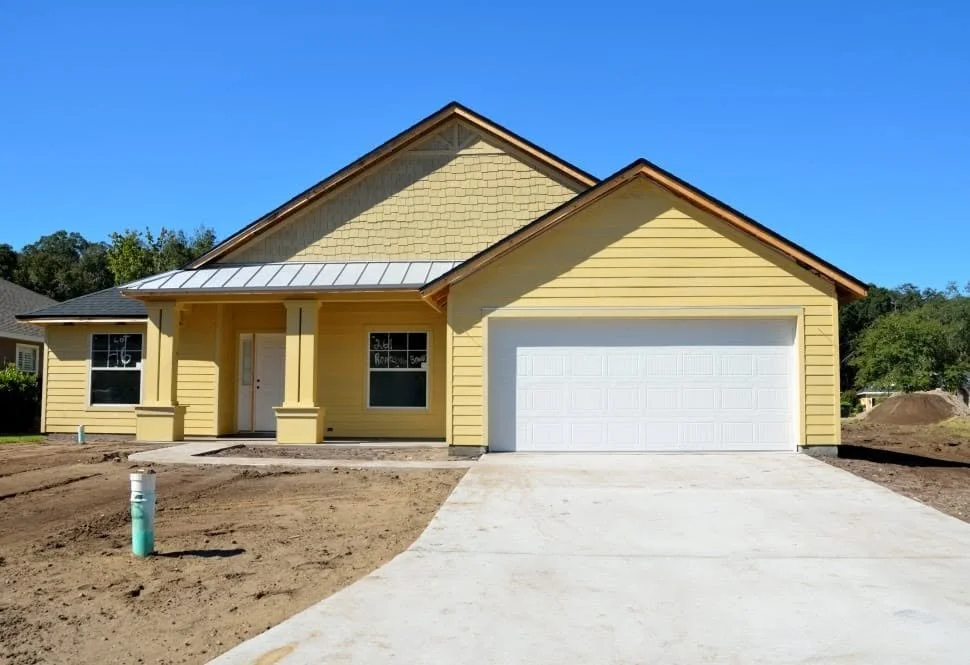 Spring repair in Chandler, AZ
What the Visit Actually Involves
Identify the system.
Torsion or extension, how many springs, what the door is, and roughly what it weighs. With older stock, this is where a job either becomes simple or turns into a conversation.
Weigh the door.
Disconnected, on a scale. Insulation, glass, and a swapped section can put two apparently identical doors far apart. A spring sized by eye to the door's dimensions is a common cause of early replacement failure.
Check what the failure touched.
Cables, drums, bearings, the shaft. A spring that let go under load can take a cable with it.
Balance and test.
Opener disconnected, the door should hold around waist height. Then the safety reverse with the opener back on.
Show you what changed.
Two minutes, and it means the next person who works on this door inherits a known quantity.
Why Springs Fail When They Do
Worth knowing, because the answer changes what you should ask for on the replacement.
Cycles, first. A spring is rated for a number of cycles, one cycle being a trip up and back down. Every household burns through them at a different rate, determined by how many people drive in and out, not by the calendar. A household with three drivers reaches the end of a rating a long way ahead of a household with one. If the garage is how everybody in the house comes and goes, that is the number to tell us when we ask, because it is what turns the cycle rating into a real decision.
Then the wind count. A spring set to the wrong number of turns runs at a stress it was never rated for. It will still work. It simply arrives at the end sooner, and the owner blames the spring, when the real event was a specification error years earlier.
Then lubrication. A spring that has never been lubricated wears at the coil contact points, where the coils touch as the spring winds and unwinds. It is undramatic, it is easy to do, and a spring that never gets it reaches the end of its rating sooner.
And not the weather, which is what people usually expect us to say. We have no source that puts Arizona heat on a spring's cycle life, so we do not make that argument. The wind count and the specification are what we can point at.
So if your springs went early, ask whether they were the right specification, whether the door is balanced, and whether anyone has ever put grease on them. If they reached the end of a normal rating, they did their job.
The Parts Question on Older Chandler Doors
This is the part that surprises people, and it is worth knowing before you decide between repair and replacement.
Springs themselves are rarely the obstacle. They are wound to a specification, and a supplier can make one to that specification, whatever the door's age. Even on a forty-year-old door, the spring is usually the easy part.
What gets hard is everything around it. End bearing plates on a discontinued profile. Drums matched to an unusual drum size. A shaft in a length nobody carries. On a one-piece tilt-up, hardware that was proprietary to a manufacturer who left the trade.
So on the older tenth, a spring call sometimes turns into a hardware call. We will tell you that at the point we find it, with the options laid out: source the part and wait, fit a modern equivalent where one exists and the door will take it, or replace the door instead.
On parts, we do not approximate. A drum that is merely close gives you a cable that unwinds unevenly, which is a bigger failure than the one you called about. Where the original is gone, we will tell you what the equivalent is, why it fits, and what it changes.
What Moves the Number on a Chandler Spring Job
The service call is $85, covering the 22-point inspection and the first half hour of labor, or $250 after hours and on weekends. Beyond that, the spring price depends on these variables:
Which spring family you have. A torsion pair on a bar above the opening and an extension pair running above the tracks are different parts, different hardware, and different labor. Chandler has both.
How many springs the door carries. Two on most double doors, one on some lighter singles.
The door's real weight is determined by insulation, glass, and any sections replaced over the years.
The cycle rating you pick. Longer-life springs are made from heavier wire at a larger diameter, so the same work puts less stress through them. They come to order, so there is a wait attached, and on a door that is currently unusable, that trade-off is real.
What the failure took with it. Sometimes nothing. Sometimes a cable, a drum, or a bearing plate that was already tired.
And whether the hardware around the spring is still obtainable. On the older tenth, that is the question most likely to move a date, and it is why the estimate follows the look.
Scope
What this page covers: torsion and extension springs, the counterbalance hardware around them, cables, drums, bearings, and the balance test that proves the work.
Outside our scope: a new outlet or circuit for an opener, which is an electrician's job before ours. Jamb, framing, drywall, and stucco. Locks, handles and rekeying. Garage screens and window retrofits. Mobile and manufactured homes. Home warranty dispatch is currently on hold.
And the motor on an opener with no photo eyes stays untouched. No photo eyes, no motor work. We will still do the springs and quote you a replacement head. Our Chandler opener page sets out the federal rule this comes from.
There is no minimum job.
Chandler Spring FAQ
I have two long springs above the tracks and no bar across the opening. Is that a problem?
It is an extension spring system, common on Chandler's older stock. Those systems work, and we work on them. The question we will ask is whether a containment cable runs through each spring. Without one, a spring that lets go can leave the wall it was mounted on.
A previous company replaced one spring. Can you match it?
Sometimes, though we usually advise against it. A spring that has done seven years of work paired with a new one gives you an unbalanced counterbalance and a second visit when the old one goes.
Can you tell what I have from a photograph?
Often, yes. One picture of the bar above the opening and one of the whole door from a few feet back will usually tell us the spring family and the count. On the older stock, that is the difference between a useful phone call and a guess.
Can you do it today?
On a door running current parts, often. On something older where a part has to be identified first, you get a straight account on the phone of what has to happen before anyone can commit to a date.
Is a broken spring dangerous to leave?
The door is. Leave it down if it is down, stop pressing the button, and leave the red release cord alone until we get there.
What Customers Say
"Took care of problem quickly. Knew issues and easily resolved."
Where We Work
Garage door repair and service across the Phoenix metro:
- Mesa,
- Gilbert,
- Chandler,
- Tempe,
- Scottsdale,
- Phoenix,
- Queen Creek,
- Apache Junction,
- Glendale,
- Peoria,
- Ahwatukee,
- Fountain Hills and
- Paradise Valley.
Two answers and a photograph.
The year the house went up, what the door is doing now, and one picture of the bar above the opening. On the older stock, that is often enough to sort the call before anyone gets in a truck.