Garage Door Cable & Track Repair in Phoenix, AZ
A quote over the phone is free. A service call on a door that has failed is $85, covering the 22-point inspection and the first half hour of labor. After hours and on weekends, it is $250. A technician coming out to look and quote is $35.
- ROC #310144
- Licensed, Bonded & Insured
- Women-Owned Family Business
- 90-Day Labor Warranty
- Google Rated
A garage door hangs on two cables. When one snaps, the other is still on the door, still wound on its drum, still carrying the load. The broken one tells us where it failed. The intact one, and its drum, tell us what size and length the new pair has to be, which is why we replace both.
What a Cable and Drum Assembly Is
We fit galvanized aircraft cable sized to your door's weight, so it seats cleanly on the drum and does not jump off or fray early.
It ends at the bottom bracket, in the lower corner of the bottom section, where the counterbalance load terminates. That is the most dangerous fitting on a garage door.
It winds onto a drum on a sectional torsion door: a grooved wheel clamped to the torsion shaft by two set screws. The shaft turns the drum, and the cable pays off its groove as the door comes down and back on as it goes up.
On a door running extension springs, there is no drum. The cable runs over a pulley, the springs lie along the horizontal tracks, and there are no winding cones anywhere on the system. Everything here about grooves and set screws describes a sectional torsion door.
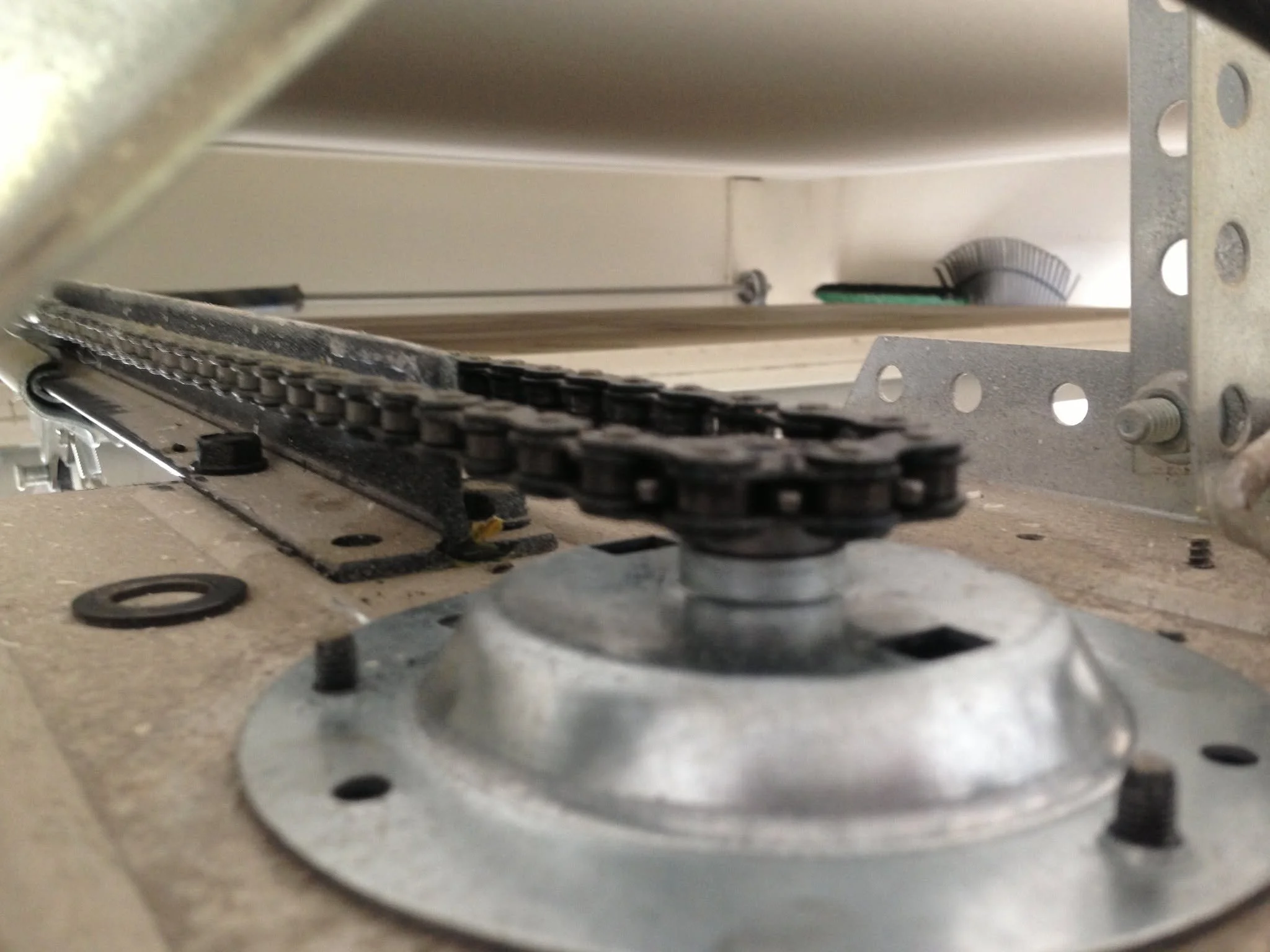 Cable repair in Phoenix, AZ
When One Cable Goes, Both Are Spent
Tension is the only thing holding a cable in its groove. Take it out, even briefly, and the cable is a loose wire on a turning wheel. What took the tension out is its own question, and our cable and track repair page carries the causes and the case that the cause is the repair.
The event loads the survivor too. When slack builds and the door drops even a short distance before the cable catches it, the force is several times what that cable sees holding a stationary door. That is shock loading, and it is why slack kills cables.
A pair has to stay a pair. A cable stretches over its working life, so a new one sits shorter under load than the stretched one beside it, and fitting one builds a permanent rack into the door. Both go on, and the survivor gets read first.
Until somebody gets there. Stop using the door, because, supported on one side, it drives its rollers into the track at an angle the track was never built for. Kill the power at the breaker, keep people out from under it, and leave the cable where it is.
What the Intact Cable Records
A broken cable tells you where it failed. The whole one tells you what the pair was.
It is a measurable sample of what was installed. Diameter comes off it with a caliper, and that number answers to two limits: the door's weight and the drum's groove. The trade works to a five-to-one safety factor, so an eighth-inch 7-by-7 cable breaking at about 1,700 pounds has a working load limit near 340.
Doors up to about 184 pounds take 3/32-inch, up to about 340 take 1/8-inch, and 341 to 560 take 5/32-inch. Each cable is sized against the whole door weight, which is where the margin comes from.
Its length is arithmetic, and the arithmetic is public. For standard-lift torsion, cable length is door height plus 18 inches; for extension springs it is plus 60.
Its condition is a map. Cables almost always break at the loop end, because that end carries the load and sits within inches of the slab, where water stands after a storm and corrosion starts. Corrosion and friction are the two named causes. Rust low down says one thing; a polished or flattened band partway up says another, because the mark locates the hardware rubbing it. Strands lifting away from the bundle say the cable is on a countdown.
What the Drum Records
The drum is aluminum, and the cable is steel, which is why the drum keeps a record the cable cannot.
The groove sets the ceiling on the cable. A drum's grooves accept up to a specified maximum wire diameter and no more, and a common residential drum caps at 1/8 inch. Fit a larger cable to a heavier door without changing the drum, and it cannot seat, so a thrown cable is built into the door from the day it goes on.
The wrap pattern is visible evidence. The wraps should sit in their grooves side by side. Cable crossing cable means more went onto that drum than the groove had room for, and cable riding on cable scores the aluminum.
Drums wear two ways, and both throw cable. The grooves score from a cable that was the wrong size or that overwrapped. And the set-screw hub can crack, which lets the drum stop being driven while the shaft keeps turning. Neither is visible from the floor.
Scoring is cumulative, which is the point. A score does not undo itself, so the drum faces keep a record of what the cable was doing when nobody was watching. They say it happened. They do not say when or how often.
And the bearing behind it comes into view. The drum rides on the shaft just inboard of an end bearing plate, and a worn one lets the shaft droop until the drum stops running true and the cable jumps the groove. It gets looked at while the drum is off.
Cable Repair on Phoenix Homes, Old and New
Three facts decide what this door takes. The counterbalance family decides whether there is a drum at all, the height of the opening sets the drum, and the weight of the door sets the cable.
Phoenix has both older homes on extension springs and newer homes on torsion springs, and your address does not tell us which you have. We read the door itself, so the right cable and drum go on the first time.
How the Visit Goes
1. The door gets secured and clamped, and the power comes off at the opener, before anything is loosened.
2. Spring tension comes down under control, with winding bars, on a torsion system, if the job needs it.
3. The cable and the drums come off and get read: diameter, length, wear and rust; groove condition, wrap pattern, set-screw hub, and the end bearings while they are accessible.
4. You get a written estimate, emailed before work starts, and nothing happens until you have said yes.
5. Both cables go on, tension is restored, and the door is balanced by hand with the opener off.
The balance check happens on every visit, and the safety reverse is tested before we leave.
Where we stop. The door is ours, and the building is not: no jambs, framing, drywall, or stucco. Locks and rekeying are a locksmith's job, a new circuit an electrician's. No mobile or manufactured homes, and no motor work on an opener with no photo eyes. One-piece tilt-up doors, extension systems, any brand, any age, and doors we did not install are all ours, and there is no minimum job.
Phoenix Cable and Drum FAQ
One cable broke, and the other looks fine. Can you just do the one?
We will do both, for a mechanical reason. A new cable sits shorter under load than the stretched one next to it, and a mismatched pair runs the door crooked. The intact one is the sample we measure.
My cable came off the drum but did not break. Is that the same job?
Same assembly, different work. A cable that jumped its groove is often the first visible stage of something upstream, so the drum, the set screws and the end bearing get checked first.
My Phoenix house is from the sixties. Can you still get parts for the door?
Cables and drums are among the more findable parts on an old door, which is not true of every part on one. What nobody can do is promise a specification from an address.
How long do cables last?
Ten to fifteen thousand cycles, which at four openings a day is seven to ten years. That is roughly the springs' clock, so the two often get done together.
Do I have safety cables, and should I?
Only if your door runs extension springs. A containment cable, about 3/32 inch against a 1/8-inch lift cable, threads through the hollow center of each spring and holds the pieces if the spring breaks. Torsion doors have none and need none: the shaft holds the spring captive. If your springs are the long horizontal kind with nothing through them, we will fit the containment cables.
What Customers Say
"… Adrian arrived as scheduled, was very polite and helpful. He answered my questions and addressed my concerns. He identified problem and was able to make repairs. … I will definitely use again."
Where We Work
Garage door repair and service across the Phoenix metro:
- Mesa,
- Gilbert,
- Chandler,
- Tempe,
- Scottsdale,
- Phoenix,
- Queen Creek,
- Apache Junction,
- Glendale,
- Peoria,
- Ahwatukee,
- Fountain Hills and
- Paradise Valley.
Tell us which side went, and whether it has gone before.
Which side matters, because the answer lives on that side of the door. Whether it has gone before matters more, because a drum that has thrown a cable twice carries the record of both. A quote over the phone is free, and a technician coming out to look is $35.