Emergency Garage Door Repair in Tempe, AZ
Door stuck open, off its track or trapping your car in Tempe? Call now. A person answers after hours, and the after-hours and weekend call fee is $250, told to you before anyone is dispatched.
- ROC #310144
- Licensed, Bonded & Insured
- Women-Owned Family Business
- 90-Day Labor Warranty
- Google Rated
On a Tempe door, there is usually a question underneath the one you are calling about.
On a Forty-Year-Old Door, This Is Rarely the First Repair
Four in ten Tempe homes predate 1980 on Census figures, and our Tempe page has what that does to a door generally. On an emergency call, it does something specific.
A door that has been in service since the seventies has usually been worked on more than once, and not always by the same hands. Owners, handymen, several companies, a neighbor with a ladder. Most of that work was done to keep a door running, and most of it did, some of it for another twenty years.
That means the first job on arrival is finding out what is actually holding the door up. On a young door, we can assume the system in front of us is the system the manufacturer supplied. On this stock, we cannot, and assuming is how somebody gets hurt.
It also means the previous repair is often the reason for the call. A cable that was joined rather than replaced eventually fails at the joint. A spring meant for a different door pulls unevenly until something else gives. A part that was close enough at the time is the part that lets go on a Tuesday night.
So we will ask you what has been done to this door, and "no idea, we bought the house in 2011" is a perfectly good answer. It tells us to look at everything.
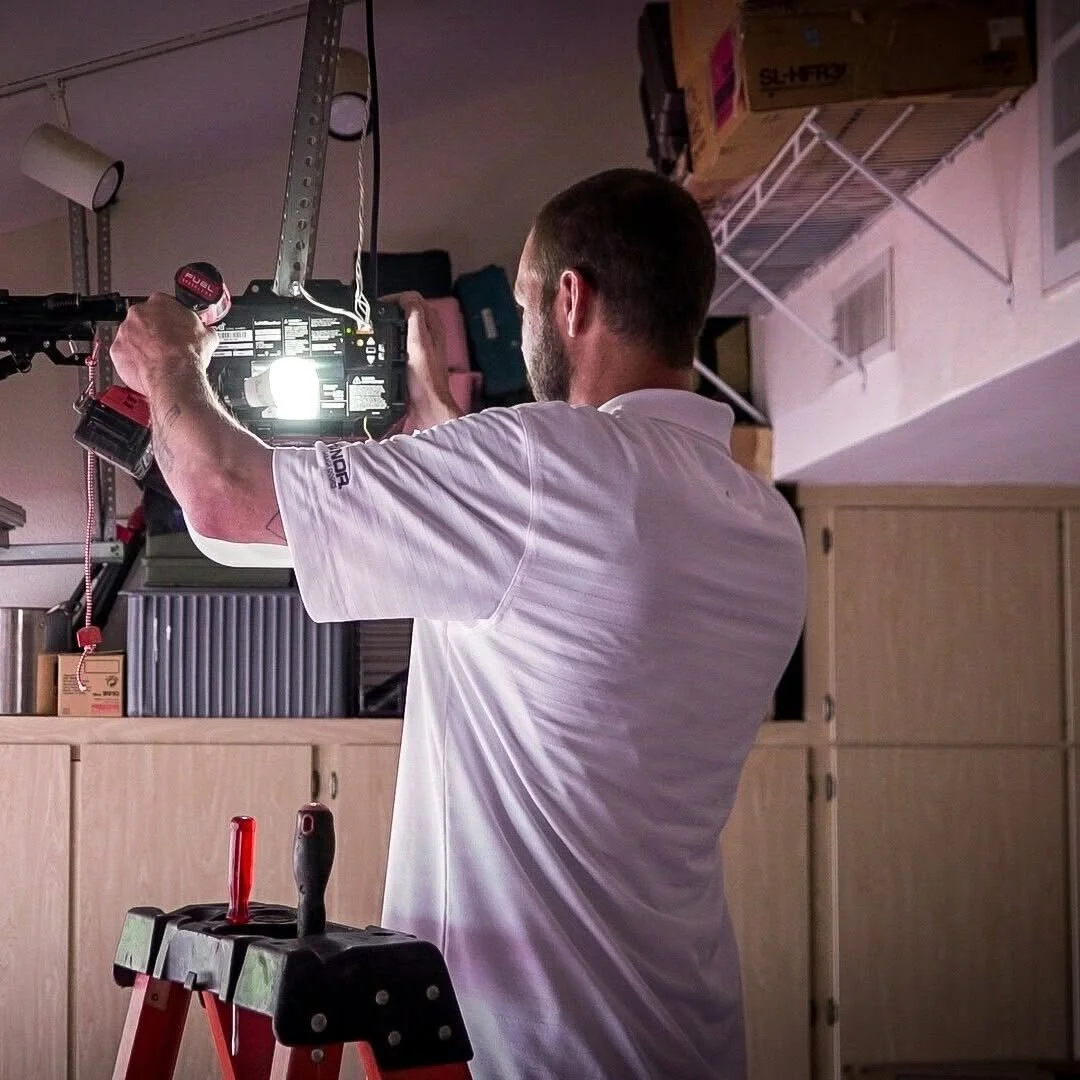 Emergency garage door repair in Tempe, AZ
The Five We Find Most, and What Each One Changes
A joined or clamped lift cable. A cable that has been shortened, spliced, or held with a clamp. It carries load right up until it does not, and it usually fails at the join with the door partway up. If we find one on the intact side while dealing with the broken side, both come off.
A mismatched spring pair. One new, one original, or two springs of different specification installed at different times. The door works and pulls unevenly, which loads the track, the cables, and the opener. On an emergency call, this explains a lot of otherwise puzzling wear.
A section repaired with a plate, screws, or rivets. Common where a car has caught the bottom section. It holds until the door flexes under an off-balance load, and the repair makes the door heavier and stiffer than the counterbalance expects.
A bypassed or relocated safety sensor. Sensors zip-tied together on one bracket, taped to a shelf, or wired out entirely. Our Tempe page sets out our rule on that, and the call time does not change it.
A bottom bracket that has been substituted. The bottom brackets carry the lift cable, and they are under the full load of the counterbalance. A generic bracket that does not match the door's hardware is the item on this list we treat most seriously, and it is the one people are least likely to know about.
What Gets Undone Before Anything Gets Fixed
On a door with history, the repair has a step in front of it, and it is worth knowing that it exists so that the visit makes sense while it is happening.
- 1.
First, work out where the load is.
Which spring is intact, which cable is carrying, whether the door is resting on the floor, on the opener, or on one bracket. Nothing comes apart until that is settled, and on a door with improvised parts in it, that takes longer than it does on a new one.
- 2.
Then release the energy in a controlled order.
A counterbalance that has been altered does not always let go in the sequence the manufacturer intended. This is the part of the job that is a trade skill, and it is why we ask you to leave the door alone until we arrive.
- 3.
Then take out what should not be there.
A clamp on a cable, a spring that belongs on a different door, a bracket that was never made for this hardware. Those come off, because putting a new part next to them moves the failure along.
- 4.
Then restore the geometry.
Track alignment, drum position, cable tension equal on both sides, the door sitting square in the opening. On an older door, this is most of the work and the part that determines whether the repair lasts.
- 5.
Then the repair itself, which by that point is usually the shortest part of the visit.
- 6.
And you get told what came off and why.
In writing, with the old parts if you want them. On a door that has been worked on by four people over forty years, the least we can do is be the ones who write down what was done.
What We Are Coming Out for Tonight
A door that will not close. The house is open and stays open until somebody closes it.
A door off its track or hanging. On older hardware, this happens more readily, and it moves less predictably once it has.
A door down with a vehicle needed behind it, and no other way to get the vehicle out.
A door that has been struck. Bent track and distorted sections hold tension where you cannot see it. It gets looked at before it gets run again.
Why the parts counter matters more here than in a newer town. On a door running current hardware, an after-hours visit has a fair chance of finishing, because what failed is something ordinary and we carry it. On a door from 1976, the failed item is more likely to be something that has to be identified first and then found, and parts counters keep their own hours. That is why we will often steer an older door toward a morning appointment and say so on the phone.
Tempe Emergency FAQ
We have owned the house two years and know nothing about the door. Is that a problem?
No, and it is the usual answer. We will work it out on site. Photographs before we arrive shorten it.
Something looks like it was repaired badly. Will you refuse to touch it?
Almost never. We will tell you what we have found, what it means, and what putting it right involves, and then it is your decision. The exception is the photo-eye rule set out below.
Can you make it safe tonight and come back for the rest?
Frequently, and on this housing stock, that is the realistic answer more often than it is on a newer door, because parts for an older system are not always sitting on a shelf.
Do you work on one-piece tilt-up doors after hours?
Yes. Tell us it is a tilt-up when you call, because what we bring is different.
The door is stuck open, and we cannot secure the garage.
Say that first when you call. An open garage is the situation that moves regardless of what else is working.
Will you tell me it can wait?
If it can, yes. That conversation happens on the phone, before anybody drives out.
The last company said the door was beyond repair. Is it?
Possibly. We would be guessing if we answered that over the phone. What we can say is that, on stock of this age, it varies: some of these doors have another twenty years in them, and some are held together by their last repair. We will show you which one yours is and let you decide.
Before We Get There
Stop pressing the button.
Most of the faults described here worsen with repeated attempts.
Leave the red release cord where it is.
Pull it on a door whose counterbalance has failed and the weight transfers to nothing.
Stay out from under it, and keep everyone else out too.
That includes reaching in for something quickly, which is how near misses happen.
Photograph the whole opening if you can do it safely.
Both tracks, the bar or springs above, and the bottom corners. On an older door, those corners tell us more than anything else in the picture, because the bottom brackets and the cable ends are where the previous forty years show up first.
What to Expect on the Call
An honest arrival time. We give you a real estimate on the phone instead of a published window, because traffic and job length change daily.
No claim that an older door gets finished in one visit. We carry the common parts. Where the failed item is something a supplier has to identify and locate, you hear about it on the day.
And the photo-eye rule holds at night. No sensors, no motor work, whatever else has gone wrong.
What Customers Say
"They were able to send out a service tech the next day and provide an estimate. Unfortunately, due to being informed we need to replace the entire garage door we did not move forward with any service."
Where We Work
Garage door repair and service across the Phoenix metro:
- Mesa,
- Gilbert,
- Chandler,
- Tempe,
- Scottsdale,
- Phoenix,
- Queen Creek,
- Apache Junction,
- Glendale,
- Peoria,
- Ahwatukee,
- Fountain Hills and
- Paradise Valley.
Tell us what you know about the door's history, even if the answer is nothing.
On a Tempe door, that answer shapes the first ten minutes on site more than the symptom does.